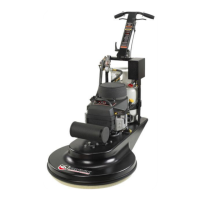
This document serves as the operator manual for the ONYX Automatic Floor Scrubber, a machine designed for commercial floor cleaning. It provides comprehensive instructions for safe operation, maintenance, and troubleshooting, ensuring optimal performance and longevity of the equipment.
Function Description
The ONYX Automatic Floor Scrubber is an industrial-grade cleaning machine primarily intended for scrubbing hard floor surfaces in indoor commercial environments. This includes locations such as factories, shops, offices, hotels, schools, hospitals, and various businesses. The machine is adept at cleaning concrete, tile, stone, and synthetic floors. It operates by applying a cleaning solution, scrubbing the surface with brushes or pads, and then recovering the dirty solution, leaving the floor clean and dry. The design emphasizes efficiency and ease of use for commercial cleaning tasks. It is not designed for cleaning carpets or sanding wood floors, and its use should be restricted to the recommended applications to prevent damage or safety hazards.
Usage Features
The operation of the ONYX Automatic Floor Scrubber is designed to be straightforward, yet it requires operators to be trained and to have read and understood the manual to ensure safe and effective use. Before operation, a pre-operational checklist guides the user to inspect the machine, including checking for dust, battery charge, pad/brush abrasion, squeegee condition, and tank levels. This proactive approach helps prevent issues during cleaning.
To start the machine, the operator switches the key to the ON(I) position. The squeegee is then lowered to the ground using a lifting rod, and the brush head is lowered either by stepping on a pedal or pressing a dedicated brush switch. For models with a vacuum motor, a switch activates this function. The cleaning speed can be adjusted using a control knob, allowing the operator to match the speed to the cleaning requirements of the floor. During operation, it is crucial to maintain a consistent cleaning path with a slight overlap (approximately 2 inches) to ensure thorough coverage. The machine must be kept moving to prevent damage to the floor.
The manual highlights specific operational guidelines for different scenarios. If drag marks appear after the squeegee, it indicates a need to lift and clean the squeegee. The machine should not be operated on slopes exceeding 5% (3 degrees) to maintain stability and safety. For extremely dirty areas, a "double scrub" method is recommended, where the squeegee is lifted to allow the brushes to scrub the floor back and forth before re-lowering the squeegee for waste recovery. Operators are advised to replace or rotate pads/brushes as needed, monitor the battery indicator for power consumption, and observe the solution tank level. When the solution tank is empty, the recovery tank should be emptied first before refilling the solution tank. Upon completion of cleaning, the machine should be stopped on level ground, turned off, and the key removed. Daily maintenance procedures are then to be performed.
Safety is paramount during operation. Operators must wear closed-toe, non-slip work shoes. Speed should be reduced when turning and when operating on inclines or slippery surfaces. The machine should not be used on inclines exceeding a 9% grade for scrubbing or a 21% grade for transport. Site safety guidelines for wet floors must be followed, and instructions on chemical containers for mixing, handling, and disposal should be adhered to. The machine is designed for indoor use only and should not be operated in areas with flammable vapors, liquids, or combustible dusts due to the risk of fire or explosion from the electric motor's sparks. Children and unauthorized persons must be kept away from the machine. Carrying passengers is prohibited, and care must be exercised when reversing.
Maintenance Features
The ONYX Automatic Floor Scrubber requires regular maintenance to ensure its optimal performance, extend its lifespan, and maintain safety standards. The manual outlines daily, monthly, and quarterly maintenance procedures, emphasizing the importance of disconnecting the battery wiring before any maintenance work to prevent electric shock hazards.
Daily maintenance tasks are critical for immediate upkeep. These include draining and cleaning both the wastewater and clean water tanks. The floating filter screen in the wastewater tank must be dismantled and flushed. The scouring pad/brush needs to be dismantled for cleaning, and if any abrasion is noted, it should be overturned or replaced. The squeegee adhesive tape should be wiped clean, and the squeegee component should be placed in the rising position to prevent damage to the tape. The abrasion conditions of the scraper edge of the squeegee adhesive tape must be checked, and if wear and tear are present, the tape should be exchanged. The machine itself should be wiped with a multi-purpose detergent and a wet cloth; high-pressure spraying or flushing with a water pipe is explicitly prohibited to avoid damaging electronic components. The skirt side of the brush head should be checked for abrasion and replaced if necessary. Finally, the battery must be charged after use, especially if the machine has been used for more than 30 minutes, to prolong battery life and maintain efficiency.
Monthly maintenance involves more in-depth checks. The filter of the clean water tank, located at the bottom of the machine, needs to be dismantled and cleaned, ensuring the tank is empty beforehand. The top of the battery should be cleaned to prevent electrode corrosion, with a reference to specific battery maintenance guidelines. The battery wiring must be checked for looseness. The cover seal of the wastewater tank should be inspected and replaced if damaged. To ensure smooth operation, silica gel dry lubricant should be sprayed on all pivots and wheels, and a layer of waterproof lubricating oil applied. All nuts and bolts on the machine should be checked for tightness, and the machine should be inspected for any leaks.
Quarterly maintenance is recommended every 250 hours of operation and involves contacting a local service center for a professional inspection of the brush and drive motors. This ensures that critical components are functioning correctly and addresses any potential issues that may not be apparent during routine checks.
The manual also provides a troubleshooting guide to help operators identify and resolve common issues. This includes problems such as the machine not operating, the brush motor not working, the vacuum motor not working, little or no water flow, low recovery rate, and short operating time. For each problem, potential reasons are listed, along with corresponding solutions, ranging from charging the battery and replacing fuses to cleaning filters, adjusting controls, and contacting a service center for more complex repairs. This comprehensive approach to maintenance and troubleshooting empowers operators to keep the ONYX Automatic Floor Scrubber in excellent working condition, minimizing downtime and maximizing cleaning efficiency.



 To Next Page
 General