Manual for Tire Pressure Monitoring Systems, TPMS
6/22
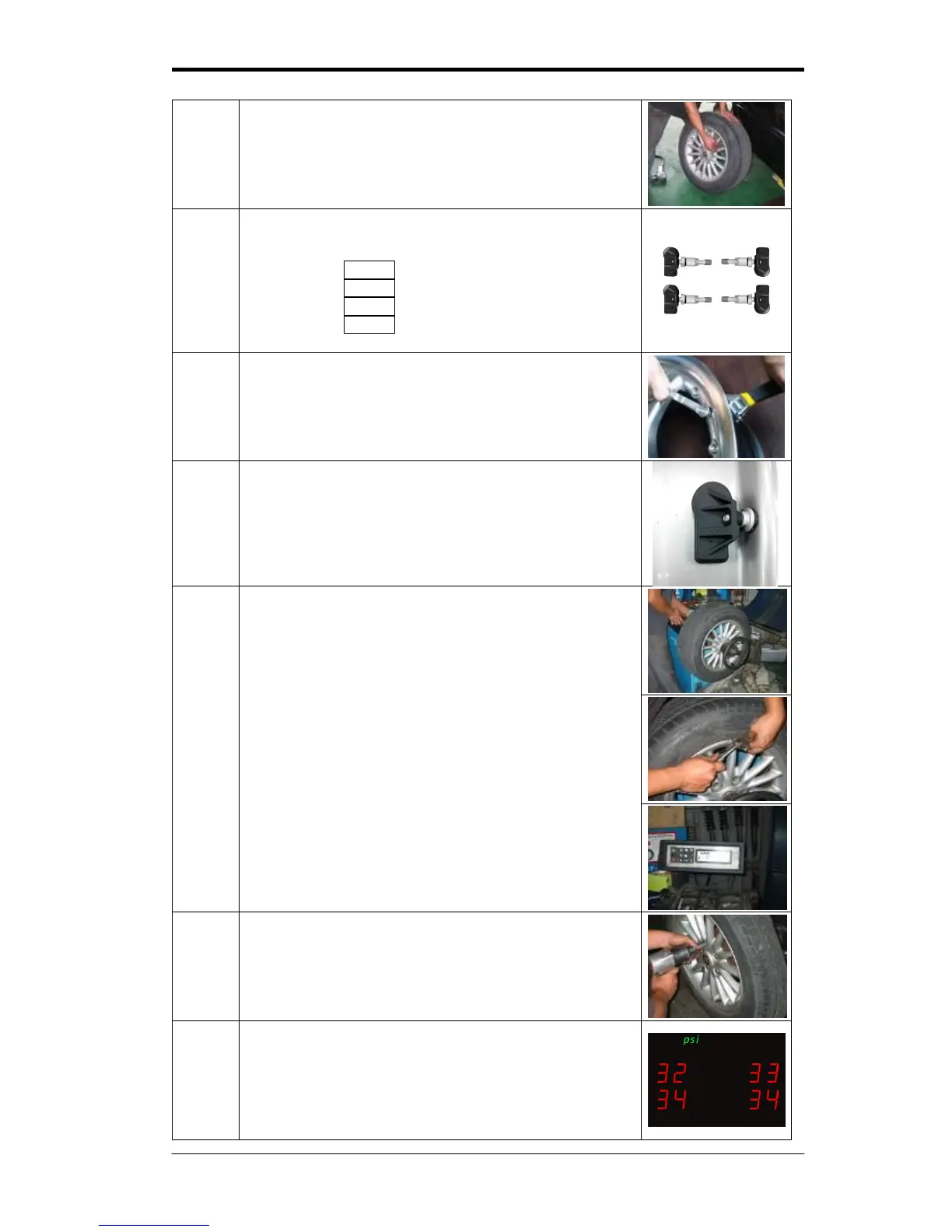
Take off the tires and bleed the air. Then take off the air
valve of the tire from the wheel. (NOTE: You must change
the valve to TPMS valve). This part of the process will
normally require the service of a tire fitting service or
mechanic.
Recognize the number on each sensor (D) with position of
tire on the vehicle. (VERY IMPORTANT)
a. RF – 1 = Right Front, No. 1
b. RR – 2 = Right Rear, No. 2
c. LR – 3 = Left Rear, No. 3
d. LF – 4 = Left Front, No. 4
Set up the new TPMS special valve (E) in the wheel.
Use wrench to fix the valve, and then tighten nut to
40~45kgf-cm (4~4.5Nm).
Clean inside the tire to prevent the tire from damaging the
transmitter sensor.
Inflate the tires.
Balance the tire
a. Balance tires using a balance machine
b. A lead tire weight may need to be added for balancing.
c. Balance until the tire balance shows balance as “OK”
The Steps above will require the assistance of a tire fitting
service or a mechanic. It is important that the wheels are
balanced after the fitting of the TPMS sensors in order to
ensure the safe operation of the tire when refitted to the
vehicle.。
Set up the other three tires in the same manner.
Turn the ignition key of the vehicle until the power is
activated on the cigar lighter, this may be first or second
position depending on the car manufacturer. The in-car
display will be activated.
The function button of the display unit can be switched to
pressure or temperature depending on the customer’s
need.



 To Next Page