EasyManua.ls Logo

Orion PinPoint 40004 - User Manual

Orion PinPoint 40004
4 pages
Print Icon
To Next Page IconTo Next Page
Loading...
Orion
®
PinPoint Telescope Focusing Masks
#40004 58-93mm; #40005 78-113mm; #40006 98-133mm; #40007 118-153mm;
#40008 138-173mm; #40009 158-193mm; #40010 178-213mm; #40011 198-233mm;
#40012 228-263mm; #40013 268-303mm
INSTRUCTION MANUAL
Orion PinPoint Telescope Focusing Masks will ensure you achieve a precise focus
for astrophotographic imaging. They take the guesswork out of nding the exact
focus point, which can be difficult when looking at stars on a DSLR’s small LCD
screen or on a laptop’s display when using a CCD camera. Whether youre doing
planetary, lunar, or deep space photography, a PinPoint focusing Mask will ensure
that your images are sharply focused every time.
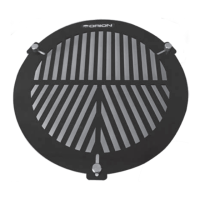
The grid cut into the PinPoint mask, which is placed on the front of your telescope,
produces three diffraction spikes when the telescope is aimed at a bright object,
like a bright star. Two of the spikes form an “X”, with the two lines intersecting on
the star, and the third spike moves back and forth across the center of the X as
the telescope’s focus is adjusted. Precise focus is achieved when the center spike
exactly bisects the X. It’s easy to see and correct small deviations from exact focus.
And the whole process takes just seconds!
Orion PinPoint focusing masks work with any type of telescope: refractor, reector,
or Cassegrain. The sizes listed above for each mask indicate the range of diam-
eters they will t (outer diameter of the telescopes front cell or dew shield). Make
sure you carefully measure the diameter of your telescopes front cell to determine
the correct mask to use.
HANDLE WITH CARE! This mask may crack if bent too forcefully. Keep it at
when storing it and use care when handling and it will last indenitely.
Figure 1. An Orion PinPoint Telescope Focusing Mask
IN 586 02/17
Question and Answer IconNeed help?

Do you have a question about the Orion PinPoint 40004 and is the answer not in the manual?

Summary

Preparation and Attachment

Removing Backing Paper

Instructions for safely peeling off the protective adhesive backing from both sides of the mask.

Assembly

Guidance on attaching the three rubber-sleeved grip posts to the mask.

Attaching the PinPoint Mask to the Telescope

Steps to securely mount the mask onto the telescope's front cell or dew shield.

Using the PinPoint Mask for Focusing

Using the PinPoint Mask to Focus

Detailed guide on how to achieve precise focus using the diffraction spike pattern.

Focusing for Visual Observation

Discussion on whether the mask is suitable for visual observing, noting it's primarily for astrophotography.

One-Year Limited Warranty

Summary

Preparation and Attachment

Removing Backing Paper

Instructions for safely peeling off the protective adhesive backing from both sides of the mask.

Assembly

Guidance on attaching the three rubber-sleeved grip posts to the mask.

Attaching the PinPoint Mask to the Telescope

Steps to securely mount the mask onto the telescope's front cell or dew shield.

Using the PinPoint Mask for Focusing

Using the PinPoint Mask to Focus

Detailed guide on how to achieve precise focus using the diffraction spike pattern.

Focusing for Visual Observation

Discussion on whether the mask is suitable for visual observing, noting it's primarily for astrophotography.

One-Year Limited Warranty

Overview

The Orion PinPoint Telescope Focusing Mask is an essential accessory designed to achieve precise focus for astrophotographic imaging, eliminating the guesswork often associated with focusing on stars using a DSLR's small LCD screen or a laptop's display with a CCD camera. This device ensures that images are sharply focused every time, whether for planetary, lunar, or deep-space photography.

Function Description:

The core function of the PinPoint Focusing Mask is to create a distinct diffraction spike pattern when placed over the front of a telescope and aimed at a bright star. The mask features a specially designed grid cut into its surface. When light from a bright celestial object passes through this grid, it produces three prominent diffraction spikes. Two of these spikes form an "X" pattern, with their lines intersecting precisely on the star. The third spike, known as the center spike, moves back and forth across the center of this "X" as the telescope's focus is adjusted. Precise focus is achieved when the center spike exactly bisects the "X" pattern. This visual feedback makes it easy to identify and correct even small deviations from perfect focus, and the entire process is designed to be completed in a matter of seconds.

The mask works by manipulating the light entering the telescope. The grid pattern intentionally introduces diffraction, which is the bending of light waves as they pass around the edges of an obstacle. This controlled diffraction creates the characteristic spike pattern. When the telescope is out of focus, the center spike will be noticeably off-center relative to the "X." As the user adjusts the focus, the center spike will move. The point of perfect focus is visually confirmed when the center spike aligns perfectly, bisecting the "X." This method is significantly more accurate and reliable than attempting to visually judge focus on a small screen, especially for the demanding requirements of astrophotography.

The PinPoint Focusing Mask is compatible with various types of telescopes, including refractors, reflectors, and Cassegrain telescopes. This versatility makes it a valuable tool for a wide range of astrophotographers, regardless of their primary telescope setup.

Important Technical Specifications:

The Orion PinPoint Telescope Focusing Masks are available in a range of sizes, each designed to fit specific outer diameter ranges of a telescope's front cell or dew shield. The available models and their corresponding diameter ranges are:

  • #40004: 58-93mm
  • #40005: 78-113mm
  • #40006: 98-133mm
  • #40007: 118-153mm
  • #40008: 138-173mm
  • #40009: 158-193mm
  • #40010: 178-213mm
  • #40011: 198-233mm
  • #40012: 228-263mm
  • #40013: 268-303mm

Users must carefully measure the outer diameter of their telescope's front cell or dew shield to select the correct mask size. The mask itself is constructed from a material that, while durable, can crack if bent too forcefully, emphasizing the need for careful handling.

Usage Features:

The PinPoint Focusing Mask is designed for straightforward installation and use:

  1. Preparation: The mask comes with a protective adhesive backing paper on both sides. This paper must be carefully peeled off using a fingernail or knife tip to lift an edge, then slowly removing the rest. Care must be taken not to apply undue pressure to the mask during this process to prevent cracking.
  2. Assembly: Three rubber-sleeved grip posts are attached to the mask using included thumbscrews. The thumbscrew heads should be positioned on the side of the mask featuring the Orion logo.
  3. Attachment to Telescope: To attach the mask to the telescope, the three thumbscrews are loosened a turn or two, allowing the grip posts to slide outward as far as they can go. The mask is then placed over the front of the telescope. Each grip post is then slid inward until it makes firm contact with the telescope's front cell or dew shield. The thumbscrews are then tightened to secure the mask. To ensure proper centering and a tight grip, it's recommended to adjust the posts so they are roughly in the same position in their slots. For an even tighter grip, one thumbscrew can be slightly loosened, the grip post pushed inward while gently pulling the mask toward that loosened grip post, and then the third thumbscrew retightened. This ensures all three grip posts are in firm contact with the telescope.
  4. Focusing Process:
    • With the mask securely in place and the camera attached and turned on, the telescope is aimed at a bright star, which is then centered in the field of view.
    • The diffraction spike pattern will be visible on the camera's LCD screen (for DSLRs) or on a laptop display running image capture software. If the telescope is significantly out of focus, the grid pattern of the mask itself might be visible; in this case, the focus should be adjusted to shrink the grid pattern into a dot with spikes before proceeding.
    • Important Note: Always use a bright star for focusing, not a planet, as planets are not point sources and will not produce the correct diffraction pattern. For planetary imaging, focus on a star first, then slew the telescope to the planet.
    • A "live view" image from the camera or software is highly recommended, as it allows real-time observation of focus adjustments, speeding up the process. If live view is not available, successive still exposures can be taken, with slight focus adjustments made between each shot, then reviewed on screen.
    • Users should "zoom in" as needed to get a clear view of the spike pattern, particularly the center spike's position relative to the "X" formed by the other two spikes. DSLRs often offer multiple magnification settings for live view, and laptop capture programs may include subframe viewing options.
    • As the telescope's focus knobs are turned, the center spike will be observed moving left or right of the "X." Fine adjustments are made until the center spike lands precisely in the center of the "X," effectively bisecting it. At this point, precise focus has been achieved.
  5. Post-Focusing: Once focus is achieved, the PinPoint mask is removed from the telescope, and the setup is ready for astrophotography of any object at infinity focus.

While the PinPoint Mask could theoretically be used for visual observation, it is generally not necessary for this purpose and is primarily intended as a tool for astrophotography due to the extreme precision it offers.

Maintenance Features:

The PinPoint Focusing Mask requires minimal maintenance, primarily focused on careful handling and storage to ensure its longevity:

  • Handle with Care: The mask is susceptible to cracking if bent too forcefully. Users are advised to exercise caution when handling it.
  • Flat Storage: To prevent warping or damage, the mask should always be stored flat when not in use.
  • Cleaning: While not explicitly detailed, general care for optical accessories suggests that if the mask becomes dusty or dirty, it should be cleaned gently with appropriate methods to avoid scratching the surface, although it is not an optical element that directly affects image quality in the same way a lens does. Its primary function is to create diffraction patterns, so minor surface imperfections might not significantly impact its performance, but good practice dictates keeping it clean.

The product is backed by a One-Year Limited Warranty from Orion Telescopes & Binoculars, covering defects in materials or workmanship for the original retail purchaser. This warranty ensures repair or replacement at Orion's option, provided the instrument is returned postage paid with proof of purchase. The warranty is valid only in the country of purchase and does not cover abuse, mishandling, modification, or normal wear and tear.

Orion PinPoint 40004 Specifications

General IconGeneral
BrandOrion
ModelPinPoint 40004
CategoryAccessories
LanguageEnglish

Related product manuals