EasyManua.ls Logo

ORTEC 109A - Suggestions for Troubleshooting

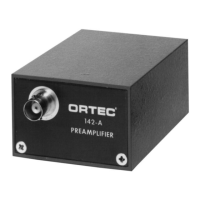
ORTEC 109A
15 pages
Print Icon
To Next Page IconTo Next Page
To Previous Page IconTo Previous Page
Loading...
If
a
multichannel
pulse
height
analyzer
is
used
following
the
main
amplifier,
the
noise
performance
can
be
tested
merely
by
using
a
cal
ibrated
test
pulse
generator
with
charge
terminator,
as
outlined
in
Section
6.1.1.
With
only
the
charge
terminator
connected
to
the
DET.
INPUT
jack,
the
spread
of
the
pulser
peak
thus
analyzed
wil
l
be
due
only
to
the
electronic
noise
contribution
of
the
preamplifier
and
main
amplifier.
The
analyzer
can
be
calibrated
in
terms
of
keV
per
channel
by
observing
two
different
pulser
peaks
of
known
energy,
and
the
FWHM
of
a
peak
can
be
taken
directly
from
the
analyzer
readout.
It
is
also
possible
to
determine
the
noise
performance
of
the
preamplifier
by
the
use
of
a
wide-bandwidth
rms
ac
voltmeter
such
as
the
Hewlett-Packard
400D,
reading
the
main
amplifier
output
noise
level
and
correlating
with
the
expected
pulse
ampl
itude
per
keV
of
input
signal
under
the
same
conditions.
Again,
a
cal
ibrated
test
pulse
generator
is
required
for
an
accurate
measurement.
In
this
method
the
preamplifier
and
main
amplifier
are
set
up
as
they
would
be
used
normally,
but
with
a
dummy
capacitor
(or
no
capacity)
on
the
DET.
INPUT
jack,
and
with
the
ac
voltmeter
connected
to
the
ampl
ifier
output.
The
noise
voltage
indicated
by
the
meter,
designated
Efms,
is
read
and
noted.
Then,
a
test
pulse
of
known
energy,
Ejn
(in
keV),
is
applied
to
the
input
jack,
and
the
amplitude
of
the
result
ing
output
pulse,
Eout.
is
measured
in
volts
with
an
oscilloscope.
The
noise
spread
can
then
be
calculated
from
the
formula
FWHM
(keV,
Si
det)
2.66
(Erms)
(Ejp)
Eout
where
Epms
is
output
noise
in
volts
on
the
400D
meter,
Ejn
is
input
signal
in
keV
particle
energy,
and
Egyt
is
output
signal
in
volts
corresponding
to
the
above
input.
If
the
gain
of
the
shaping
amplifier
is
adjusted
so
that
the
output
voltage
is
2.66
V,
then
the
meter
reading
will
be
directly
in
keV
FWHM
except
for
a
scale
factor.
[The
factor
2.66
is
the
product
of
two
relations:
correction
from
rms
to
FWHM
(2.35),
and
correction
of
the
400D
meter
from
sinewave
to
white
noise
(1.13).]
The
noise
performance
of
the
preampl
ifier,
as
measured
by
the
above
methods,
should
not
differ
significantly
from
that
given
in
Section
2.
6.1.4
When
testing
the
preamplifier
and
detector,
if
the
noise
performance
of
the
preamplifier
has
been
verified
as
outlined
in
the
preceding
section
or
is
otherwise
not
suspected,
a
detector
may
be
tested
to
some
extent
by
duplicating
the
noise
performance
tests
with
the
detector
connected
in
place,
and
with
normal
operating
bias
applied.
The
resulting
combined
noise
measurement,
made
either
with
an
analyzer
or
by
the
voltmeter
method,
indicates
the
sum
in
quadrature
of
the
separate
noise
sources
of
the
am
plifier
and
the
detector.
In
other
words,
the
total
noise
is
given
by
(Ntot)^
=
(Ndet)^
+
(Nampl)^-
Each
quantity
is
expressed
in
keV
FWHM.
The
quantity
N^et
is
known
as
the
"noise
width"
of
the
detector,
and
is
included
as
one
of
the
specified
parameters
of
each
ORTEC
semiconductor
de
tector.
By
use
of
the
above
equation,
and
with
a
knowedge
of
the
noise
of
the
preampl
ifier,
the
noise
width
of
the
detector
can
be
determined.
The
significance
of
this
noise
width
in
evaluating
the
detector
is
subject
to
interpretation,
but
generally
the
actual
resolution
of
the
detector
for
pro
tons
or
electrons
will
be
approximately
the
same
as
the
noise
width;
the
resolution
of
the
detector
for
alpha
particles
will
be
poorer
than
the
noise
width.
The
most
useful
application
of
determining
the
noise
width
of
a
detector
is
in
the
occasional
monitoring
of
this
quantity
to
verify
that
the
detector
characteristics
have
not
undergone
any
significant
change
during
use.
6.2
Suggestions
for
Troubleshooting
If
the
preampl
ifier
is
suspected
of
malfunctioning,
it
must
be
isolated
and
tested
alone,
not
in
a
system
involving
other
units
such
as
a
source
of
particles
to
be
analyzed,
the
de
tector,
the
preamplifier,
a
main
ampl
ifier,
and
subsequent
sealers
and/or
analyzers.
Such
logical
isolation
and
individual
testing
of
components
wil
l
be
the
most
productive
approach.
6.2.1
Charge-Sensitive
Loop
The
function
of
the
preamp
lifier
is
simple
and
lends
itself
to
relatively
easy
scrutiny.
The
charge-sensitive
loop
performs
a
charge-to-voltage
conversion
on
the
input
signal.
It
has
an
output
signal
that
manifests
itself
as
a
fast
rise
(~15
ns
at
0
pF
external
capacitance)
step
of
voltage
whose
height
is
determined
by
the
input
charge,
fol
lowed
by
a
400-/is
decay
back
to
the
baseline.
This
signal
can
be
observed
at
the
emitter
of
Q4
while
impressing
a
signal,
as
described
in
Section
3.4.
The
ampl
itude
of
thissignal
should
be45
mV
per
MeV
equivalent
input
signal.
6.2.2
Voltage
Amplifier
To
reduce
pulse
pileup
in
the
voltage
amplifier
and
subsequent
stages,
the
output
signal
from
Q4
is
differentiated
with
a
50-/xs
time
constant
by
C12.
Transistors
Q6
and
Q7
provide
voltage
amplification
of
0.34
or
3.4
for
the
XI
or
X10
gain
switch
positions,
respectively.
Accordingly,
the
output
signal
at
the
81
wiper
arm
should
be
a
fast
rise
with
50-;tis
time
constant
decay,
with
amplitude
either
0.34
or
3.4
times
greater
than
that
at
the
Q4
emitter.
6.2.3
Cable
Driver
The
cable
driver,
consisting
of
Q8
through
Q11,
is
simply
an
impedance
converter,
and
the
output
signal
should
look
exactly
l
ike
the
input
signal.
No
gain
is
obtained
in
the
cable
driver.
6.2.4
Table
of
DC
Voltages
The
following
l
ist
of
voltages
will
help
to
locate
defective
components.
Exercise
extreme
caution
in
making
these
measurements,
because
a
probe
shorting
two
points
on
the
printed
board
can
cause
great
damage.

Related product manuals