EasyManua.ls Logo

ORTEC 420 - Foreword

Default Icon
22 pages
Print Icon
To Next Page IconTo Next Page
To Previous Page IconTo Previous Page
Loading...
MODEL
420
TIMING
SINGLE
CHANNEL
ANALYZER
Foreword
Introduction
to
Fast
Timing
With
Linear
Signals
Precise
determination
of
the
time
of
occurrence
of
nuclear
events
is
often
compli
cated.
Detection
of
these
events
usually
results
in
a
voltage
pulse
whose
amplitude
is
a
function
of
the
energy
loss
in
the
detector,
and
whose
rise
time
is
a
function
of
the
conversion
process
from
detector
energy
to
charge.
When
time
determination
is
derived
from
the
leading
edge
of
such
a
pulse
(by
means
of
a
discriminator,
e.g., a
Schmitt
trigger),
there
is
a
time
shift
of
the
discriminator
output
that
depends
on
the
pulse
rise
time
and
the
range
of
pulse
amplitudes
involved.
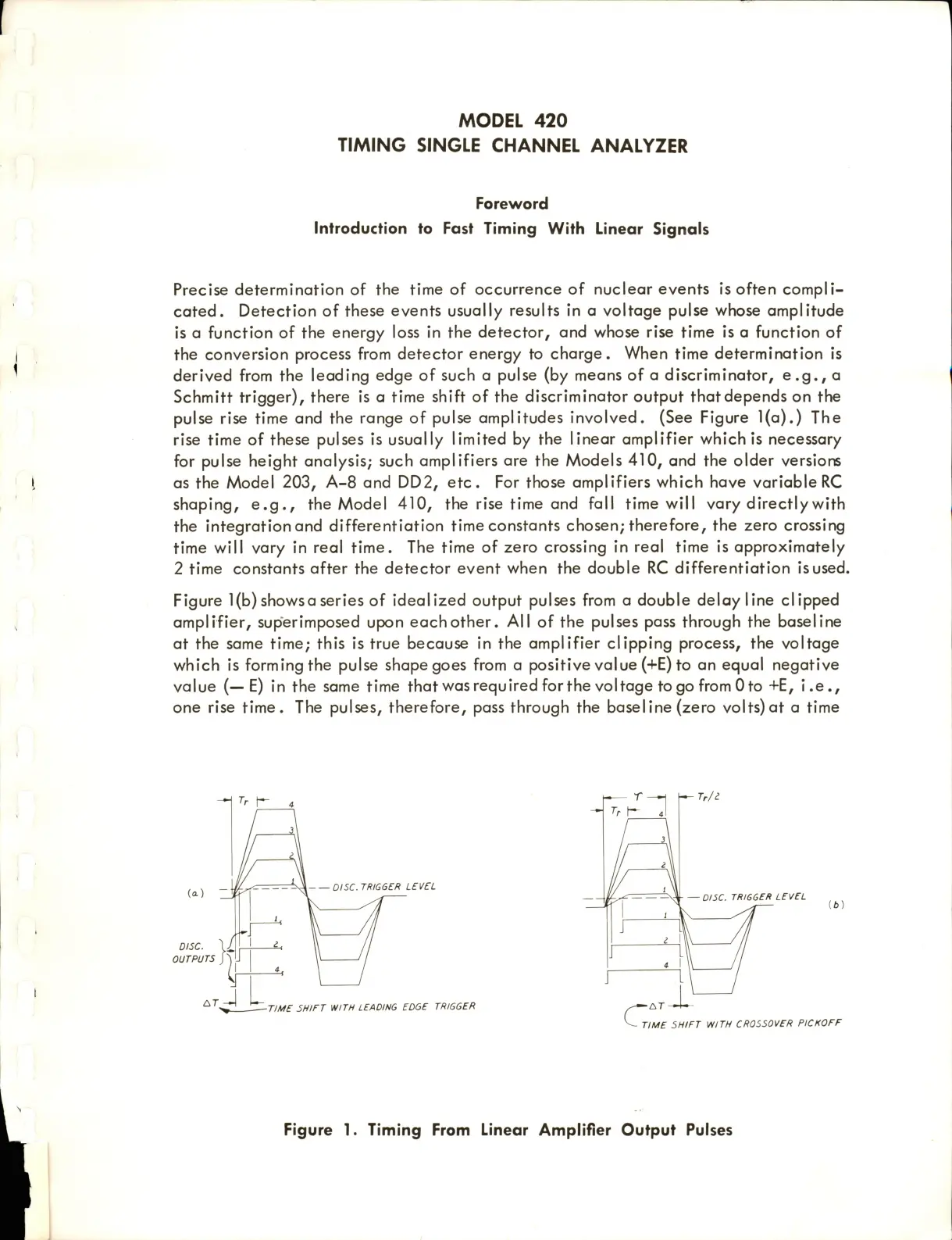
(See
Figure
1(a).)
The
rise
time
of
these
pulses
is
usual
ly
limited
by
the
linear
amplifier
which
is
necessary
for
pulse
height
analysis;
such
amplifiers
are
the
Models
410,
and
the
older
versions
OS
the
Model
203,
A-8
and
DD2,
etc.
For
those
amplifiers
which
have
variable
RC
shaping,
e.g.,
the
Model
410,
the
rise
time
and
fall
time
will
vary
directly
with
the
integration
and
differentiation
time
constants
chosen;
therefore,
the
zero
crossing
time
will
vary
in
real
time.
The
time
of
zero
crossing
in
real
time
is
approximately
2
time
constants
after
the
detector
event
when
the
double
RC
differentiation
is
used.
Figure
1(b)
shows
a
series
of
idealized
output
pulses
from
a
double
delay
line
clipped
amplifier,
superimposed
upon
each
other.
All
of
the
pulses
pass
through
the
baseline
at
the
same
time;
this
is
true
because
in
the
amplifier
clipping
process,
the
voltage
which
is
forming
the
pulse
shape
goes
from
a
positive
value
(+E)
to
on
equal
negative
value
(—E)
in
the
same
time
that
wasrequired
forthe
voltage
to
go
from
0
to
+E,
i.e.,
one
rise
time.
The
pulses,
therefore,
pass
through
the
baseline
(zero
volts)at
a
time
Tr
r
-01
DISC.
TRIGGER
LEVEL
Tr/i
DISC.
TRIGGER
LEVEL
DISC.
\i,
OUTPUTS
h
J
TIME
SHIFT
WITH
LEADING
EDGE
TRIGGER
(6)
TIME
SHIFT
WITH
CROSSOVER
PICKOFF
Figure
1.
Timing
From
Linear
Amplifier
Output
Pulses

Related product manuals