EasyManua.ls Logo

ORTEC 473 - Constant Fraction Operation; Slo R.T. Rej Operation

Default Icon
31 pages
Print Icon
To Next Page IconTo Next Page
To Previous Page IconTo Previous Page
Loading...
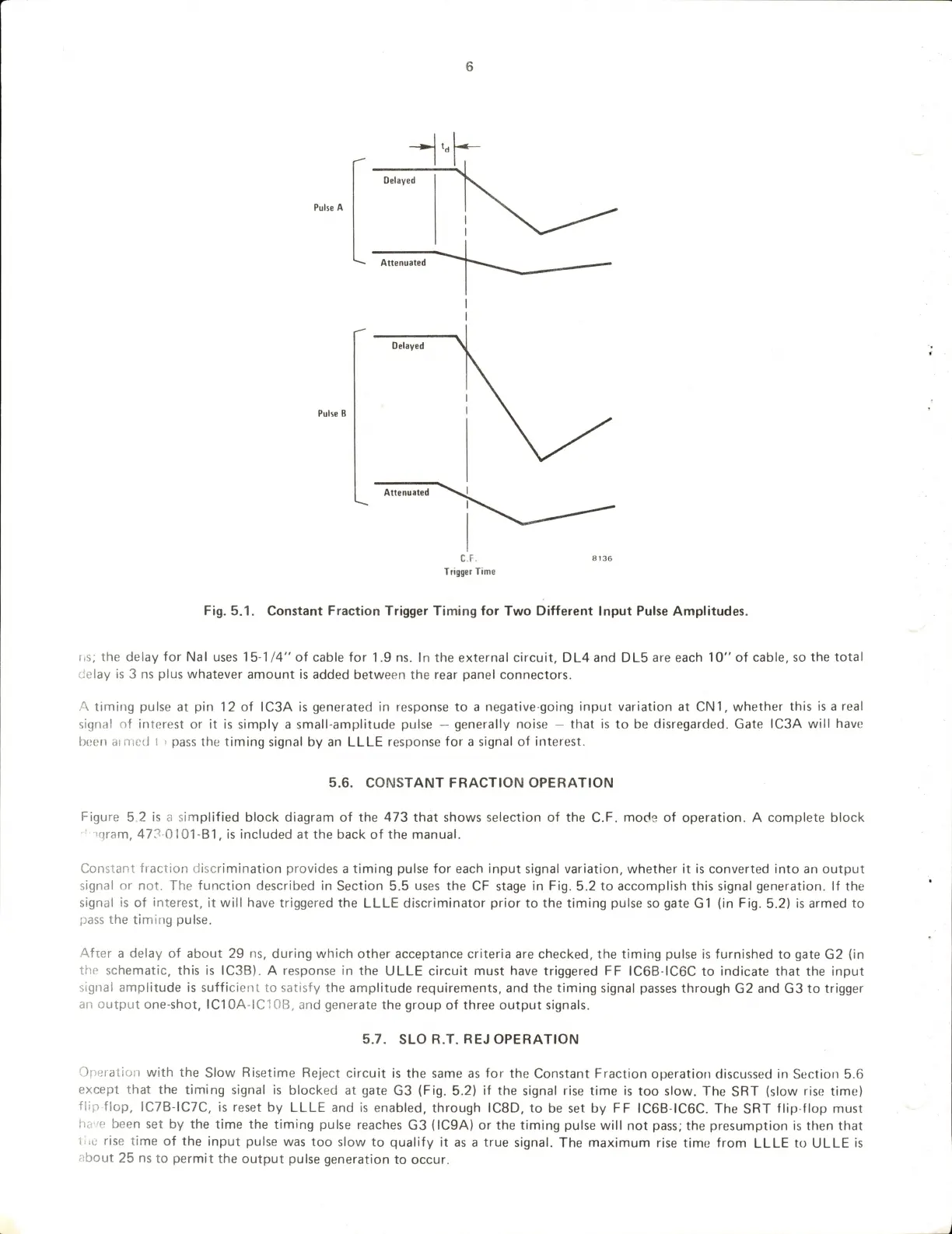
Pulse
A
Delaved
Attenuated
Delayed
Attenuated
Trigger
Time
Fig.
5.1.
Constant
Fraction
Trigger
Timing
for
Two
Different
Input
Pulse
Amplitudes.
ns;
the
delay
for
Nal
uses
15-1/4"
of
cable
for
1.9
ns.
In
the
external
circuit,
DL4
and
DL5
are
each
10"
of
cable,
so
the
total
delay
Is
3
ns
plus
whatever
amount
Is
added
between
the
rear
panel
connectors.
A
timing
pulse
at
pin
12
of
IC3A
Is
generated
In
response
to
a
negative-going
Input
variation
at
CN1,
whether
this
Is
a
real
signal
of
Interest
or
It
Is
simply
a
small-amplitude
pulse
generally
noise
that
Is
to
be
disregarded.
Gate
IC3A
will
have
been
aimed
I
>
pass
the
timing
signal
by
an
LLLE
response
for
a
signal
of
Interest.
5.6.
CONSTANT
FRACTION
OPERATION
Figure
5.2
Is
a
simplified
block
diagram
of
the
473
that
shows
selection
of
the
C.F.
mode
of
operation.
A
complete
block
r'
iqram,
473-0101-B1,
Is
Included
at
the
back
of
the
manual.
Constant
fraction
discrimination
provides
a
timing
pulse
for
each
Input
signal
variation,
whether
It
Is
converted
Into
an
output
signal
or
not.
The
function
described
In
Section
5.5
uses
the
CP
stage
In
Fig.
5.2
to
accomplish
this
signal
generation.
If
the
signal
Is
of
Interest,
It
will
have
triggered
the
LLLE
discriminator
prior
to
the
timing
pulse
so
gate
G1
(In
Fig.
5.2)
Is
armed
to
pass
the
timing
pulse.
After
a
delay
of
about
29
ns,
during
which
other
acceptance
criteria
are
checked,
the
timing
pulse
Is
furnished
to
gate
G2
(In
the
schematic,
this
Is
IC3B).
A
response
In
the
ULLE
circuit
must
have
triggered
FF
IC6B-IC6C
to
Indicate
that
the
Input
signal
amplitude
Is
sufficient
to
satisfy
the
amplitude
requirements,
and
the
timing
signal
passes
through
G2
and
G3
to
trigger
an
output
one-shot,
IC10A-IC10B,
and
generate
the
group
of
three
output
signals.
5.7.
SLO
R.T.
REJ
OPERATION
Operation
with
the
Slow
RIsetlme
Reject
circuit
Is
the
same
as
for
the
Constant
Fraction
operation
discussed
In
Section
5.6
except
that
the
timing
signal
Is
blocked
at
gate
G3
(Fig.
5.2)
If
the
signal
rise
time
Is
too
slow.
The
SRT
(slow
rise
time)
flip
flop,
IC7B-IC7C,
Is
reset
by
LLLE
and
Is
enabled,
through
IC8D,
to
be
set
by
FF
IC6B-IC6C.
The
SRT
flip-flop
must
have
been
set
by
the
time
the
timing
pulse
reaches
G3
(IC9A)
or
the
timing
pulse
wil
l
not
pass;
the
presumption
Is
then
that
the
rise
time
of
the
Input
pulse
was
too
slow
to
qualify
It
as
a
true
signal.
The
maximum
rise
time
from
LLLE
to
ULLE
Is
about
25
ns
to
permit
the
output
pulse
generation
to
occur.

Table of Contents