Need help?
Do you have a question about the Oster OGZD0701 and is the answer not in the manual?
Basic safety precautions to prevent injury and avoid excessive microwave energy exposure.
Importance of maintaining door integrity and clean sealing surfaces for safe operation.
Instructions regarding operating a damaged microwave or unauthorized repairs.
Requirements for grounding the microwave to prevent electric shock and ensure safety.
Measures to take if the microwave causes interference with radio or television reception.
Specifies the necessary voltage, frequency, and amperage for the microwave.
Recommendations for using the power cord, including extension cords.
Instructions on how to correctly install the glass tray and turntable ring assembly.
Identification of the main parts of the microwave oven as shown in the diagram.
Technical details and dimensions of the microwave oven.
Explanation of the purpose and operation of each button on the control panel.
Steps to set the 12 or 24-hour clock for the microwave.
Guide on how to use the microwave's built-in timer function.
Instructions for setting cooking time and power level for various cooking tasks.
How to use the Express Cook feature for quick, full-power cooking.
Using the +30 Sec button to start cooking quickly or add time.
Procedure for defrosting food based on its weight.
How to use the Speed Defrost feature to defrost food manually.
Instructions for cooking food automatically based on its weight category.
Programming multiple cooking stages for complex recipes.
How to enable and disable the child lock feature for safety.
Instructions for cooking microwave popcorn using preset settings.
How to heat beverages based on cup size and quantity.
Guide for cooking potatoes of different sizes using preset options.
Instructions for cooking frozen dinners based on portion size.
How to reheat a slice or a whole pizza using the microwave.
Using the reheat setting for pre-cooked or chilled food.
Utensils that are safe and recommended for use in the microwave.
Utensils with limited use or requiring caution when used in the microwave.
Utensils that should not be used in the microwave due to safety risks.
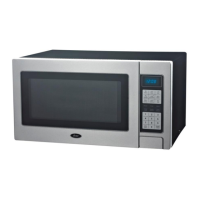
This document is the user manual for the Oster 0.7 cu. ft. Countertop Microwave, models OGZD0701 and OGCMZD07S2B-07. It provides essential information for safe operation, installation, usage, and maintenance of the appliance.
The Oster 0.7 cu. ft. Countertop Microwave is designed for heating, cooking, and drying foods using microwave energy. It is a compact appliance suitable for countertop placement. The microwave features various cooking modes, including quick cook settings for popular items like potato, popcorn, pizza, beverage, frozen dinner, and reheat. It also offers programmed cooking based on food weight (Cook by Weight) and automatic defrosting cycles (Weight Defrost and Speed Defrost). The appliance includes a timer function and a clock display. A child lock feature is available to prevent unsupervised operation.
The manual emphasizes several critical safety precautions to reduce the risk of burns, electric shock, fire, injury, or exposure to excessive microwave energy. Users are advised to read all instructions before use, particularly the "PRECAUTIONS TO AVOID POSSIBLE EXPOSURE OR EXCESSIVE MICROWAVE ENERGY" section. The microwave must be properly grounded, and installation should follow the provided guidelines, ensuring adequate air flow around the unit. Certain items, such as whole eggs and sealed containers, should not be heated in the oven due to explosion risk. The microwave is not designed for corrosive chemicals or laboratory use. Close supervision is necessary when children use the appliance. To prevent fire, users should avoid overcooking food, remove wire twist-ties from bags, keep the door closed if materials ignite, and not use the cavity for storage. Liquids, coffee, or tea can overheat beyond boiling point without visible bubbling, posing a risk of sudden boil-over; therefore, users should stir liquids, avoid straight-sided containers, allow standing time, and use extreme care when inserting utensils. Oil or fat for deep frying is not recommended. Foods with heavy skins, like potatoes, should be pierced before cooking. Baby food should be stirred and checked for temperature before serving. Pot holders may be needed for hot utensils. Openings on the microwave should not be covered or blocked. The appliance should not be used outdoors or near water. Operation with a damaged cord, plug, or if the unit is not working properly, is prohibited. Only thermometers specifically designed for microwaves should be used. The glass tray and roller rings must be in place during operation. Cleaning should be done with mild, nonabrasive soaps or detergents. Servicing should only be performed by qualified personnel.
Users are warned not to operate the microwave with the door open, as this can result in harmful exposure. Tampering with door interlocks is strictly prohibited. No objects should be placed between the front face and the door, and sealing surfaces must be kept clean. The microwave should not be operated if damaged, especially if the door, hinges, latches, or seals are compromised. Adjustments or repairs should only be done by qualified service personnel.
Before installation, all packing materials must be removed. The microwave should be inspected for any damage. It must be placed on a flat, stable surface capable of supporting its weight and the heaviest food. The oven should not be placed near heat, moisture, high humidity, or combustible materials. Adequate air flow is crucial, requiring 8 inches of space above, 4 inches at the back, and 2 inches on each side. Openings should not be covered or blocked, and microwave feet should not be removed. The oven should not be operated without the glass tray, roller support, and shaft in their proper positions. The power supply cord must be undamaged and routed safely. The socket must be readily accessible for emergency unplugging.
The microwave must be grounded to reduce the risk of electric shock in case of a short circuit. Users should consult a qualified electrician if grounding instructions are unclear. If an extension cord is necessary, it must be a 3-wire grounded cord with a 3-blade plug and a 3-slot receptacle, with an electrical rating equal to or greater than the appliance's rating. Improper use of the grounding plug can lead to electric shock.
The microwave requires a 120V, 60Hz, AC only, 15 amp electrical supply. A separate circuit is recommended. It is equipped with a 3-prong grounding plug and must be plugged into a properly installed and grounded wall outlet.
A short power cord is provided to minimize entanglement and tripping risks. Longer cords or extension cords can be used with care, ensuring their electrical rating meets or exceeds the microwave's requirements and that they are grounded 3-wire cords. Longer cords should be arranged to avoid draping over counters or tabletops.
If the microwave causes interference with radio or TV reception, users should try placing the oven on a different circuit, relocating the radio or TV, and checking the antenna's position and signal.
The glass tray should never be placed upside down or restricted. Both the glass tray and turntable ring assembly must always be used during cooking, and all food should be placed on the glass tray. If the glass tray or turntable ring assembly cracks or breaks, customer service should be contacted.
The manual includes a diagram illustrating the microwave's components: Door Safety Lock System, Oven Window, Turntable Roller, Door Release Button, Control Panel, Wave Guide (mica plate should not be removed), and Glass tray.
The manual concludes with copyright information and customer support contact details for service, support, and warranty information.
 General
| Brand | Oster |
|---|---|
| Model | OGZD0701 |
| Category | Microwave Oven |
| Language | English |

 To Next Page