Need help?
Do you have a question about the Ozito Power X Change PXCCSS-0182 and is the answer not in the manual?
Details the terms and conditions for the 5-year replacement warranty for the product.
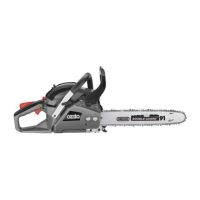
Identifies and labels the major parts of the brushless chainsaw.
Provides step-by-step instructions for fitting the chain and guide bar.
Explains how to properly adjust the tension of the chainsaw chain for safe operation.
Instructs on how to fill the chain oil tank and check the lubrication system.
Describes the correct procedure for inserting and removing batteries from the chainsaw.
Details the steps required to safely turn the chainsaw on and off.
Explains the automatic and manual operation of the chainsaw's chain brake.
Guides basic cutting actions on timber, emphasizing safe practices.
Provides safety and procedural guidance for felling trees, intended for trained operators.
Explains the process of removing branches from a fallen tree.
Describes how to cut a log into smaller lengths for easier handling.
Details the steps for removing limbs from a standing tree, with safety precautions.
Offers advice for safer and more effective chainsaw cutting.
Instructions for cleaning and maintaining the chainsaw's guide bar.
Details the process and tools required for sharpening the saw chain.
Guidance on cleaning the chainsaw and proper storage methods.
Instructions for charging the 18V Lithium Ion battery pack.
Explains how to check the battery's charge level using the indicator.
Explains the features of the battery protection system for longevity.
Details the terms and conditions for the 36-month replacement warranty for the battery.
Step-by-step guide for charging the battery pack using the charger.
Instructions for maintaining and cleaning the battery charger unit.
This document provides comprehensive instructions for the Ozito PXCCSS-0182 Brushless Chainsaw, an 18V Lithium-Ion Power X Change tool, along with its associated battery and charger. It covers assembly, operation, maintenance, troubleshooting, and warranty information, ensuring users can safely and effectively utilize the device.
The Ozito Brushless Chainsaw is designed for cutting wood, offering a robust solution for various tasks such as felling small trees, limbing, bucking, and pruning. Its brushless motor technology provides efficient power delivery and extended tool life. The chainsaw operates on two 18V Lithium-Ion batteries from the Ozito Power X Change range, emphasizing the importance of using batteries of the same capacity and charge state for optimal performance.
Before any assembly or maintenance, it is crucial to ensure the tool is switched off and batteries are disconnected. The assembly process begins with fitting the chain and guide bar. Users are instructed to completely unscrew the guide bar lock knob, remove the side cover, and then fit the chain over the guide bar, ensuring the cutters face the correct direction of rotation. Incorrect chain installation can lead to excessive vibration and inefficient cutting. The guide bar and chain are then positioned, making sure the chain is around the sprocket wheel and the threaded pin fits into the guide bar tension dial. The side cover is reattached, and the guide bar lock knob is secured, though not fully tightened until chain tension is adjusted.
Adjusting the chain tension is a critical step for safe and proper operation. This involves slightly loosening the guide bar lock knob and then using the chain tensioning adjustment dial. Turning the dial clockwise increases tension, while counter-clockwise decreases it. A crucial caution is provided: attempting to adjust tension while the chain cover lock is tight can damage the mechanism. The ideal tension is achieved when, upon pulling the chain up at the middle of the guide bar, a 3-4mm gap is visible, meaning the bottom tip of the links just stays within the track. Once tensioned, the guide bar lock knob is fully tightened.
Oil lubrication is essential for the chainsaw's performance and longevity. Users are instructed to only use oil expressly labeled "chain bar oil." The chain bar oil cap is removed, and the tank is filled with 225ml of chain bar oil, taking care not to overfill. The cap is then refitted, and any spillage is cleaned. It is vital to always fill the oil tank when the oil level drops below the minimum mark on the oil level window. A warning emphasizes that work should never begin unless the chain and bar are lubricated. To check the lubricating system, the chainsaw is switched on and held over light-colored paper; a steadily increasing oil stain indicates proper function. A note advises draining the oil if the tool is to be left unused for an extended period, and refilling before subsequent use, as some leakage is normal.
Operating the chainsaw involves inserting the batteries and switching the tool on and off. The chainsaw requires two 18V batteries of the same capacity and charge state. Batteries are inserted by aligning their ribs with the recess in the chainsaw and sliding them in until they click. To remove batteries, the release tab is pressed and held, and the battery is slid out.
To switch the chainsaw on, the hand guard/chain brake is pulled towards the user. The front handle is held with the left hand and the rear handle with the right. The lock-off button is pressed with the thumb, followed by squeezing the trigger switch. The chainsaw starts after a short delay, and the chain begins running once the lock-off switch is released. To switch off, the trigger switch is simply released, causing the chain and motor to stop quickly.
The chainsaw features an automatic chain brake that activates in the event of kickback, bringing the chain to a stop within a tenth of a second. The hand guard/chain brake can also be operated manually by pushing it forward. Kickback occurs when the guide bar tip touches an object or when the wood pinches the saw chain, causing the chainsaw to recoil. The hand on the front handle during operation is designed to push the guard forward, engaging the brake.
First-time users are advised to practice cutting logs on a saw-horse or cradle. When cutting, the bucking spikes should be pressed against the timber, ensuring the chain is not touching the material. Cutting starts by holding the chainsaw by the front handle and raising the rear handle. For cuts that cannot be completed in a single stroke, light pressure is applied to the front handle, the chainsaw is drawn back slightly, the bucking spikes are applied a little lower, and the cut is finished by raising the rear handle. The chainsaw should be withdrawn from the cut while the chain is still running.
Several hints and tips are provided for effective and safe cutting:
Felling a tree should only be done by trained operators. The direction of fall should be decided considering wind, branches, tree lean, and subsequent limbing and bucking. When limbing (removing branches), always cut on the opposite side of the branch's bending direction to prevent pinching. For large limbs, an initial cut from the bent side should be followed by sawing from the opposite direction. Bucking (cutting logs into lengths) involves sawing halfway, then rolling the log and cutting from the opposite side. If the log is supported off the ground, saw up from the bottom one-third, then down from the top. A crucial caution is to avoid cutting the ground, as this quickly dulls the saw chain. Pruning (removing limbs from a standing tree) requires caution: avoid unstable footholds, overreaching, and sawing above shoulder height. Always use both hands and cut up from the bottom, then finish down from the top.
Before any cleaning or maintenance, the batteries must be removed to prevent accidental starting. Gloves should always be worn when handling the chain due to its sharpness.
Guide bar maintenance involves removing sawdust from the guide bar and its groove, as sawdust and oil can cause a burning smell. The oil port should be checked for clogs, and the nose sprocket at the guide bar tip should be greased. Oil leakage and loose fastenings, particularly those securing handles and the guide bar, should be checked. The guide bar should be reversed every 8 working hours to ensure uniform wear, and guide rails should be checked for burrs and squared up with a flat file if necessary.
Chain sharpening is crucial for maintaining optimum performance. Signs of a dull chain include powdery sawdust, increased force required for cutting, cuts that don't track straight, and increased vibration. Each cutter should be sharpened using a round 3.96mm (5/32") chain file, keeping the file level with the top plate of the tooth. Outward strokes should be used, maintaining a 30° angle between the chain and file. All sharpened cutters must have the same width and length. After every 3-4 uses, professional sharpening at an authorized repair center is recommended to ensure correct cutting angles and depths.
Cleaning and storing instructions include keeping handles free of grease for a firm grip, cleaning the device with a damp cloth and mild washing-up liquid, and removing chain oil from the tank if storing for an extended period. The chain and cutter rail should be briefly immersed in an oil bath and wrapped in oil paper. The guide bar cover must be in place when storing. Warnings reiterate disconnecting batteries before cleaning and never immersing the unit in water or other liquids. The chainsaw should be stored in a safe, dry place out of reach of children.
A troubleshooting guide addresses common issues:
The battery protection system is highlighted, which cuts off power if the tool is overloaded (release trigger, remove overload, restart) or if battery capacity is low (recharge). This system does not damage the tool. If the battery has a short run time, ensure it is properly charged, noting that it takes 4-5 charging cycles to reach optimum performance. Visible sparking through housing air vents is normal and not an issue.
The product comes with a 5-year replacement warranty for DIY use, with Lithium-Ion batteries and chargers covered by a 36-month warranty. Consumable parts like the guide bar, chain, and included accessories are excluded. To make a warranty claim, the product and register receipt must be returned to a Bunnings Warehouse. The warranty is void if the tool is operated on an incorrect voltage, shows signs of abuse, accidents, alterations, lack of maintenance, or if it is disassembled or tampered with, or used for professional/industrial purposes.
Extensive safety warnings are provided for both the battery and charger. Users must read all instructions and cautionary markings. Chargers are for rechargeable batteries only, and should not be placed on soft surfaces or near heat sources. Cords should be handled carefully to avoid damage. Extension cords should only be used if absolutely necessary and must be suitable for outdoor use if applicable. Chargers should not be operated if damaged, disassembled, or connected to other chargers. Batteries should be stored away from metal objects to prevent shorting and should not be incinerated or opened. Charging should occur in a well-ventilated area, with optimal air temperature between 18-24°C.
This comprehensive manual ensures users have all necessary information for the safe and effective use, maintenance, and troubleshooting of their Ozito Brushless Chainsaw, battery, and charger.
 General
| Type | Cordless Chainsaw |
|---|---|
| Battery Voltage | 18V |
| Power Source | Battery |
| Weight | 2.5kg |
| Bar Length | 305mm (12") |


 To Next Page