16
full pressure within the pumped fluid pipe
system.
Double Mechanical Seal with a high
pressure liquid flush when:
• The pumped fluid has no lubricating
properties and cannot be allowed onto
seal faces
• The pumped fluid is highly viscous, i.e.
over 150,000 cP.
• A high pressure sterile liquid barrier is
required.
When the double seal is used with a high
pressure liquid flush for the reasons described
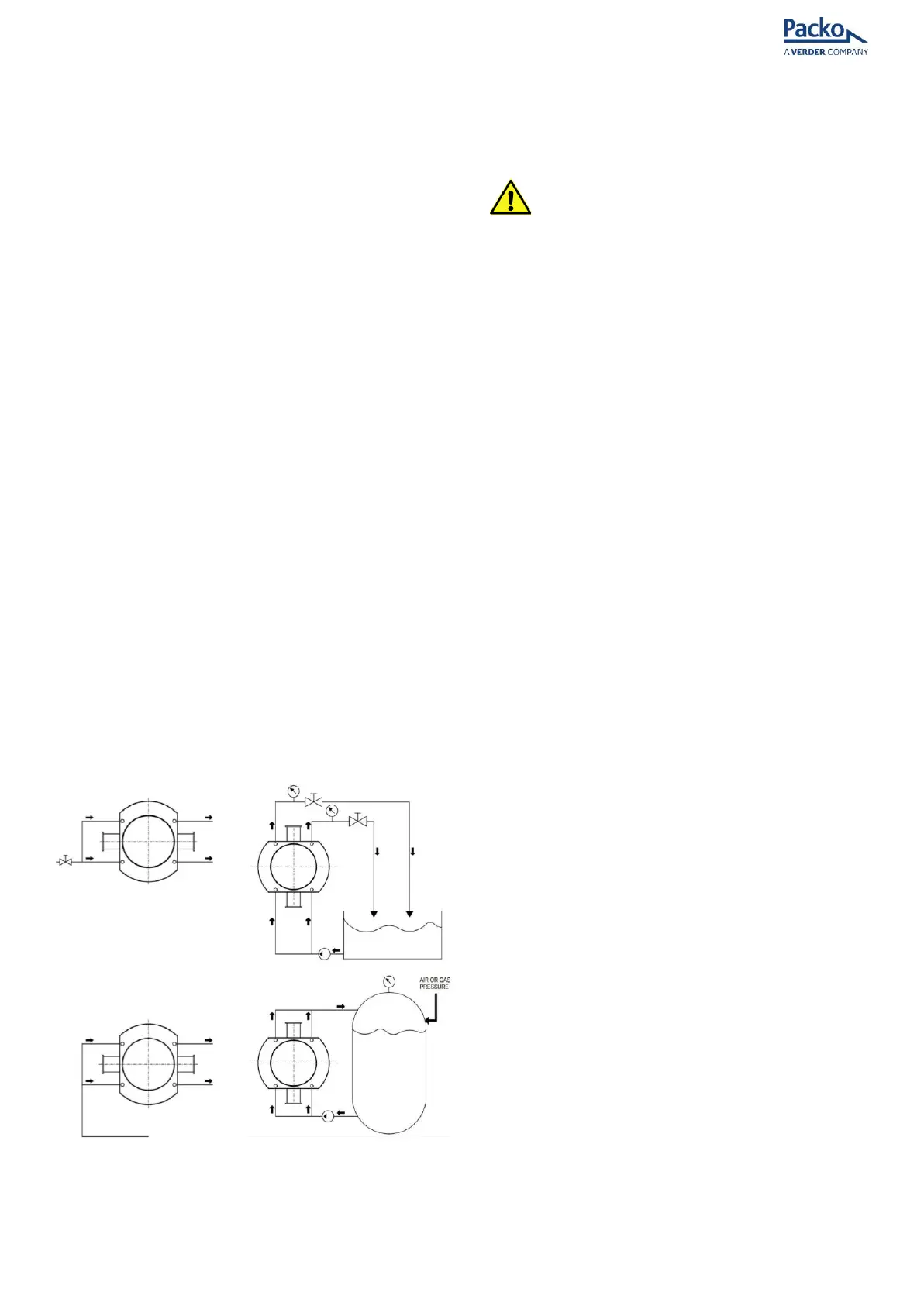
above, a flushing system must be installed as
follows:
• The flushing liquid used must itself be
compatible with the pumped fluid and
must itself not require a complex seal, i.e.
must be non-hazardous, non-abrasive and
lubricating.
• Flush liquid must be at a pressure of 1 bar
(15psi) above the discharge pressure of
the pump and should flow at 35 to 55
litres/hour (10 to 15 US gal/hour) per seal.
• Flush fluid should be connected to flow in
at the lowest point on the seal housing
and out at the highest point to vent air
pockets.
Refer to the drawing below for the suggested
liquid flush system (Figure 13).
Figure 13 - High pressure liquid supply for double seals
Double Mechanical Seal with steam when:
No bacteria or contamination can be allowed to
enter the pump, i.e. an aseptic system.
A steam barrier system must be installed as
follows:
ATTENTION
• Wherever possible, sterile liquid i.e. steam
condensate should be used as a flush.
Condensate should be connected to flow
in at the lowest point on the seal housing
and out at the highest point to vent air
pockets.
• Where steam is essential, great care must
be taken with the design of pipework,
steam traps and controls.
• Steam must be clean, filtered and wet, i.e.
not superheated.
• The pressure of steam should be as low as
possible consistent with the desired
temperature.
• Steam should be connected in at the
highest point on the seal housing and out
at the lowest point to allow any
condensate to drain from the lowest point.
• Refer to Figure 14 for suggested steam
connection.



 To Next Page