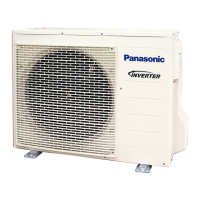
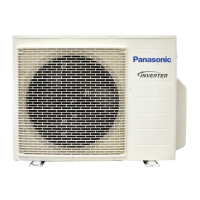
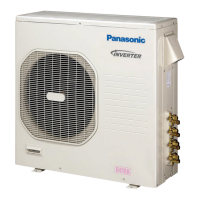
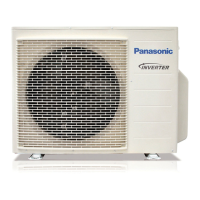
Why is my Panasonic CU-3RE18SBE making a cracking sound during operation?
- KKyle ThompsonSep 6, 2025
The cracking sound during operation is caused by changes in temperature that lead to the expansion and contraction of the unit's components.
Why is my Panasonic CU-3RE18SBE making a cracking sound during operation?
The cracking sound during operation is caused by changes in temperature that lead to the expansion and contraction of the unit's components.
Why does the POWER indicator blink on my Panasonic Air Conditioner before it turns on?
The POWER indicator on your Panasonic Air Conditioner might blink before the unit is switched on as a preliminary step in preparation for operation when the ON timer has been set. When the ON Timer is set, the unit may start earlier (up to 35 minutes) before the actual set time in order to achieve the desired temperature on time.
Why is the cooling/heating capacity reduced on my Panasonic Air Conditioner at the lowest fan speed?
If you've noticed a reduction in cooling/heating capacity during the lowest fan speed setting on your Panasonic Air Conditioner, it's because the low fan speed prioritizes low noise operation, which can reduce cooling/heating capacity. To increase capacity, increase the fan speed.
Why Panasonic CU-3RE18SBE unit doesn't receive signal from remote control?
If your Panasonic Air Conditioner unit isn't receiving the signal from the remote control, ensure that the receiver is not obstructed. Note that certain fluorescent lights may interfere with the signal transmitter; consult an authorized dealer for assistance.
What to do if Panasonic CU-3RE18SBE Air Conditioner remote control does not work?
If the remote control for your Panasonic Air Conditioner isn't working, first, ensure the batteries are inserted correctly. If the display is dim or the transmission signal is weak, try replacing the batteries.
Why are some plastic parts discolored on my Panasonic CU-3RE18SBE?
Discoloration of some plastic parts in your Panasonic Air Conditioner is subject to the material types used and is accelerated when exposed to heat, sunlight, UV light, or environmental factors.
Why does the POWER indicator blink before I turn on my Panasonic CU-3RE18SBE Air Conditioner?
The POWER indicator blinking before your Panasonic Air Conditioner is switched on is a preliminary step in preparation for operation when the ON timer has been set.
Why does dust accumulate on the wall near my Panasonic CU-3RE18SBE?
Dust accumulation on the wall near your Panasonic Air Conditioner is due to air circulation or static electricity generated by the unit. Some types of wallpaper may collect dust easily, so it's recommended to clean the area frequently.
Why does airflow continue after stopping my Panasonic CU-3RE18SBE Air Conditioner?
The airflow continuing after your Panasonic Air Conditioner has stopped is due to the extraction of remaining heat from the indoor unit, which can take up to 30 seconds.
What causes a splashing sound during Panasonic CU-3RE18SBE Air Conditioner operation?
The splashing sound during the operation of your Panasonic Air Conditioner is due to the unit generating nanoe.
Instructions on selecting modes, starting/stopping, and adjusting temperature.
Guidelines for safe handling and installation of indoor and outdoor units.
Prohibitions and compulsory actions to prevent hazards like injury or electric shock.
Guidelines for safe use of power supply, cords, and plugs.
Hazards associated with R32 refrigerant and precautions to avoid ignition risks.
Safety requirements for installing and operating the unit in rooms, ventilation, and avoiding ignition sources.
Special considerations and precautions when using R32 refrigerant, including installation tools and piping.
Guidelines for installing the unit in suitable spaces, pipework, and compliance with regulations.
Requirements for trained and certified personnel performing servicing and maintenance.
Safety checks and procedures for working on systems with flammable refrigerants to minimize ignition risks.
Methods and equipment for checking refrigerant presence and handling leaks.
Prohibiting ignition sources when working with flammable refrigerants.
Safety procedures for repairing sealed components, including disconnecting power and leak detection.
Methods for detecting flammable refrigerants without using ignition sources.
Acceptable methods for detecting leaks in refrigerant systems, including equipment and fluids.
Procedures for removing and evacuating refrigerant from the system for repairs or decommissioning.
Requirements for charging refrigerant, including contamination prevention and electrostatic discharge.
Steps for safely decommissioning the unit, including refrigerant recovery and electrical isolation.
| Cooling Capacity (BTU) | 18000 |
|---|---|
| Refrigerant | R32 |
| Inverter | Yes |
| Cooling Capacity (kW) | 5.3 |
| Power Supply | 220-240V, 50Hz |
| Type | Split System |
| Noise Level (Outdoor Unit) | 50 dB |


Loading...