Precautions Concerning Programs
4-20
4.5.2 Memory Areas Which can be Modified with Index Registers
Index registers can be used to modify other types of memory areas in addition to data
registers DT.
IXWX0, IXWY1, IXWR0, IXSV0, IXEV2, I0WX10, I2WY1, I3WR0, IASV0, IBEV2
Constants can also be modified.
IXK10, IXH1001
In the FP2SH/FP10SH, the relay numbers can be modified.
I0X0, IAR10
In the FP2/FP2SH/FP10SH, an index register can be modified using another index
register.
In the FP0/FP−e, an index register cannot modify another index register.
Possibility: I0ID
Impossibility: IXIY, IXIX (except FP2/FP2SH/FP10SH)
I0I0, IAIA (for FP2/FP2SH/FP10SH)
When a 32-bit constant is modified, the specified number and the following number are
used in combination to handle the data as a 32-bit data.
The result of the modification is a 32-bit data.
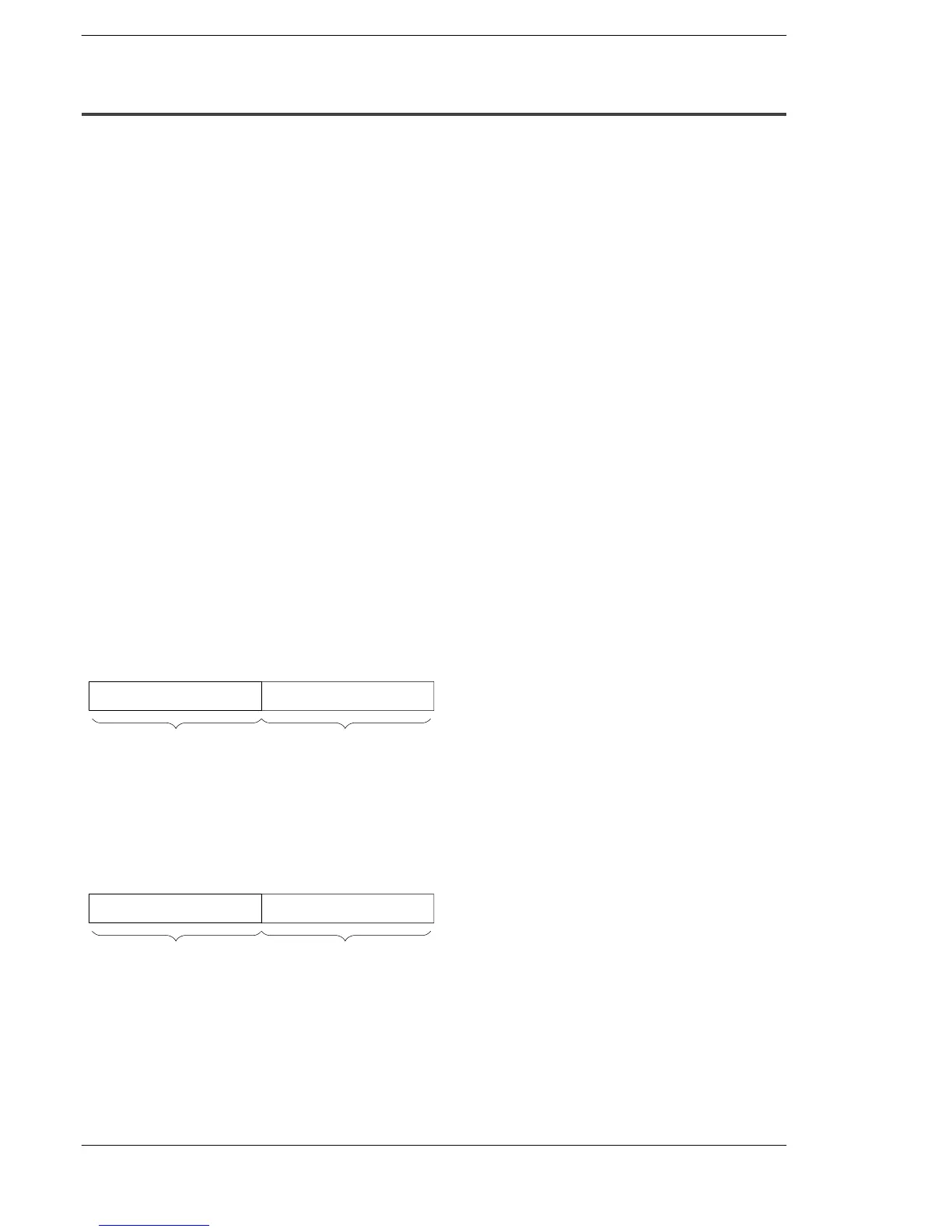
In the FP0/FP−e
Lower 16-bit areaHigher 16-bit area
Contents of IXContents of IY
When using index modification with an instruction which handles 32-bit data, specify
with IX.
In the FP0R/FPΣ/FP−X/FP2/FP2SH/FP10SH (example of specify with I0)
Lower 16-bit areaHigher 16-bit area
Contents of I0Contents of I1
When modifying a 32-bit number, do not specify ID. Be aware that a syntax error will
not occur even if this is not specified.





 To Next Page