High−level Instructions
3 − 20
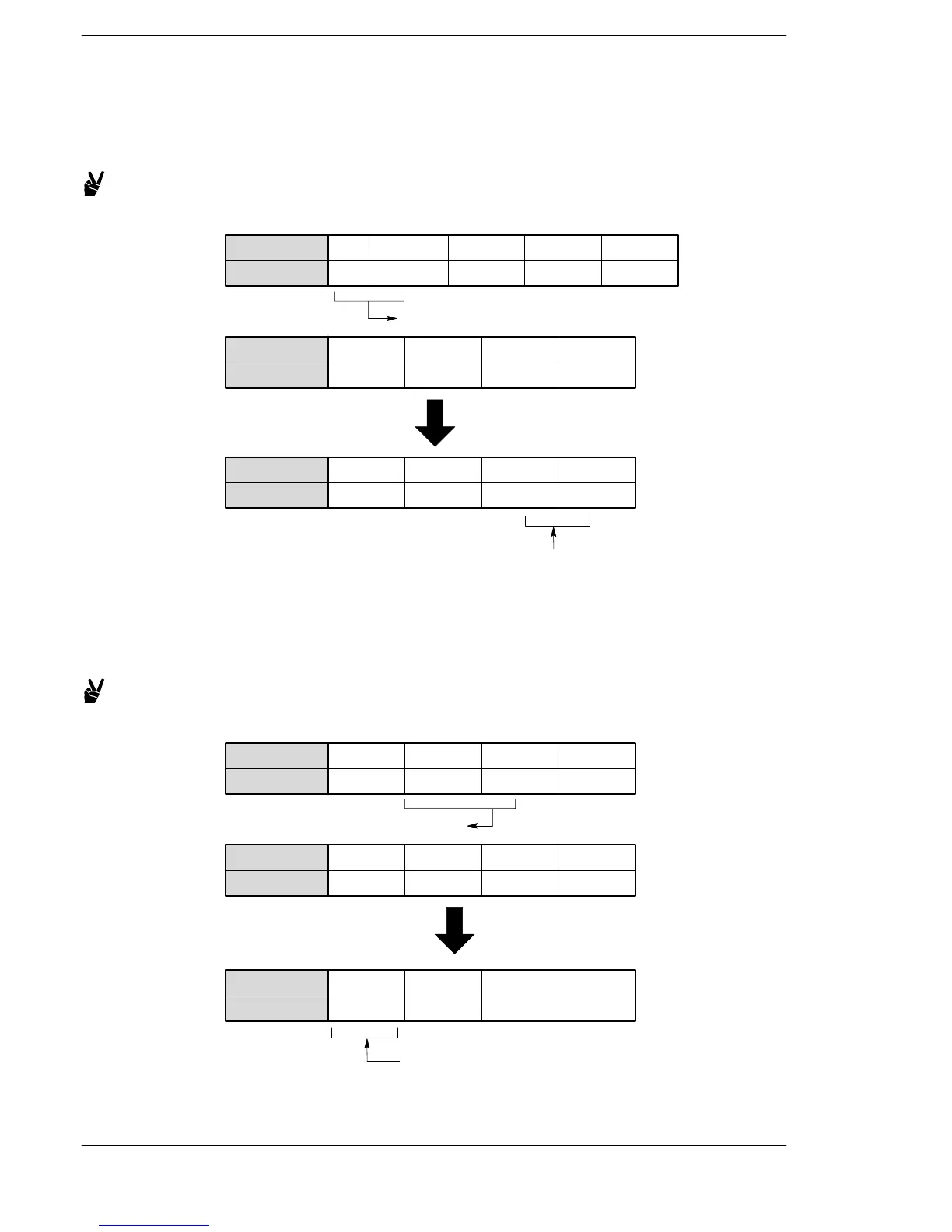
If “0” is specified as the number of bits to be transferred, the specified one bit is transferred.
If the specified range extends beyond the area of S, the contents of the part extending beyond the area are
transferred as “0”.
Example: When four bits starting from bit position 14 of S are transferred
to bit position 2 of D...n = H23E
Four bits, starting from bit position 14
Bit positions 14 and 15 of S are trans-
ferred to bit positions 2 and 3 of D. “0”
is stored in bit positions 4 and 5 of D.
“F5 (BTM)” execution
····
Bit position
·····
S
15
110
12
0
11
110
8
1
7
000
4
1
3
101
0
0
····
Bit position
·····
D
15
001
12
0
11
000
8
1
7
101
4
1
3
100
0
1
····
Bit position
·····
D
15
001
12
0
11
000
8
1
7
100
4
0
3
110
0
1
··
00
If the specified range extends beyond the area of D, the contents of the part extending beyond the area are
not transferred. Data is not written to the next address.
Example: Six bits starting from bit position 6 of S are transferred to bit
position 12 of D...n = HC56
“F5 (BTM)” execution
Six bits, starting from bit position 6
····
Bit position
·····
S
15
000
12
0
11
010
8
1
7
110
4
1
3
111
0
1
····
Bit position
·····
D
15
000
12
0
11
100
8
1
7
111
4
1
3
001
0
1
····
Bit position
·····
D
15
011
12
1
11
100
8
1
7
111
4
1
3
001
0
1
From among bit positions 6 to 11 of S, bit
positions 6 to 9 are transferred to bit positions 12
to 15 of D (the contents of bit positions 10 and 11
of S are ignored).





 To Next Page