High−level Instructions
3 − 328
2) Setting the baud rate
For FP10SH
The baud rate (transmission speed) for serial transmission is initially set to 9600 bps.
To change the baud rate to match the external device connected to the COM. port, set the lower row of
operation mode switches as shown below.
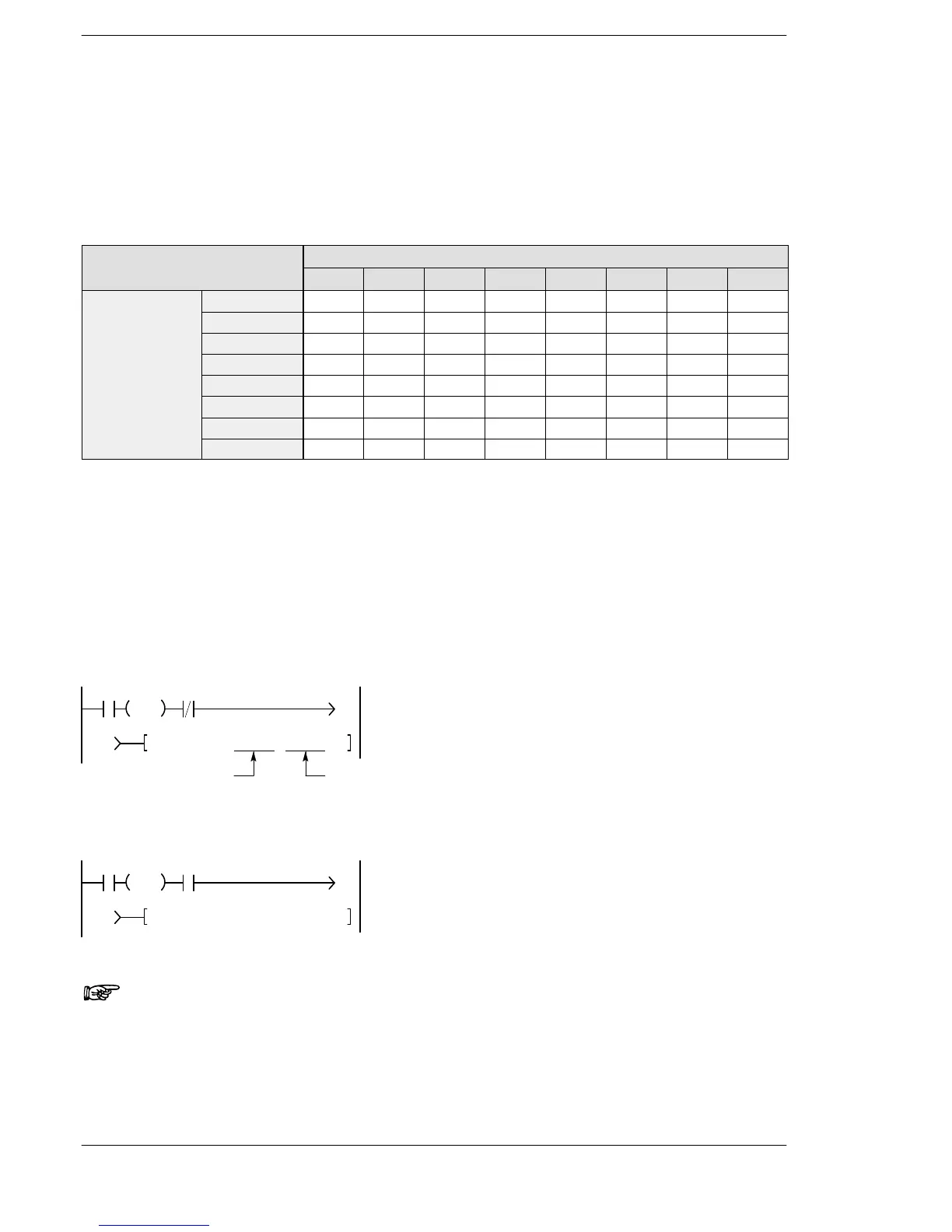
Operation mode switches (using lower dip switch)
Functions
Settings
SW1 SW2 SW3 SW4 SW5 SW6 SW7 SW8
Transmission
115,200 bps — — — — — off off off
speed
57,600 bps — — — — — on off off
38,400 bps — — — — — off on off
19,200 bps — — — — — on on off
9,600 bps — — — — — off off on
4,800 bps — — — — — on off on
2,400 bps — — — — — off on on
1,200 bps — — — — — on on on
For FP2/FP2SH
Set the transmission speed so that the “COM Port Baud Rate Setting” of system register 414 matches the
external device connected to the COM. port. The default setting is “19200 bps”.
3) Setting the use of the COM. port
Set system register 412 for serial transmission (general purpose port).
To switch between “computer link communication” and “serial data communication” (general purpose
port), execute an F144 (TRNS) instruction. Set “n” (the number of transmission bytes) to H8000, and then
execute the instruction.
When executed when “computer link” is selected, the setting will change to “general purpose port.”
F144 TRNS, DT100, H8000
Set to H8000.In this case, the
parameter is disabled
regardless of the number.
X0 R9032
DF
1
1
When executed when “general purpose port” is selected, the setting will change to “computer link.”
F144 TRNS, DT100, H8000
X0 R9032
DF
1
1
R9032: COM. port selection flag, this flag turns on when
“General purpose port” is selected.
Note
When the power is turned on, the port use will revert to the
setting of system register 412.
FP2/FP2SH/FP10SH





 To Next Page