Relays, Memory Areas and Constants
1-42
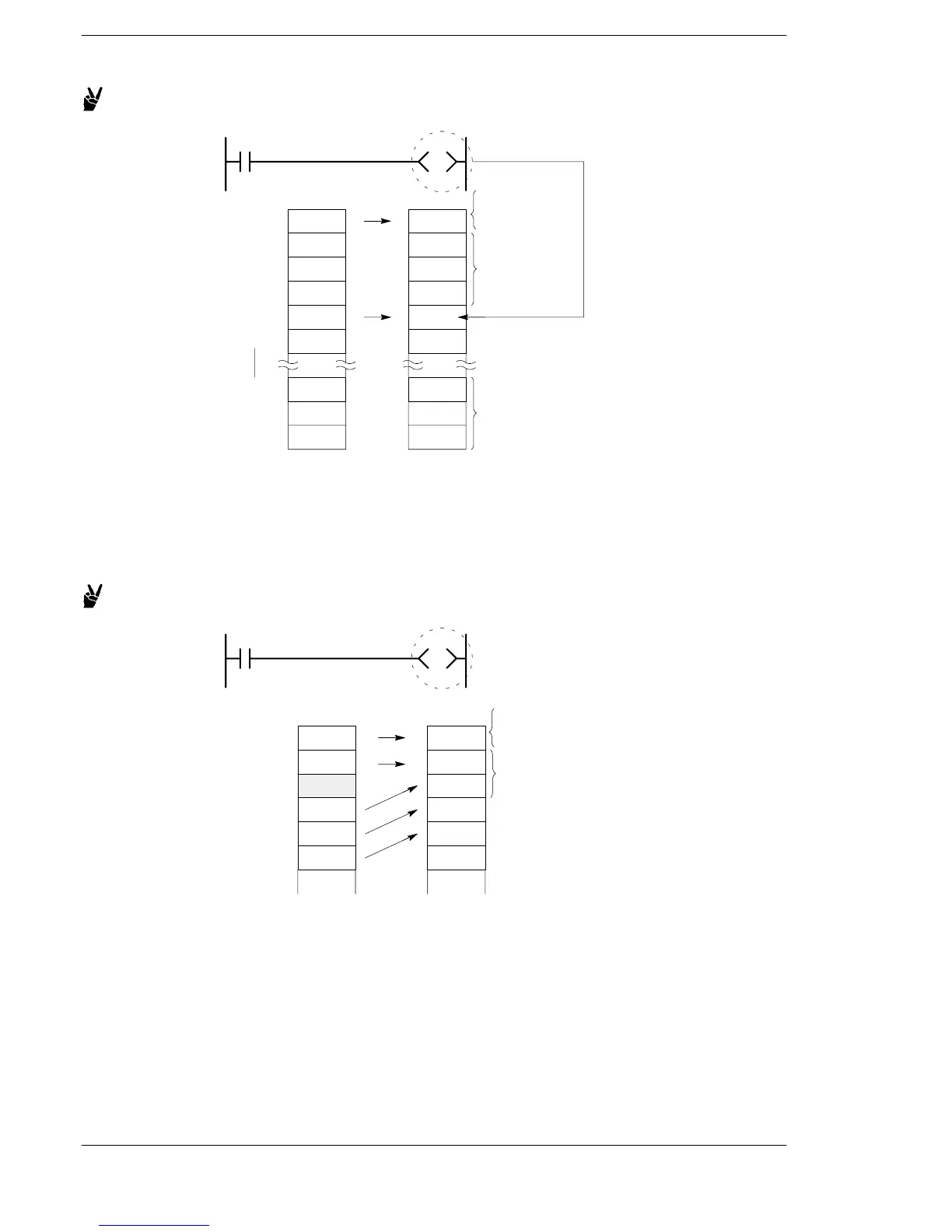
Example: If X0 goes on when an error occurs
X0
E15
Set E15
S
X0 : on
DT90420
K3
K21
K12
K5
K0
K0
K4
K21
K12
K5
K15
K0
No. of error
alarm relays
which are on
Relay numbers
of error alarm
relay which are
on
+1
DT90421
DT90422
DT90400
DT90401
DT90402
DT90403
DT90404
DT90405
Data of calen-
dar timer which
the error alarm
relay of relay
number in
DT90400.
Program for resetting (turning off) an error alarm relay
When an error has been corrected, the RST instruction should be used to turn off the
error alarm relay.
Example: If X1 goes on when an error is corrected
X1
E12
Reset E12
R
X1 : on
K4
K21
K12
K5
K0
K0
K3
K21
K5
K0
K0
DT90400
−1
DT90401
DT90402
DT90403
DT90404
DT90405
No. of error alarm
relays which are on
Relay numbers of
error alarm relay
which are on
Clearing all buffer areas
Either of the following methods may be used.
− To reset all of the error alarm relays, use the RST instruction in the same way
as that described on the next page, and specify special data register
DT90400.
− If the Initialize/Test switch is set to the Initialize side in the PROG mode, all
error alarm relays (E) go off, and the storage buffer is cleared.
(To avoid clearing the buffer with the Initialize switch, change the setting of
system register 4.)







 To Next Page