Relays, Memory Areas and Constants
1-72
1.4 Explanation of Constants
1.4.1 Integer Type Decimal Constants (K)
Function of decimal constants (K)
This is binary data that has been converted to the decimal format.
When entering and reading a decimal constant, specify the value by entering a K at the
beginning.
Decimal constants are primarily used to specify data sizes and quantities such as set
values for timer.
In the PLC, the decimal constant (K) is processed as binary (BIN) data in units of 16 bits,
as shown below.
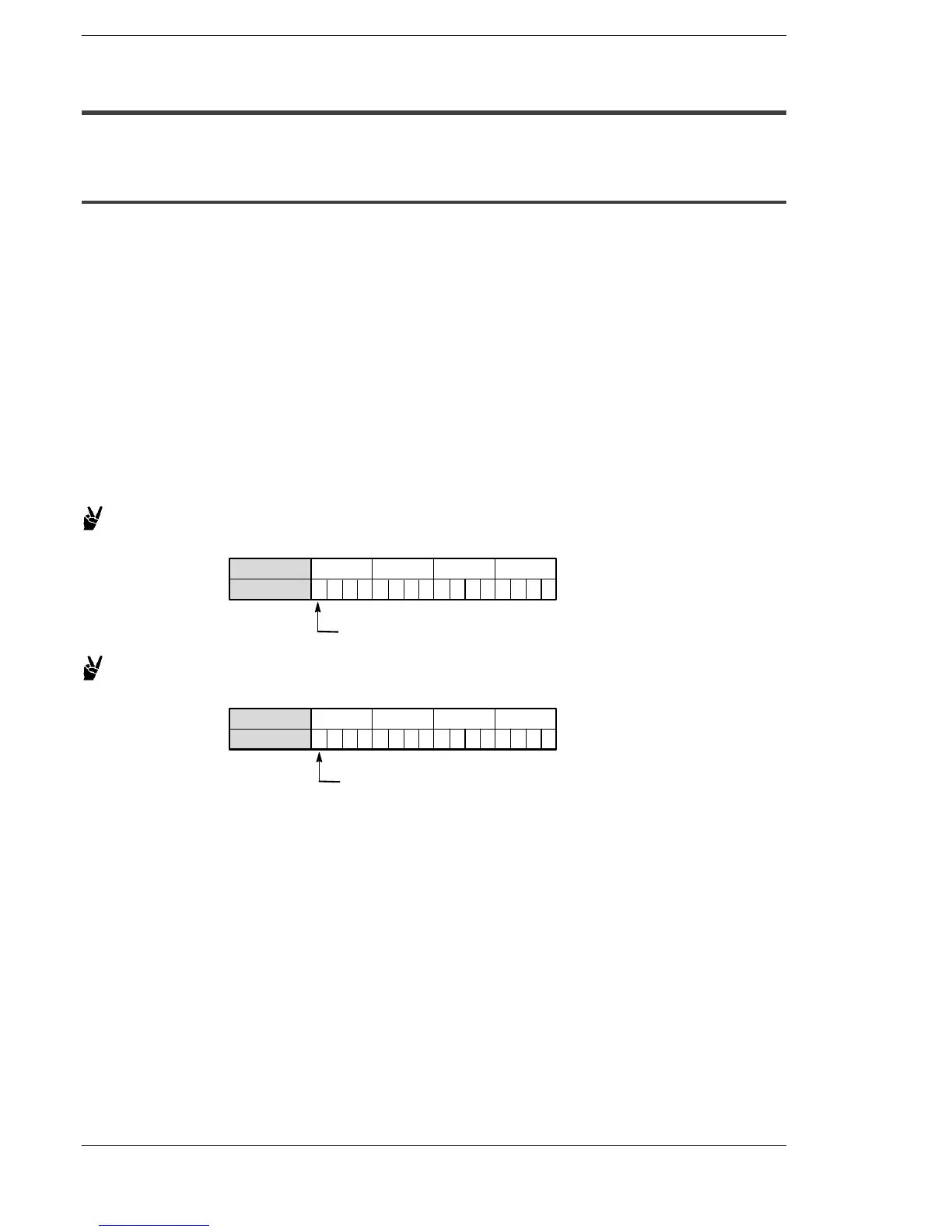
The sign is determined by the MSB “Most Significant Bit” (bit position 15). [A “0”
indicates a positive sign (+), and a “1” indicates a negative sign (−).] The MSB (Most
Significant Bit) is called the “sign bit”.
Example: Decimal number “+32” (K32)
“+”
Bit position
15
000
1211
0
8
0
7
01
43
0
0
·········
00 0 0 00 00
Binary data
Example: Decimal number “−32” (K−32)
“−”
Bit position
15
111
1211
1
8
1
7
11
43
0
0
·········
11 1 1 00 00
Binary data
Data is normally handled in units of one word (16 bits), however, it is also occasionally
handled in units of two words (32 bits). In this case, as well, the MSB serves as the sign
bit.
The available range of a decimal constant is:
16-bit equivalent data: K-32768 to K32767
32-bit equivalent data: K-2147483648 to K2147483647





 To Next Page