Basic Diagnostic Testing
Battery Testing Cont
'd..
.
[2]
Static Battery Test (No Load)
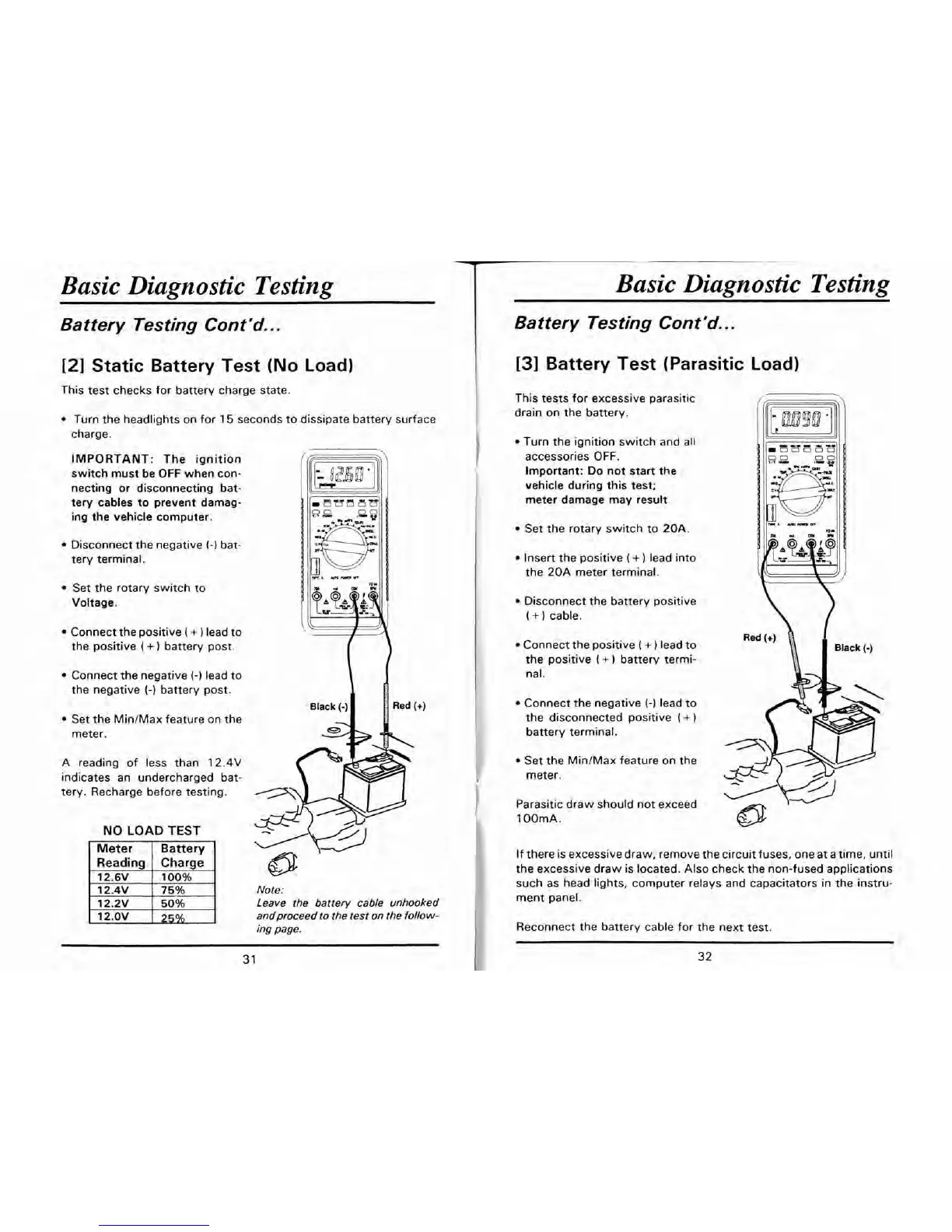
This test checks for battery charge state.
Turn the headlights on for
15
seconds to dissipate battery surface
charge.
IMPORTANT:
The ignition
switch must be
OFF
when con-
necting or disconnecting bat-
tery cables to prevent damag-
ing the vehicle computer.
Disconnect the negative
(-1
bat-
tery terminal.
Set the rotary switch to
Voltage.
Connect the positive
(
+
lead to
the positive
(
+
battery post.
Connect the negative
(-)
lead to
the negative
(-)
battery post.
Set the MinIMax feature on the
meter.
A reading of less than
12.4V
indicates an undercharged bat-
tery. Recharge before testing.
NO
LOAD
TEST
Note:
Leave the battery cable unhooked
andproceed to the test on the follow-
ing page.
Basic Diagnostic Testing
Battery Testing Cont
'd..
.
[3]
Battery Test (Parasitic Load)
This tests for excessive parasitic
drain on the battery.
Turn the ignition switch and
all
accessories
OFF.
Important: Do not start the
vehicle during this test;
meter damage may result.
Set the rotary switch to
20A.
Insert the positive
(
+
1
lead into
the 20A meter terminal.
Disconnect the battery positive
(
+
)
cable.
Connect the positive
(
+
)
lead to
the positive
(
+
)
battery termi-
nal.
Connect the negative
(-1
lead
to
the disconnected positive
(
+
1
battery terminal.
Set the MinlMax feature on the
meter.
Parasitic draw should not exceed
1
00mA.
If there is excessive draw, remove the circuit fuses, one at a time, until
the excessive draw is located. Also check the non-fused applications
such as head lights, computer relays and capacitators in the instru-
ment panel.
Reconnect the battery cable for the next test.


 To Next Page