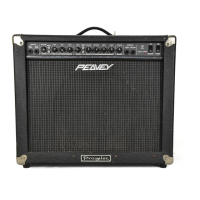
The Peavey Programax 10 is a self-contained guitar amplifier that offers a unique blend of analog and digital design technologies. It features a sophisticated microprocessor control system, precise digital-to-analog and analog-to-digital conversion, and a robust power amplifier, all integrated into a single unit. This design allows for a wide range of tonal possibilities, from crisp clean sounds to heavily overdriven distortion, making it suitable for various musical styles. The amplifier is designed to be user-friendly, with intuitive controls and programmable memory for storing custom sound presets.
Function Description
The Programax 10 functions as a complete guitar amplification system, integrating a preamplifier, power amplifier, and a digital control section. Its core functionality revolves around its ability to store and recall ten distinct sound programs, allowing musicians to switch between different tonal settings instantly.
- Preamplifier Section: This section includes controls for Pre Gain, Saturation, and Post Gain, which interact to create a full spectrum of sounds. The Pre Gain control acts as the initial level-setting device, increasing the gain in the preamp section. The Saturation control simulates the gain compression and harmonic overload of vacuum tubes, adding richness and sustain to the sound. The Post Gain control acts as a relative volume control, balancing the level of individual programs.
- Equalization Controls: The amplifier features four bands of equalization: Low, Mid, High, and Presence. The Low, Mid, and High EQ bands are passive, offering broad tonal adjustments. The Mid Shift control works in conjunction with the Mid EQ to determine the affected frequency range. The Presence EQ is an active circuit that regulates the uppermost range of equalization, adding a final "edge" to the sound.
- Reverb System: A Master Reverb Control determines the amount of delayed signal returned into the main signal, adding depth and spaciousness to the sound.
- Master Volume Control: This control regulates the overall volume level of the amplifier and is not stored within program parameters, allowing global volume adjustments without affecting individual program balances.
- Program Control Switch Matrix: An array of 12 push-button switches is used to store, recall, or modify programs. This includes a Bank A/B Switch for selecting between two banks of five programs each, and five Program Keys (1-5) for recalling or storing specific programs.
- Preset Equalization Curves: The BRT (Bright) Key adds a preset high-frequency equalization curve, while the Thick Key adds a preset mid-band equalization boost, both of which are programmable parameters.
- Effects Loops: Two effects loops are provided: EFX1 (Pre-EQ) and EFX2 (Post-EQ). EFX1 operates at low voltage levels (-14 dBV) for instrument-level effects devices, while EFX2 operates at line-level voltage (0 dBV) for professional line-level effects devices. Both are programmable parameters.
- Manual Mode: The MAN (Manual) Key allows users to override programmed functions, returning all controls to their actual setting positions for creating new programs.
- Mute Function: The MUTE Key temporarily silences the amplifier without altering sound or system settings, providing a convenient "stand-by" mode.
- Ground Lift Switch: This three-position switch helps in properly grounding the amplifier, reducing hum and popping, especially when AC power receptacles are not properly grounded.
- MIDI Interface: The amplifier includes MIDI In and Thru sockets, allowing it to interface with MIDI controllers for remote program selection. It acts as a MIDI slave device, responding to MIDI Preset Select commands.
Important Technical Specifications
- Power Amplifier Section:
- Frequency Response: +0, -1 dB, 60 Hz to 15 kHz @ 200 W into 4 ohms.
- Rated Power & Load: 210 W RMS into 4 ohms (prior to clipping, 1 kHz, 120 VAC line).
- Total Harmonic Distortion: Less than 0.2%, 100 mW to 200 W RMS, 60 Hz to 10 kHz, 4 ohms (typically below 0.1%).
- Intermodulation Distortion: Less than 0.2%, 100 mW to 200 W RMS, 60 Hz to 5 kHz, 4 ohms (typically below 0.1%).
- Hum & Noise: More than 90 dB below rated power.
- Slew Rate: Greater than 10 V/uSec.
- Power Consumption (Domestic): 600 watts, 50/60 Hz, 120 VAC.
- Preamplifier Section (measured @ 1 kHz with specific control presets):
- Pre-Amp High Gain Input (No Pad):
- Impedance: High Z, 47K ohms.
- Nominal Input Level: -28 dBV, 40 mV RMS.
- Minimum Input Level: -46 dBV, 5 mV RMS.
- Maximum Input Level: +8 dBV, 2.5 V RMS.
- Pre-Amp Low Gain Input (-6 dB Pad):
- Impedance: High Z, 94K ohms.
- Nominal Input Level: -22 dBV, 80 mV RMS.
- Minimum Input Level: -40 dBV, 10 mV RMS.
- Maximum Input Level: +10 dBV, 3 V RMS.
- Channel Hum & Noise @ Nominal Input Level: 75 dB below rated output power (20 Hz to 20 kHz unweighted).
- Equalization: Low, Mid, Shift & High: Passive Type EQ. Bright: +6 dB @ 2 kHz.
- Pre-EQ Patch Input/Output (Effects Loop #1):
- Function: Low Level Pre-EQ Effects/Pedal Send and Return.
- Load Impedance: 10K ohms or greater.
- Nominal Output: -14 dBV, 0.2 V RMS.
- Input Impedance: High Z, 220K ohms minimum.
- Input Level: -14 dBV, 0.2 V RMS.
- Post-EQ Patch Input/Output (Effects Loop #2 with Level Control):
- Function: High Level Post-EQ Signal Send and Return.
- Load Impedance: 1K ohms or greater.
- Nominal Output: 0 dBV, 1.0 V RMS.
- Maximum Output: +18 dBV, 8.0 V RMS.
- Input Impedance: High Z, 5K ohms minimum.
- Input Level: 0 dBV, 1.0 V RMS.
- MIDI: Slave device, responds to MIDI Preset Select 1 through 10 on Channel 1.
Usage Features
- Programmable Memory: The Programax 10 can store up to ten distinct programs (five in Bank A and five in Bank B), each retaining specific control settings. Factory-input programs are pre-loaded and retained indefinitely, while user-input programs are retained for approximately three weeks without power.
- Program Recall: Programs are recalled by selecting the appropriate bank (A or B) and then pressing the corresponding Program Key (1-5).
- Program Storage: To store a new or modified program, select the desired bank and Program Key, then press and hold the Program Key until its LED stops flashing (approximately three seconds). This overwrites any previously stored program in that location.
- Program Modification: Any stored program can be modified by simply adjusting its controls. The amplifier automatically overrides the stored setting for any control that is physically moved. A flashing LED on the Program Key indicates a modified program.
- Program Creation: New programs can be created from scratch by entering Manual mode (MAN Key) and adjusting controls to desired positions.
- MIDI Control: The MIDI In socket allows remote program selection using a MIDI controller, such as the Peavey RMC 2000. The MIDI Thru socket allows chaining of multiple MIDI-compatible devices.
- Effects Loop Integration: The Pre-EQ (EFX1) and Post-EQ (EFX2) effects loops allow for the integration of external effects devices, with EFX1 suitable for instrument-level pedals and EFX2 for line-level professional effects. The Post-EQ Level Control (Y) on the rear panel adjusts the return level for EFX2.
- Safety Features: The amplifier incorporates a three-wire AC (mains) cable with proper grounding facilities to reduce noise and shock hazard. The Ground Lift Switch further aids in proper grounding.
Maintenance Features
- Internal Battery: The Programax 10 contains a special rechargeable internal battery that protects and maintains stored programs when the amplifier is off. This battery recharges automatically when the amplifier is in use.
- Battery Life: Under normal use, the internal battery has a life expectancy exceeding five years.
- Battery Failure Indication: Battery failure is indicated if the amplifier fails to retain user-created or modified programs after a power-off/power-on cycle.
- Battery Replacement: Battery replacement should only be performed by an Authorized Peavey Dealer or qualified service technician, as it is an integral component of the amplifier's circuitry.
- Program Backup: It is recommended to record user-input programs in writing, as they may be lost if the amplifier is turned off for prolonged periods (several weeks or longer).
- Program Deletion/Factory Reset: All user-input programs can be simultaneously deleted by turning the amplifier off, then pressing and holding BOTH the BANK A/B key (M) and the MAN key (T) while turning the amplifier on. This procedure will revert the amplifier to its original factory-preset programs.
- Cleaning: Metal parts can be cleaned with a damp rag. The vinyl covering can be cleaned with a damp rag or an ammonia-based household cleaner.
- General Servicing: The user should not attempt to service the equipment. All service work should be done by a qualified service technician. This includes checking for damaged power supply cords, foreign objects falling into the unit, or if the unit does not operate correctly or has been dropped.

 Need help?

 To Next Page
 General