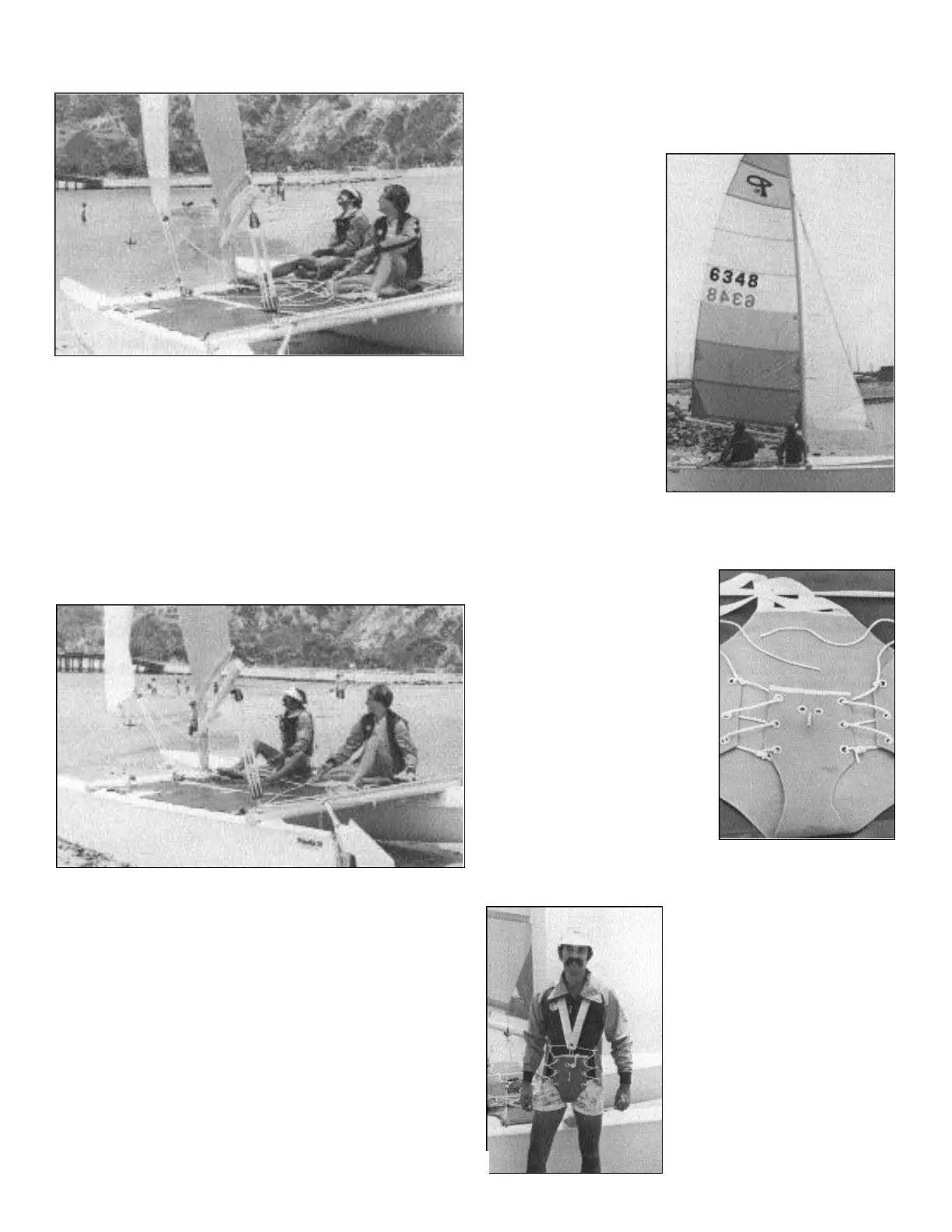
Reaching
The main traveler should be set a few inches
from center with the main sheet snug and
the jib sheet slightly looser than used when
going to weather. This will allow the dis-
tance between the main and the jib to
increase. Both sails should be sheeted in so
that both the leeward and windward tell-
tales are streaming back.
Downwind
Let the main traveler all the way out to the
end of the crossbar and sheet the main
loosely. Do not let the main out far enough
to rub against the shrouds if at all possible.
Trim the jib sheet loosely trying to keep the
windward and leeward tell-tales streaming
back.
If your boat is equipped with a barber hauler,
see Section V - Tuning for Performance for
instructions regarding its use.
Downhaul Systems
The luff of both the main and jib should be
pulled down tightly to pull all the wrinkles
out when sailing. You have to be quite
strong to over-
downhaul the
mainsail, so give it
a hard pull. You
can easily over-
tighten the jib
downhaul, so just
pull hard enough
to get wrinkles.
Notice the diagonal
wrinkles in the luff
of both the main
and jib. Both sails
should be down-
hauled until they
disappear.
TRAPEZING
Lacing the Harness
Using bowlines, tie each
of the lines supplied onto
the bottom inside grom-
mets. Lace back and
forth loosely and tie a
half hitch at the top out-
side grommets.
Put the harness on. It
should be slightly loose.
Most people find a tightly
laced harness uncom-
fortable. Slip the web-
bing over your head.
Feed the lines through the webbing grommet
from the backside, then
feed one through each
backside of top grom-
met near hook. Tie
ends together using an
overhand knot. Do not
use a square knot. The
webbing over your
shoulders should fit
tightly. The tighter it is
the more it will support
your back and shoul-
ders.
24



 To Next Page