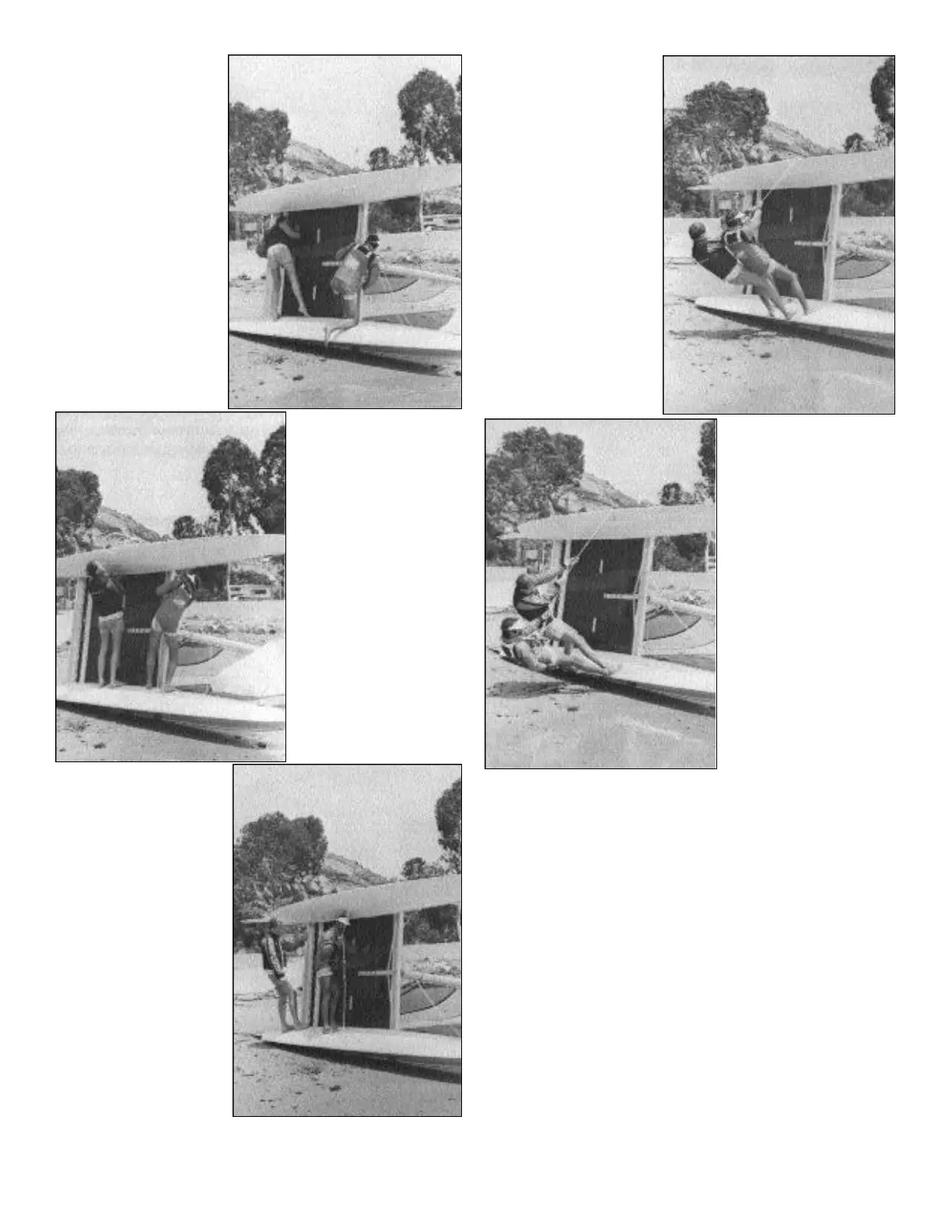
The skipper
should uncleat
the main while
the crew uncleats
the jib.
The crew should
reach around the
front crossbar for
the righting line
and throw it over
the top hull.
Make sure the
bows are pointing
into the wind.
If the mast is
pointed into the
wind, the boat
may flip over in
the other direction
as you try to right
it. To swing bows
around into the
wind, walk back
towards the tran-
som slowly until
bows are posi-
tioned properly.
Be careful not to
shift your com-
bined weight too
far forward or aft
as this may cause
the boat to roll
and turn “turtle”.
Standing even
with the front
crossbar, the
skipper and crew
should grab the
righting line and
lean backwards.
Knots in the line
help keep your
hands from slipping. If you are single-hand-
ing your boat,
carry your jib bag
on board. Grab
onto the righting
line, scoop up a
bag of water and
hold it over your
shoulder while
leaning back. This
extra weight
should allow you
to right the boat.
An alternative
method is to tie a
loop in the end of
the righting line
and attach the
loop to your tra-
peze harness
hook for more
leverage.
Once the tip of
the mast comes
out of the water,
the boat will right
quickly. Be sure
to hold onto the
righting line until
you can grab the
boat and pull
yourself up. The
boat will now be
pointing directly into the wind and moving
slowly if at all. Stow the righting line back in
the pouch and you are sailing again!
REEFING
Unlock the main halyard and lower the main-
sail down about 4 feet. Lock the lower metal
stop on the halyard wire into the halyard
lock on the mast. The sail should now be
about 4 feet short of being fully hoisted.
Downhaul the luff using the ring in the reef
patches.
30



 To Next Page