Gemini 105Mc Owner’s Manual
39Copyright © 2004 Performance Cruising Inc.
Anchoring
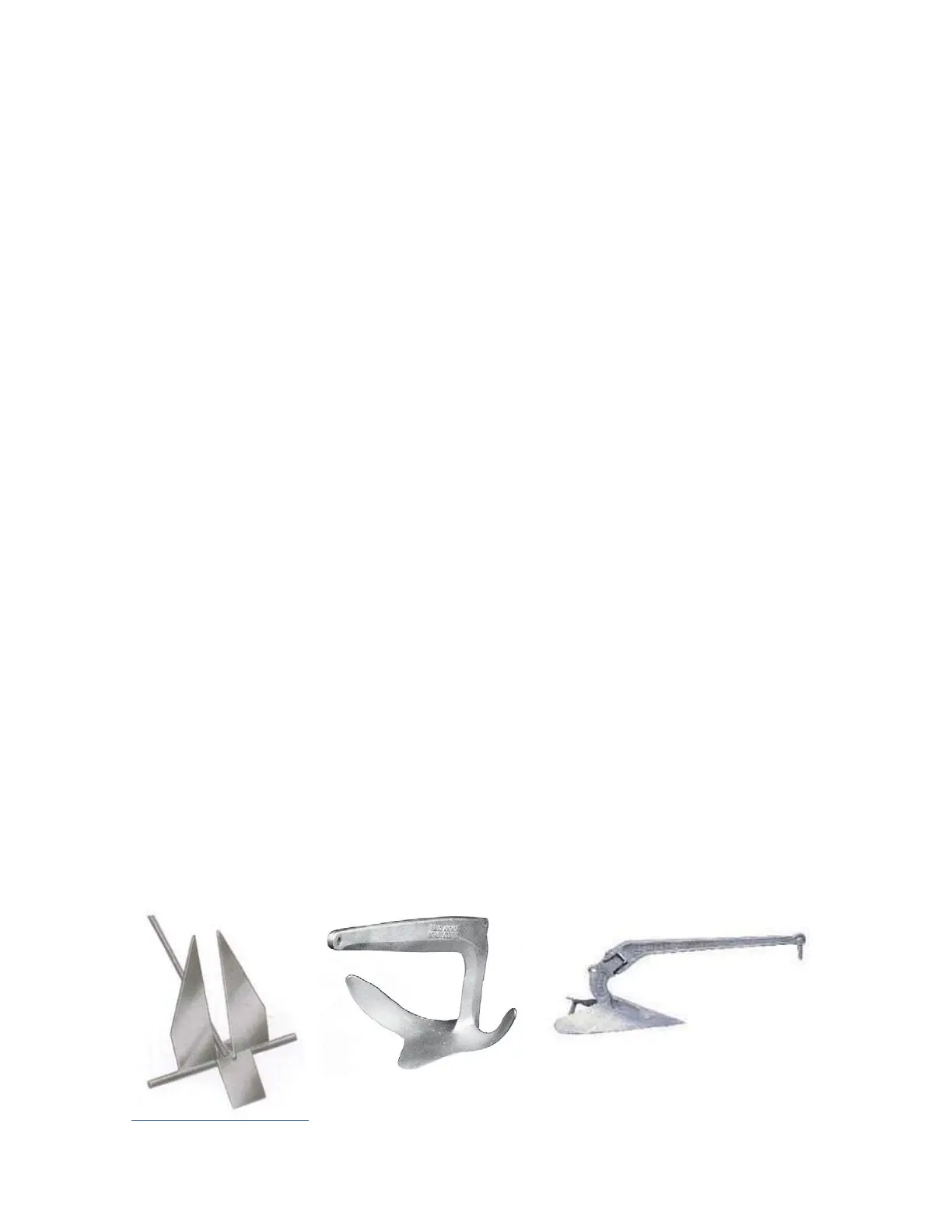
The Gemini 105Mc is outfitted with a 22lb Danforth
anchor supplying 1600lb of holding power. There is
a stowing anchor roller through the bowsprit and an
anchor locker just behind the bowsprit.
Cautionary Notes on Using the Danforth: The Dan-
forth anchor has the highest straight line holding
power but will not take a wind shift. The anchor
can be capsized and released and when loaded with
mud can be difficult to reset if the boat is being
blown fast. The flukes of the Danforth can also be
loaded with grass or kelp and then not hold.
The 22lb Bruce anchor is the strongest but can
develop a ball of mud between the blades and not
hold. The flukes of the Bruce will probably get a
hold in rocks and are strong enough to withstand
breaking.
The 25lb CQR or Harbor Fast from Simpson Law-
rence will plow a circle in the sea bottom in the
event of a wind change. The CQR is a strong forged
anchor but is expensive, whereas the Harbor Fast is
fabricated.
There are other anchors similar to the three above
with different features: The Aluminum Fortress
anchor is like the Danforth but has a high blade
area with light weight. This anchor will hold well,
but because of its light weight will skid across the
seabed if the boat is being blown backwards. The
lighter 13lb Hi-Tensile Danforth has a higher holding
power of 2200lb. This anchor theoretically will hold
more than the standard anchor once it gets a grip
and digs in, but of course, does not have the weight
to hold on a rock or if it gets loaded with weed.
This is a good anchor for racing where weight is a
consideration when sailing.
Setting the Anchor
The standard boat comes with a short length of chain
and 100' of 1/2" nylon rope. This is adequate for nor-
mal anchoring in sand or mud. The nylon will stretch
to absorb the shock loads of rough sea. The chain
helps to keep the stock down to make the anchor
plough in. For anchoring in coral where the anchor
line can rub across the coral and get cut, it is recom-
mended that all chain be used. Chain will not absorb
shock like nylon so it is not recommended for other
uses. A compromise is to only use chain that will rub
on the seabed.
While the anchor roller on the Gemini is flared and
rounded at the edges, we still recommend using
some form of chafe guard while at anchor—especially
in rough conditions. The simplest, least expensive
chaffing guard is to simply cut open a 3’ section of
garden hose and wrap the hose around the anchor
line going through the roller. Be sure to also tie off
the section of hose so that it does not simply slip
down the anchor line.
There are numerous theories on anchoring. It is ad-
visable to check into these theories but do not auto-
matically assume that in a bad storm two anchors
are better than one. Unfortunately in a storm there
will almost certainly be a change in the wind direc-
tion, at which point the two anchors will wrap to-
gether and pull out.
There are several systems for anchoring in confined
spaces to prevent the boat moving down onto other
boats when there is a change in the wind direction.
Anchoring fore and aft is one way. Another way is to
set two anchors facing one another 150 ft or so
apart, and then connecting them together in the
center with a swivel on the sea bed. Finally, take a
line from the swivel up to the boat. In this system
the anchors will not pull out in the case of a wind
shear. Unfortunately, this system will need consider-
able skill and time to set and retrieve.
Anchoring
Danforth Anchor Bruce Anchor
CQR Anchor



 To Next Page