Gemini 105Mc Owner’s Manual
45Copyright © 2004 Performance Cruising Inc.
Hauling and Trucking the Gemini
With the Gemini’s straight keels, hauling the boat is
a relatively easy procedure. The straps of the lift
will go right under both hulls and since the straps
do not stretch there is no tendency for them to
crush the hulls.
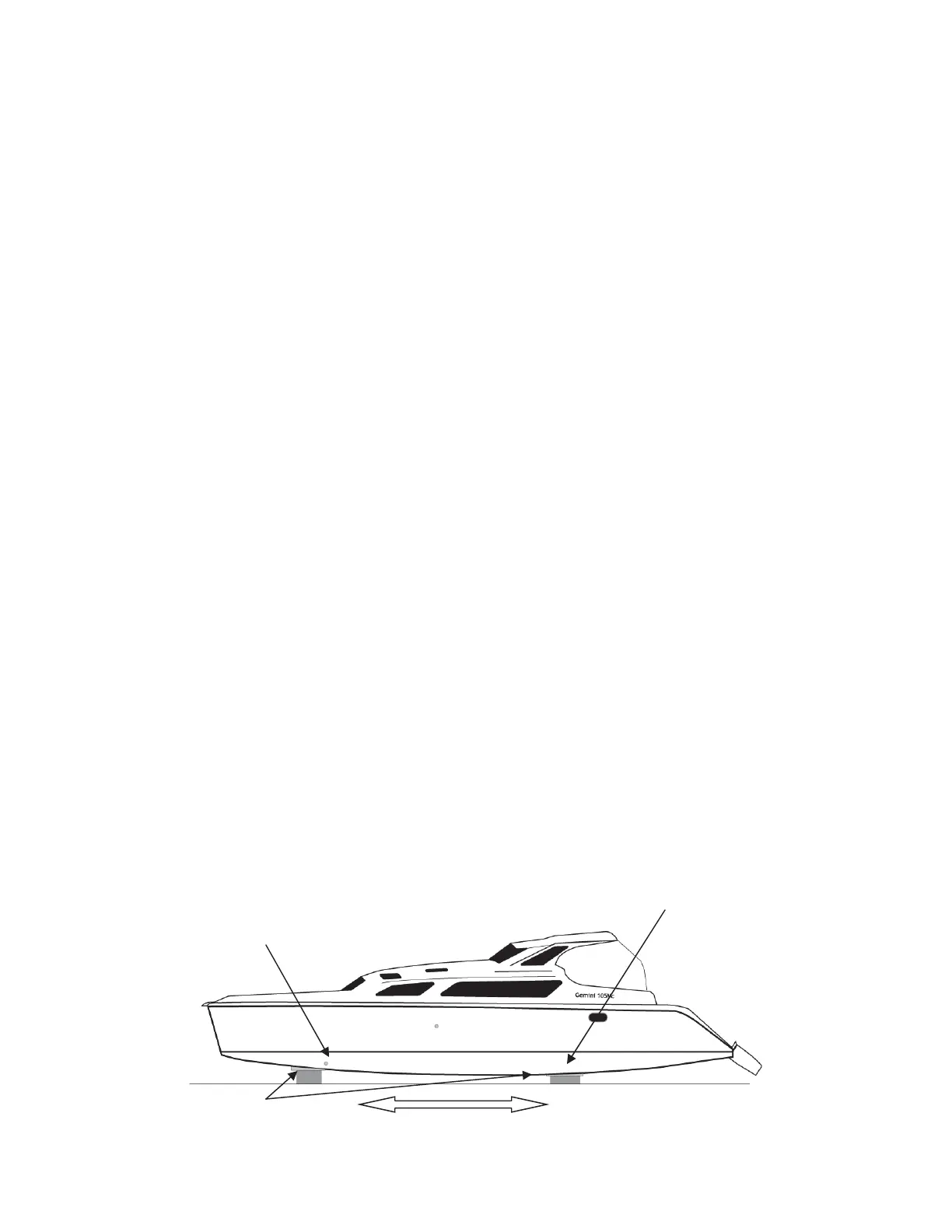
Once the boat is out of the water it can simply be
placed on top of four piles of cinderblocks with four
blocks in each pile; making a square pile. The
blocks should be 16’ apart front to back. Place the
front two piles of bricks under the bulkhead at the
back of the buoyancy tanks in the bow. The correct
placement is parallel with a line 4” forward of the
toilet through hull on the port side.
Place the rear two piles under the front edge of the
aft bed. The correct placement is a parallel line 1’
ahead of the outside aft cabin window which is
inline with the bulkhead in front of the aft bunk.
Place a piece of 1” thick plywood about 18" square
(a 2 x 12 cut to 30” running for and aft would be
even better) between the blocks and the hull. Be
sure to bring the bow of the boat down first (until
the straps are loose) and then the stern. When the
stern is about 1” away from the blocks, insert shims
so that each hull is an equal distance from the
blocks. The aim is to distribute the boats weight
over the four blocks evenly. Wedge under the wood
so that the plywood follows the angle of the bottom
of the hull. It is important to evenly distribute the
load over as large an area as possible so as not to
place a point load on the hull.
Trucking the Gemini
At 14' wide, the Gemini can be trucked anywhere far
easier and for less expense than any other cruising
catamaran. However, the transom and rudders must
be lifted above the rear wheels of the truck.
The flat bed of the truck is normally 8' wide but the
keels of each hull are 10' apart. This requires two
large timbers placed on the flat bed for the boat to
sit on. These timbers should be 10" x 12" x 14' long.
They are placed 16' apart on the flat bed. The front
timber will be directly under the bulkhead at the
back of the forward buoyancy tanks. (roughly 6’ back
from the bow) The rear timber will be under the
bulkhead in front of the aft bunks. (located at the
same places as the cinderblocks when storing the
boat) Then a series of wedges about 4" high must be
nailed to the timbers at the sides of the hull to give
additional side support and stop the boat from mov-
ing. Place carpet between the hulls and these tim-
bers and wedges to prevent any scratching of the
gelcoat.
Once the boat is in place, use a chainsaw to remove
as much excess wood from the ends of the timbers as
possible. Tie the boat down with lines going from
the four corner cleats diagonally down and back to
the flat bed. This will prevent movement up and
down as well as back to front. The timbers must
also be chained to the truck. Also, to stop the cen-
terboards from hitting the road should they fall
down, take a line from the stanchion above the cen-
terboards down under the hulls to the truck.
Hauling and Trucking
Blocks placed 4”
forward of the toilet
through hull -inline
with the forward bulk-
head.
Blocks placed 1’ ahead of
the aft cabin window—
inline with the bulkhead
directly in front of the
water tanks.
16’
Blocking the Gemini
1” thick plywood running
for and aft



 To Next Page