There is no hard
and
fosf rule for properly regulofing the flow of oil so
OS
to ensure
that
the
head
ports
will be
adequately
lubricated. The correct
amount
of oil, however, can be easily established by the following tes't:
Hold a piece of
cardboard
between the presser
bar
and
the rear wall
of
the machine
and
run the machine
at
top
speed.
Turn regulating stud o
as
may be required to
obtain
two
thin lines of
spray
oil on the
cardboard
which
should
be
the
case
after
10
seconds.
To
ensure
adequate
lubrication
of
the
needle
bar
|/hich
is
constantly
under
heavy strain, an
oil
wick
has been passed
throudh
the take-up
link
stud,
wound
Ground
the
needle
bar
upper
bushing,
ta|<en
down
to
the
lower
bushing,
wound
around
the
needle
bar
and
secured
by a clip. (Photo 20).
A
second
oil wick connects the
take-up
link
stud
w
is
secured
inside
the
machine
head
with
a
screw
fakeup
link
whenever
it
brushes
past.
th a small oil
pad
which
and
delivers
oil
to
the
23.
Regulafing
fhe
Hook
Lubrication
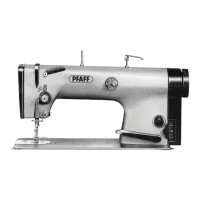
The
rotary
hook
of
the PFAFF 433 is oiled
indepedently
of
the
forced
feed
lubrication
system
of
the machine.
This
feature
has
proved
very
advantageous
because
it
permits
to
supply
the
sewing
hook
as
the
most
sensitive
part
in a sewing machine with
fresh,
and
clean
oil
of
excellent
lubricity. This is
particularly
important
in
handling
delicate
fabrics.
:ant,
the
oil in
the
forced
er
color
which,
although
soil
the
thread
if
used
Because
of
the fine grit which mixes with the lubri
feed
lubrication
system
will
soon
assume
a dark
it
does
not
impair its lubricity in the
least,
migh
for
the
lubrication
of
the
hook.
For instructions about
filling
the hook
oil
reservbir in the top cover see
Section
2. i
Oil is
conducted
to the
rotary
hook by
means
of the
transparent
plastic
tubes
2
and
3. When the machine runs,
valve
v is
opened
by oil
pressure
which is
generated
in
pump
p
and
conveyed
through
tube
1. As the machine
stops,
the
valve
is
closed
by
spring
action.
(Photo
22).
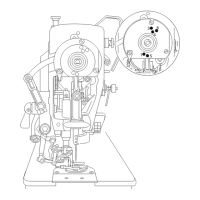
Tube 3
conducts
the oil from
valve
v to regulating
screw
q in the hook
shaft
bearing
which
regulates
the
oil
flow
to
the
sewing
hook.
As
shown
in
photo
23, this
screw
can
be
reached
with
a
small
screw
driver
after
remov
ing the needle
plate.
Turn the
screw
to the left for
more
oil
and
to the right
for
less
oil.
24


 To Next Page