Selection of the proper transducer is often a matter of tradeoffs between various characteristics. It may be
necessary to experiment with a variety of transducers in order to find one that works well for a given job.
The transducer is the “business end” of the instrument. It transmits and receives ultrasonic sound waves that
the instrument uses to calculate the thickness of the material being measured. The transducer connects to the
instrument via the attached cable, and two coaxial connectors. When using transducers, the orientation of the
dual coaxial connectors is not critical: either plug may be fitted to either socket in the instrument.
The transducer must be used correctly in order for the instrument to produce accurate, reliable
measurements. Below is a short description of the transducer, followed by instructions for its use.
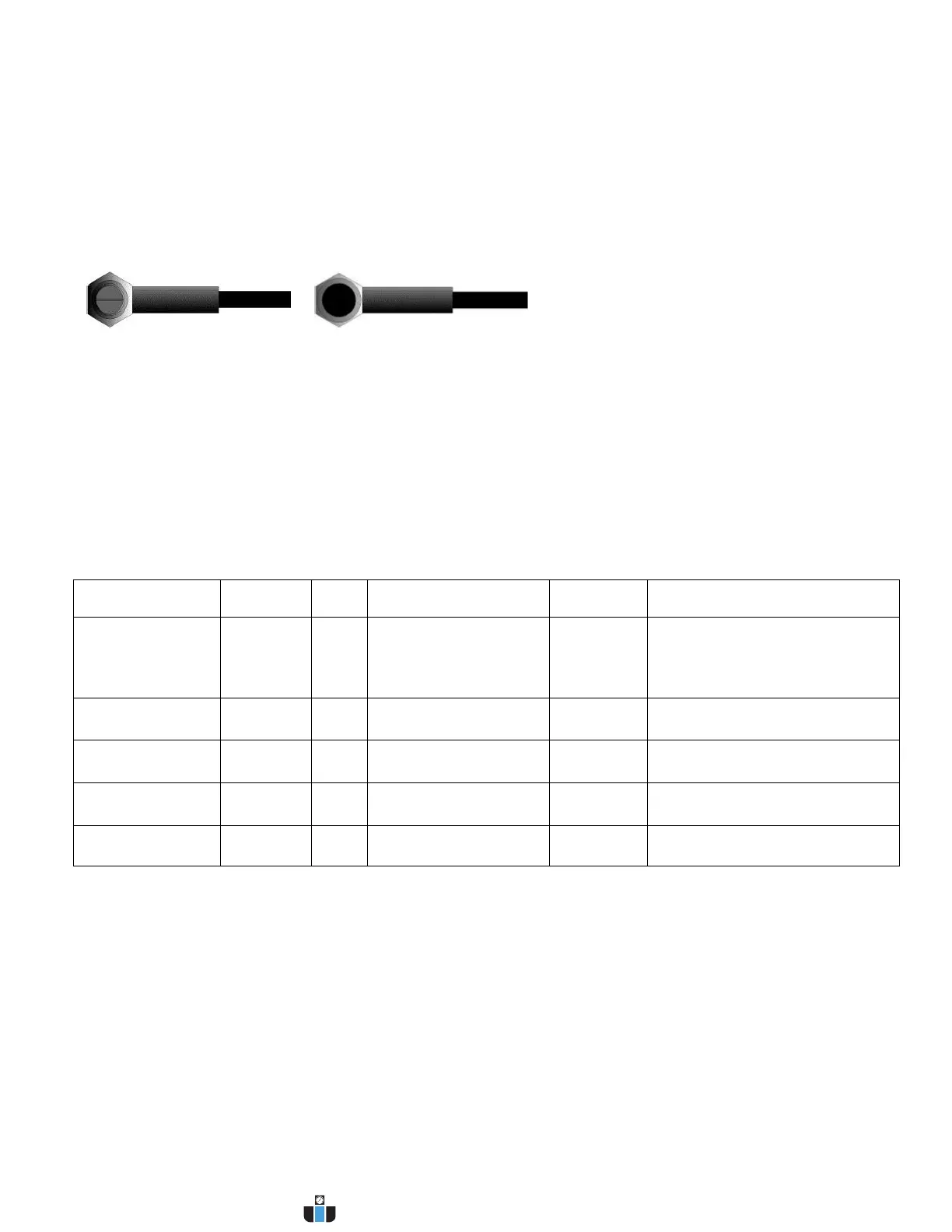
Above Left figure is a bottom view of a typical transducer. The two semicircles of the wearface are visible, as
is the barrier separating them. One of the semicircles is responsible for conducting ultrasonic sound into the
material being measured, and the other semicircle is responsible for conducting the echoed sound back into the
transducer. When the transducer is placed against the material being measured, it is the area directly beneath
the center of the wearface that is being measured.
Right figure is a top view of a typical transducer. Press against the top with the thumb or index finger to hold
the transducer in place. Moderate pressure is sufficient, as it is only necessary to keep the transducer stationary,
and the wearface seated flat against the surface of the material being measured.
Table 3-1 Transducer Selection
Model Freq
MHZ
Diam
mm
Measuring Range Lower limit Description
UTG2000-440 2 22
3.0mm~300.0mm(In
Steel)
40mm (in Gray Cast Iron
HT200)
20
Rough Surface
Also for thick, highly attenuating, or
highly scattering materials
Standard Probe 5 10
1.2mm~230.0mm(In
Steel)
Φ20mm×
3.0mm
Normal Measurement
UTG2000-420 5 10
1.2mm~230.0mm(In
Steel)
Φ20mm×
3.0mm
Normal Measurement
N07 7 6
0.75mm~80.0mm
(In Steel)
Φ15mm×
2.0mm
For thin pipe wall or small
curvature pipe wall measurement
UTG2000-450 5 14
3~200mm (In Steel)
30 For high temperature up to 570°F
UTG2600-400 5 4 30 Thin walled or small parts
www.calcert.com sales@calcert.com1.888.610.7664
0
5
10
15
20
25
30


 To Next Page