www.phenomenex.com
5
B. Carrier Gas Selection and Flow Optimization
It is advisable to use the highest purity gas possible. Ultra high purity (99.99 %),
ultra pure carrier (99.995 %), or even research grade (99.9999 %) is preferred
to minimize critical impurities, instrument downtime and troubleshooting. Three
types of gas are commonly used as a carrier gas:
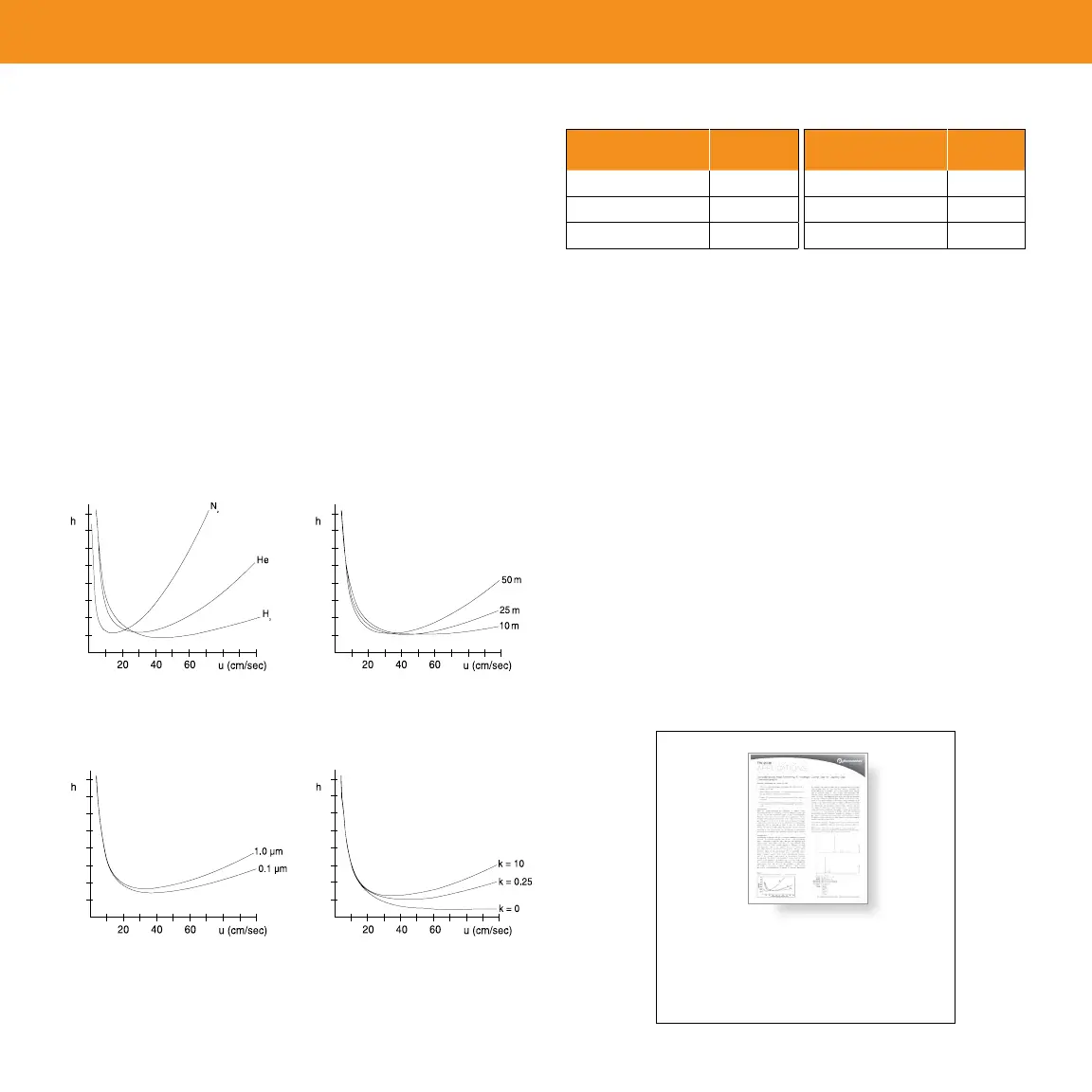
Hydrogen (H1.
2
): Hydrogen will yield maximal number of theoretical
plates for thin film columns and the high efficiency is largely retained at
velocities higher than u
opt
. Hydrogen is not generally recommended due to
its hazardous nature.
Helium (He): When hydrogen is not used, helium is the best alternative for 2.
speed and sensitivity.
Nitrogen (N3.
2
): Nitrogen is the last choice for thin film columns. For thick
film columns, nitrogen yields the highest number of theoretical plates.
However, the optimal velocity is fairly low (long analysis times), and the
loss in efficiency at higher velocities is high. If resolution is sufficient,
hydrogen or helium are good alternatives.
Figure 4: Carrier Gas Selection and Velocity Optimization Plots
C. Column Storage
Important! The column may be left in the instrument for short-term storage.
Ensure a flow of carrier gas through the column at 100-200 °C. For long-term
storage, disconnect from the GC and cap or seal the capillary ends. Oxygen
and moisture can degrade or irreversibly damage the column, especially
cyanopropyl-based phases. Wax (polyethylene glycol) and cyanopropyl-based
phases are also susceptible to UV-induced degradation and should be shielded
from light (fluorescent or sunlight). Store the column in the original box. Upon
reinstallation, cut column ends to ensure that septum fragments or other debris
have not been left in the column.
Carrier Gas Length
H(u) curves for different gases H(u) curves for different
column lengths
Film Thickness Retention Factor
H(u) curves for different film
thicknesses
H(u) curves for different k values
Optimal velocities
for low d
f
values:
u
opt
(cm/sec)
H
2
40
He 25
N
2
10
Optimal velocities
for high d
f
values:
u
opt
(cm/sec)
H
2
25
He 15
N
2
7
GC Hints and Tips
Request your free technical note on:
Considerations when Switching from
Hydrogen to Helium
TN-2037



 To Next Page