EasyManua.ls Logo

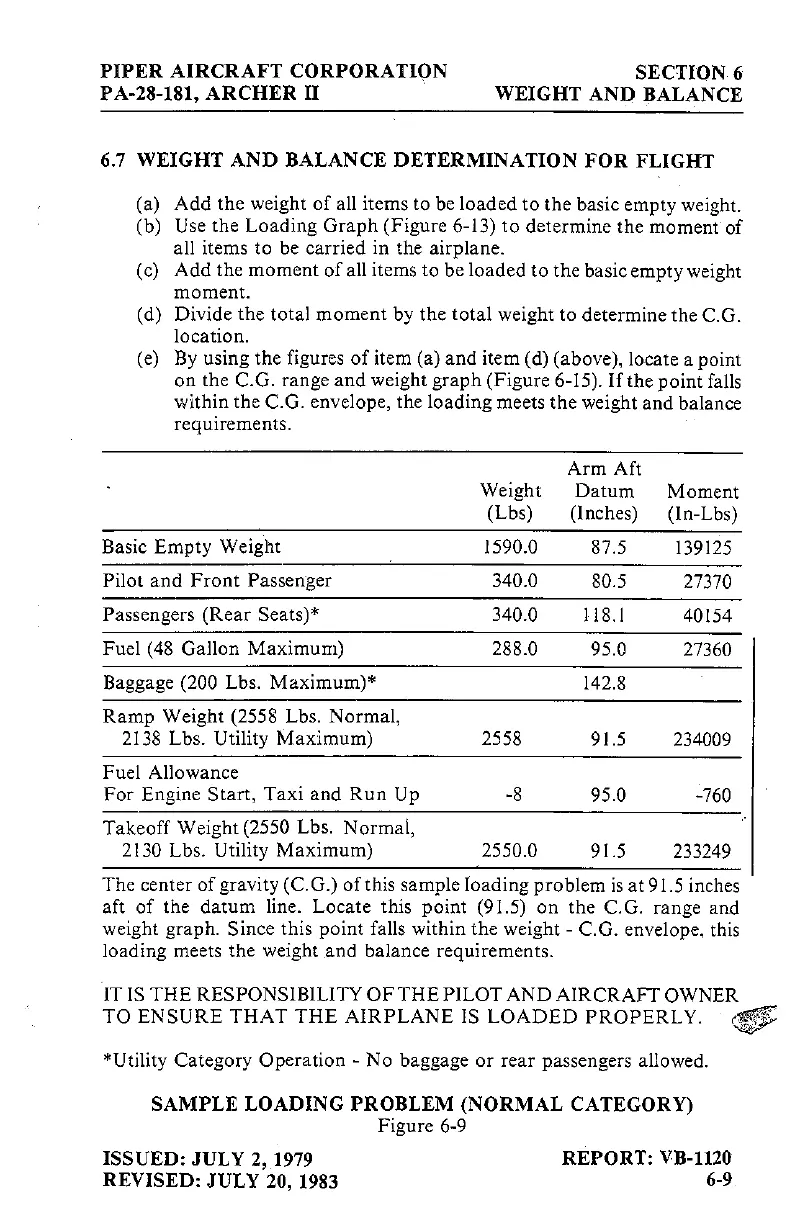
Piper ARCHER II - Weight and Balance Determination for Flight

Piper ARCHER II
286 pages
Print Icon
To Next Page IconTo Next Page
To Previous Page IconTo Previous Page
Loading...
PIPER
AIRCRAFT
CORPORATION
SECTION
6
PA-28-181,
ARCHER
II
WEIGHT
AND
BALANCE
6.7
WEIGHT
AND
BALANCE
DETERMINATION
FOR
FLIGHT
(a)
Add
the
weight
of
all
items
to
be
loaded
to
the
basic
empty
weight.
(b)
Use
the
Loading
Graph
(Figure
6-13)
to
determine
the
moment
of
all
items
to
be
carried
in
the
airplane.
(c)
Add
the
moment
of
all
items
to
be
loaded
to
the
basic
empty
weight
moment.
(d)
Divide
the
total
moment
by
the
total
weight
to
determine
the
C.G.
location.
(e)
By
using
the
figures
of
item
(a)
and
item
(d)
(above),
locate
a
point
on
the
C.G.
range
and
weight
graph
(Figure
6-15).
If
the
point
falls
within
the
C.G.
envelope,
the
loading
meets
the
weight
and
balance
requirements.
-
Arm
Aft
Weight
Datum
Moment
(Lbs)
(Inches)
(In-Lbs)
Basic
Empty
Weight
.
1590.0
87.5
139125
Pilot
and
Front
Passenger
340.0
80.5
27370
Passengers
(Rear
Seats)*
340.0
118.1
40154
Fuel
(48
Gallon
Maximum)
288.0
95.0
27360
Baggage
(200
Lbs.
Maximum)*
142.8
Ramp
Weight
(2558
Lbs.
Normal,
2138
Lbs.
Utility
Maximum)
2558
91.5
234009
Fuel
Allowance
For
Engine
Start,
Taxi
and
Run
Up
-8
95.0
-760
Takeoff
Weight
(2550
Lbs.
Normal,
2130
Lbs.
Utility
Maximum)
2550.0
91.5
233249
The
center
of
gravity
(C.G.)
of
this
sample
loading
problem
is
at
91.5
inches
aft
of
the
datum
line.
Locate
this
point
(91.5)
on
the
C.G.
range
and
weight
graph.
Since
this
point
falls
within
the
weight
-
C.G.
envelope,
this
loading
meets
the
weight
and
balance
requirements.
IT
IS
THE
RESPONSIBILITY
OF
THE
PILOT
AND
AIRCRAFT
OWNER
TO
ENSURE
THAT
THE
AIRPLANE
IS
LOADED
PROPERLY.
©
a&
*Utility
Category
Operation
-
No
baggage
or
rear
passengers
allowed.
SAMPLE
LOADING
PROBLEM
(NORMAL
CATEGORY)
Figure
6-9
ISSUED:
JULY
2,
1979
REPORT:
VB-1120
REVISED:
JULY
20,
1983
6-9.

Table of Contents