EasyManua.ls Logo

Piper ARCHER II - Stalls; Turbulent Air Operation

Piper ARCHER II
286 pages
Print Icon
To Next Page IconTo Next Page
To Previous Page IconTo Previous Page
Loading...
PIPER
AIRCRAFT
CORPORATION
SECTION
4
PA-28-181,
ARCHER
II
NORMAL
PROCEDURES
Tie
downs
can
be
secured
to
rings
provided
under
each
wing
and
to
the
tail
skid.
The
rudder
is
held
in
position
by
its
connections
to
the
nose
wheel
steering
and
normally
does
not
have
to
be
secured.
4.37
STALLS”
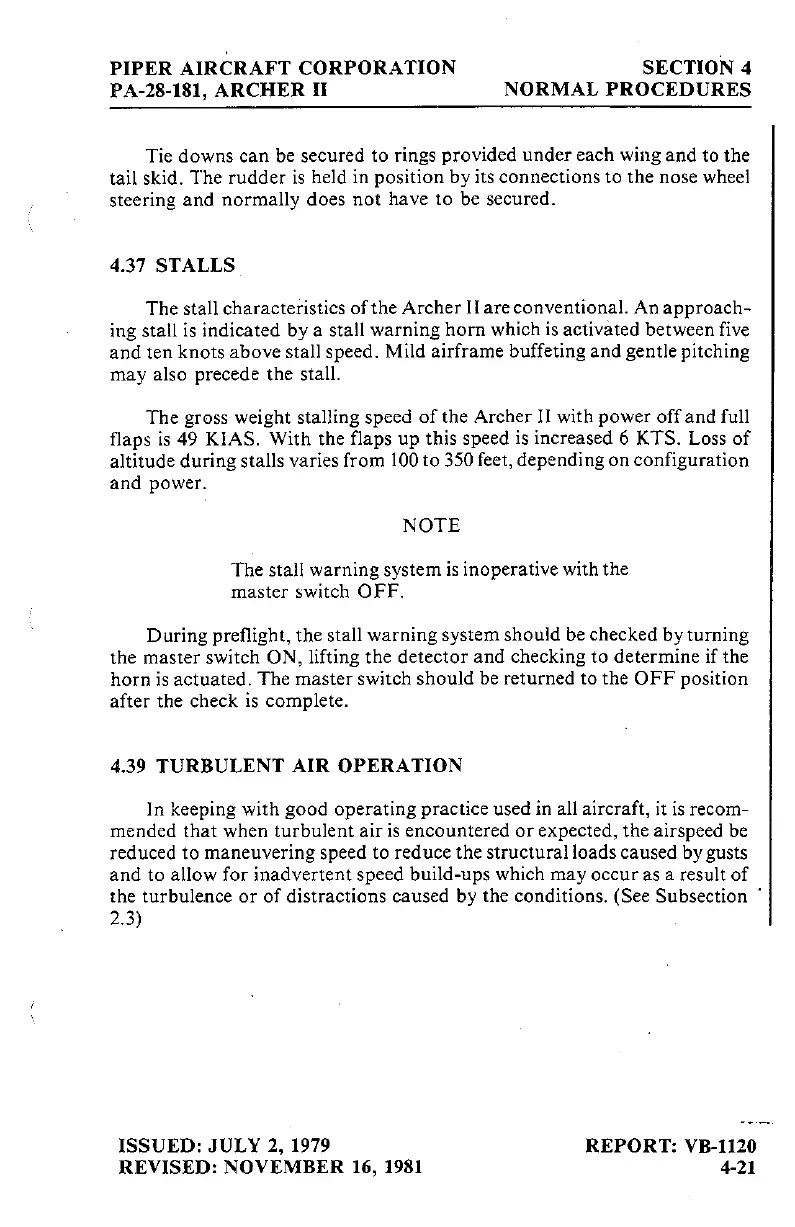
The
stall
characteristics
of
the
Archer
I]
are
conventional.
An
approach-
ing
stall
is
indicated
by
a
stall
warning
horn
which
is
activated
between
five
and
ten
knots
above
stall
speed.
Mild
airframe
buffeting
and
gentle
pitching
may
also
precede
the
stall.
The
gross
weight
stalling
speed
of
the
Archer
II
with
power
off
and
full
flaps
is
49
KIAS.
With
the
flaps up
this
speed
is
increased
6
KTS.
Loss
of
altitude
during
stalls
varies
from
100
to
350
feet,
depending
on
configuration
and
power.
NOTE
The
stall
warning
system
is
inoperative
with
the
master
switch
OFF.
During
preflight,
the
stall
warning
system
should
be
checked
by
turning
the
master
switch
ON,
lifting
the
detector and
checking
to
determine
if
the
horn
is
actuated.
The
master
switch
should
be
returned
to
the
OFF
position
after
the
check
is
complete.
4.39
TURBULENT
AIR
OPERATION
In
keeping
with
good
operating
practice
used
in
all
aircraft,
it
is
recom-
mended
that
when
turbulent
air
is
encountered
or
expected,
the
airspeed
be
reduced
to
maneuvering
speed
to
reduce
the
structural
loads
caused
by
gusts
and
to
allow
for
inadvertent
speed
build-ups
which
may
occur
as
a
result
of
the
turbulence
or of
distractions
caused
by
the
conditions.
(See
Subsection
°
2.3)
ISSUED:
JULY
2,
1979
REPORT:
VB-1120
REVISED:
NOVEMBER
16,
1981
4-21

Table of Contents

Related product manuals