EasyManua.ls Logo

Piper CHEROKEE 180 - Engine Stopping Procedure

Piper CHEROKEE 180
73 pages
Print Icon
To Next Page IconTo Next Page
To Previous Page IconTo Previous Page
Loading...
CHEROKEE
180 SECTION
III
Operation
of the
engine
driven
fuel
pump
should
be
checked while
taxiing
or
during
pretake-off
engine run up
by
switching
off
the electric
fuel pump
and
observing fuel
pressure.
The electric
fuel
pump
should
be
on during
take-off
to
prevent
loss of
power
should the engine driven
pump
fail.
The
engine
is
warm
enough
for
take-off
when the throttle
can be opened without
the engine
faltering.
For
air conditioner ground
check
refer
to
page
30.
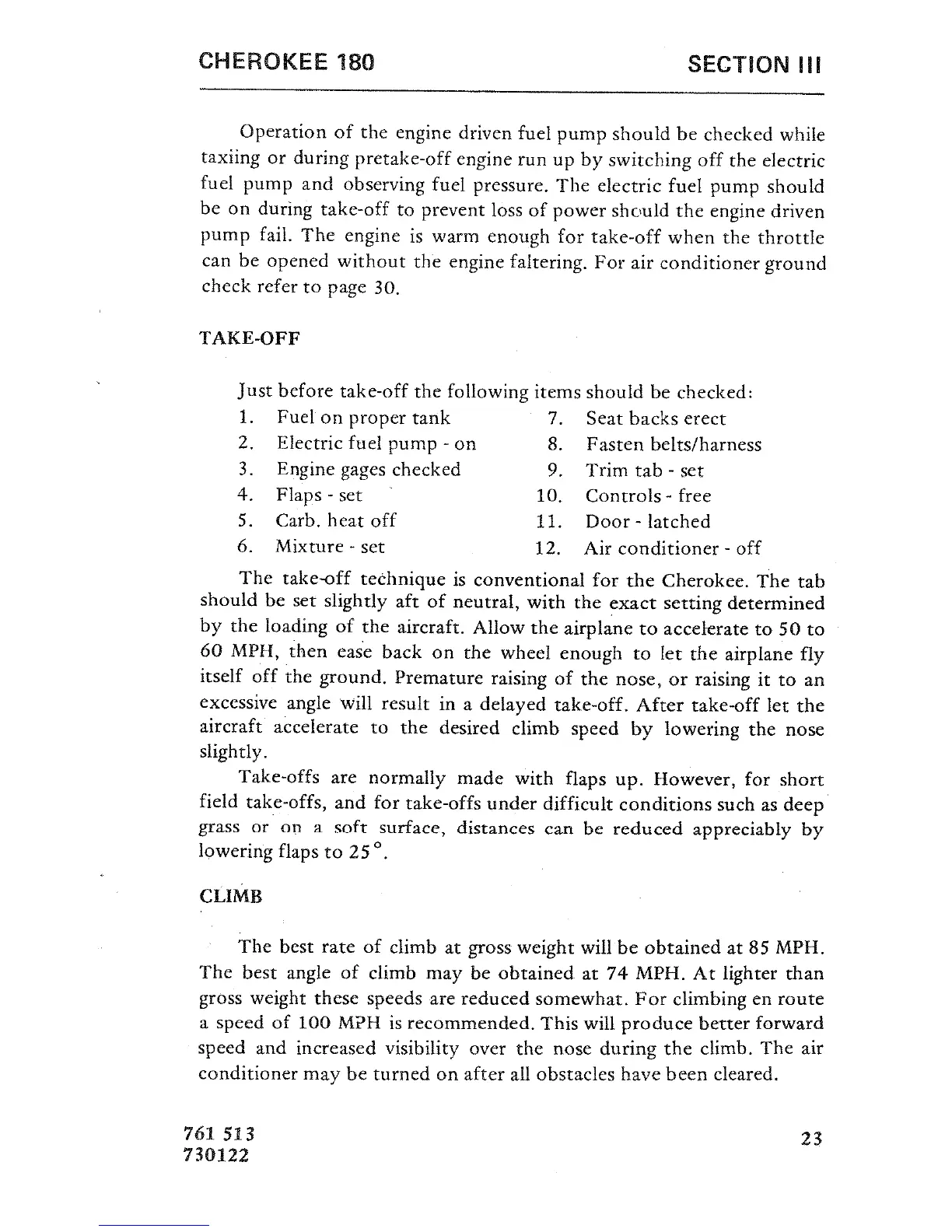
TAKE-OFF
Just
before
take-off
the
following
items should be
checked:
1.
Fuel
on
proper
tank
7.
Seat
backs
erect
2. Electric fuel pump
-
on
8.
Fasten
belts/harness
3. Engine gages checked
9.
Trim
tab
-
set
4.
Flaps
-
set
10. Controls
-
free
5. Carb. heat
off
11.
Door
-
latched
6. Mixture
-
set
12.
Air conditioner
-
off
The
take<>ff
technique
is
conventional for the
Cherokee.
The tab
should be set
slightly aft of
neutral,
with
the
exact
setting
determined
by
the
loading of
the
aircraft.
Allow the airplane
to
accelerate
to
50 to
60
MPH, then ease
back on the
wheel
enough to let
the airplane fly
itself
off
the
ground. Premature
raising
of the
nose,
or
raising
it
to an
excessive
angle
will
result
in
a
delayed
take-off.
After
take-off
let
the
aircraft accelerate to the
desired
climb speed
by lowering
the
nose
slightly.
Take-offs
are
normally made with
flaps
up. However,
for
short
field
take-offs,
and
for
take-offs
under difficult
conditions such as
deep
grass or
on a
soft
surface,
distances
can
be
reduced
appreciably by
lowering flaps
to
25°.
CLIMB
The
best rate
of
climb
at
gross
weight
will be
obtained
at
85
MPH.
The best angle of
climb may
be
obtained at 74
MPH. At
lighter
than
gross
weight these
speeds
are
reduced
somewhat. For
climbing
en
route
a
speed
of
100 MPH
is
recommended.
This will
produce better
forward
speed and increased visibility
over the
nose
during
the
climb.
The air
conditioner
may
be turned on
after
all
obstacles have
been cleared.
761
513
23
730122

Table of Contents

Related product manuals