3.1 Overview:
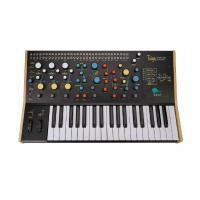
The Pittsburgh Modular Taiga Keyboard Synthesizer combines the functionality of many modular synthesizer modules behind
a single panel. Connect different functions using patch cables to create complex sounds and textures.
The Taiga Keyboard signal path is divided into two types of signals: audio signals and control voltages. The audio signal is
the sound that is produced. The audio signal path starts at an oscillator or other sound source. The audio signal is then
patched through other functions used to shape the sound such as a lter or dynamics module.
Control voltages (CV) manipulate the audio signal in several different ways. Gates are represented by a high (5 volts) or low
(<= 0 volts) control voltage. A gate can be generated using a pulse or square wave from an oscillator or modulation source,
or by using the MIDI gate or clock output. A gate can be shaped using an ADSR to control the attack, decay, sustain, and
release of the gate. The modied gate signal can then be sent to any CV input on Taiga.
A second use for control voltages is as a modulation source. For example, a control voltage from the [MIDI Pitch Output]
jack patched into the [Filter Freq CV 1 Input] jack on the lter module controls the cutoff frequency of the lter based on the
midi note received. The LFO provides a separate low frequency oscillator that makes a perfect control voltage modulation
source. Audio rate modulation signals also make a great CV source for oscillator FM (frequency modulation).
Taiga Keyboard uses Eurorack standard 1/8” mono jacks for all the patch points.
The Taiga Keyboard interface does not distinguish between audio and control voltage signals. In theory, any output can be
patched into any input. In practice, inputs respond best when patched to the expected signal type. However,
experimentation can yield surprising results. The type of signal input and output of each jack is covered in the
corresponding section.
3 Taiga Keyboard Overview


 To Next Page