cabinet design, wide dispersion, ultra-low distortion, and smooth bass
roll-off, PMC loudspeakers are more forgiving of difcult room conditions and placement
constraints than conventional designs – you will be able to achieve a superb sound throughout
the room with little effort. However, we encourage you to spend some time experimenting in
your own room to achieve the very best results, remembering that small changes in location
can often inuence system performance signicantly. The following guidelines are suggestions
for a starting point to locate your new loudspeakers. Fine-tuning of their positioning can start
from there.
Dispersion and Toeing-in
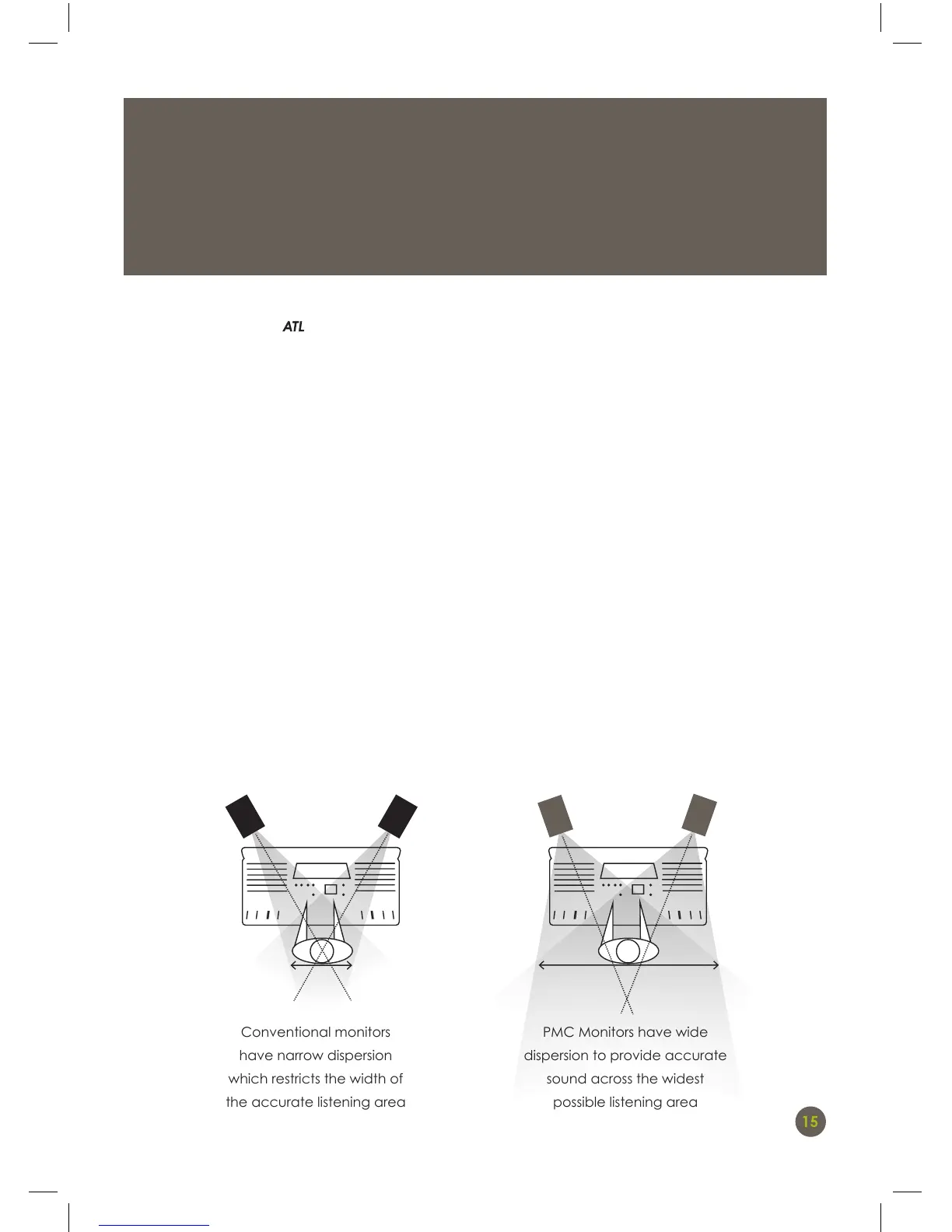
Most loudspeakers have a relatively narrow dispersion and are designed to be aimed directly
at the listening position, as shown in the left-hand image below. However, the excellent
stereo imaging which PMC monitors are known for is due, in part, to their wide dispersion
characteristic, as shown on the right-hand image. To optimise the stereo imaging, PMC
monitors should be angled so that their axes cross about 0.5 metres (2ft) behind the listening
position (as illustrated below). Varying the ‘toe-in’ angle to adjust the actual point at
which the speaker axes crossover will subtly affect the vividness of the audio soundstage.
Conventional monitors
have narrow dispersion
which restricts the width of
the accurate listening area
PMC Monitors have wide
dispersion to provide accurate
sound across the widest
possible listening area


 To Next Page