EasyManua.ls Logo

Porter-Cable 630 - Using the Router

Porter-Cable 630
20 pages
Print Icon
To Next Page IconTo Next Page
To Previous Page IconTo Previous Page
Loading...
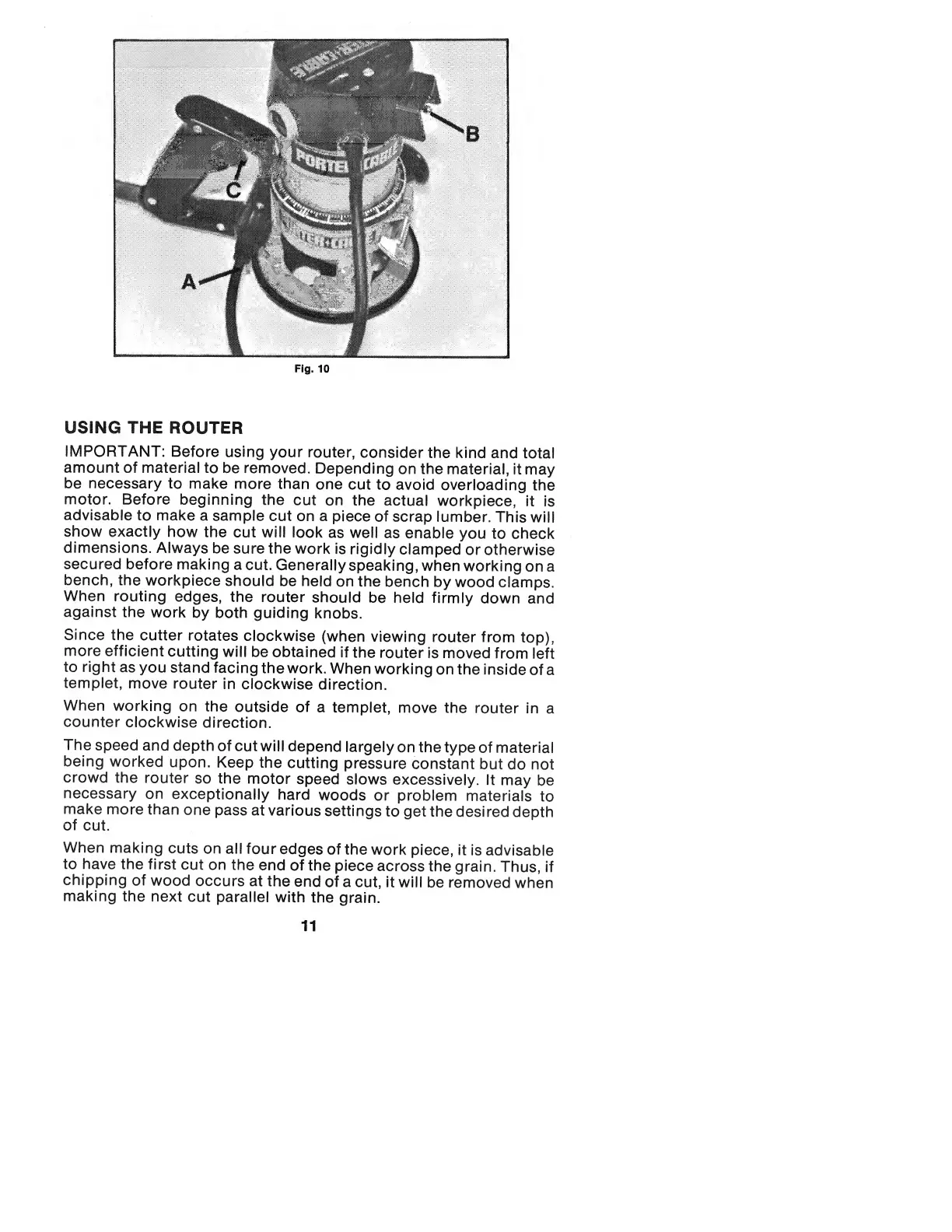
Fig.
10
USING
THE
ROUTER
IMPORTANT:
Before
using
your
router,
consider
the
kind
and
total
amount
of
material
to
be
removed.
Depending
on
the
material,
it
may
be
necessary
to
make
more
than
one
cut
to
avoid
overloading
the
motor.
Before
beginning
the
cut
on
the
actual
workpiece,
it
is
advisable
to
make
a
sample
cut
on
a
piece
of
scrap
lumber.
This
will
show
exactly
how
the
cut
will
look
as
well
as
enable
you
to
check
dimensions.
Always
be
sure
the
work
is
rigidly
clamped
or
otherwise
secured
before
making
a
cut.
Generally
speaking,
when
working
on
a
bench,
the
workpiece
should
be
held
on
the
bench
by
wood
clamps.
When
routing
edges,
the
router
should
be
held
firmly
down
and
against
the
work
by
both
guiding
knobs.
Since
the
cutter
rotates
clockwise
(when
viewing
router
from
top),
more
efficient
cutting
will
be
obtained
if
the
router
is
moved
from
left
to
right
as
you
stand
facing
the
work.
When
working
on
the
inside
of
a
templet,
move
router
in
clockwise
direction.
When
working
on
the
outside
of
a
templet,
move
the
router
in
a
counter
clockwise
direction.
The
speed
and
depth
of
cut
will
depend
largely
on
the
type
of
material
being
worked
upon.
Keep
the
cutting
pressure
constant
but
do
not
crowd
the
router
so
the
motor
speed
slows
excessively.
It
may
be
necessary
on
exceptionally
hard
woods
or
problem
materials
to
make
more
than
one
pass
at
various
settings
to
get
the
desired
depth
of
cut.
When
making
cuts
on
all
four
edges
of
the
work
piece,
it
is
advisable
to
have
the
first
cut
on
the
end
of
the
piece
across
the
grain.
Thus,
if
chipping
of
wood
occurs
at
the
end
of
a
cut,
it
will
be
removed
when
making
the
next
cut
parallel
with
the
grain.
11

Related product manuals