EasyManua.ls Logo

Porter-Cable CF1540 - Description of Operation

Porter-Cable CF1540
36 pages
Print Icon
To Next Page IconTo Next Page
To Previous Page IconTo Previous Page
Loading...
DESCRIPTION
OF
OPERATION
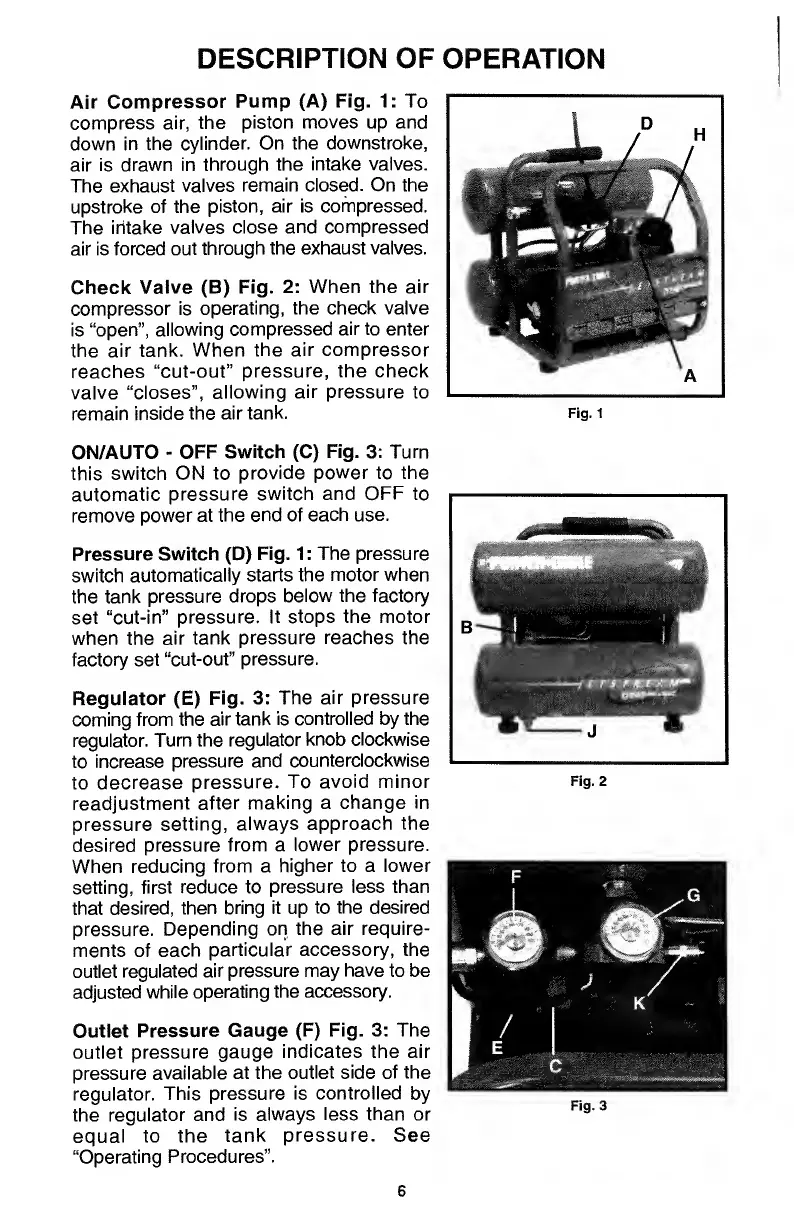
Air
Compressor
Pump
(A)
Fig.
1:
To
compress
air,
the
piston
moves
up
and
down
in
the
cylinder.
On
the
downstroke,
air
is
drawn
in
through
the
intake
valves.
The
exhaust
valves
remain
closed.
On
the
upstroke
of
the
piston,
air
is
compressed.
The
intake
valves
close
and
compressed
air
is
forced
out
through
the
exhaust
valves.
Check
Valve
(B)
Fig.
2:
When
the
air
compressor
is
operating,
the
check
valve
is
“open”,
allowing
compressed
air
to
enter
the
air
tank.
When
the
air
compressor
reaches
“cut-out”
pressure,
the
check
valve
“closes”,
allowing
air
pressure
to
remain
inside
the
air
tank.
Fig.
1
ON/AUTO
-
OFF
Switch
(C)
Fig.
3:
Turn
this
switch
ON
to
provide
power
to
the
automatic
pressure
switch
and
OFF
to
remove
power
at
the
end
of
each
use.
Pressure
Switch
(D)
Fig.
1
:
The
pressure
switch
automatically
starts
the
motor
when
the
tank
pressure
drops
below
the
factory
set
“cut-in”
pressure.
It
stops
the
motor
when
the
air
tank
pressure
reaches
the
factory
set
“cut-out”
pressure.
Regulator
(E)
Fig.
3:
The
air
pressure
coming
from
the
air
tank
is
controlled
by
the
regulator.
Turn
the
regulator
knob
clockwise
to
increase
pressure
and
counterclockwise
to
decrease
pressure.
To
avoid
minor
readjustment
after
making
a
change
in
pressure
setting,
always
approach
the
desired
pressure
from
a
lower
pressure.
When
reducing
from
a
higher
to
a
lower
setting,
first
reduce
to
pressure
less
than
that
desired,
then
bring
it
up
to
the
desired
pressure.
Depending
on
the
air
require¬
ments
of
each
particular
accessory,
the
outlet
regulated
air
pressure
may
have
to
be
adjusted
while
operating
the
accessory.
Outlet
Pressure
Gauge
(F)
Fig.
3:
The
outlet
pressure
gauge
indicates
the
air
pressure
available
at
the
outlet
side
of
the
regulator.
This
pressure
is
controlled
by
the
regulator
and
is
always
less
than
or
equal
to
the
tank
pressure.
See
“Operating
Procedures”.
Fig.
2
Fig.
3
6

Related product manuals