6
crystalline silica from bricks and cement
and other masonry products, and arsenic
lumber (CCA).
Your risk from these exposures varies,
depending on how often you do this
type of work. To reduce your exposure
to these chemicals: work in a well
ventilated area, and work with approved
safety equipment, such as those dust
masks that are specially designed to
filter out microscopic particles.
• Avoid prolonged contact with
dust from power sanding, sawing,
grinding, drilling, and other
construction activities. Wear
protective clothing and wash
exposed areas with soap and water.
Allowing dust to get into your mouth,
eyes, or lay on the skin may promote
absorption of harmful chemicals.
WARNING: Use of this tool can
generate and/or disburse dust, which may
cause serious and permanent respiratory
or other injury. Always use NIOSH/OSHA
approved respiratory protection
appropriate for the dust exposure. Direct
particles away from face and body.
Always operate tool in well-ventilated area
and provide for proper dust removal. Use
dust collection system wherever possible.
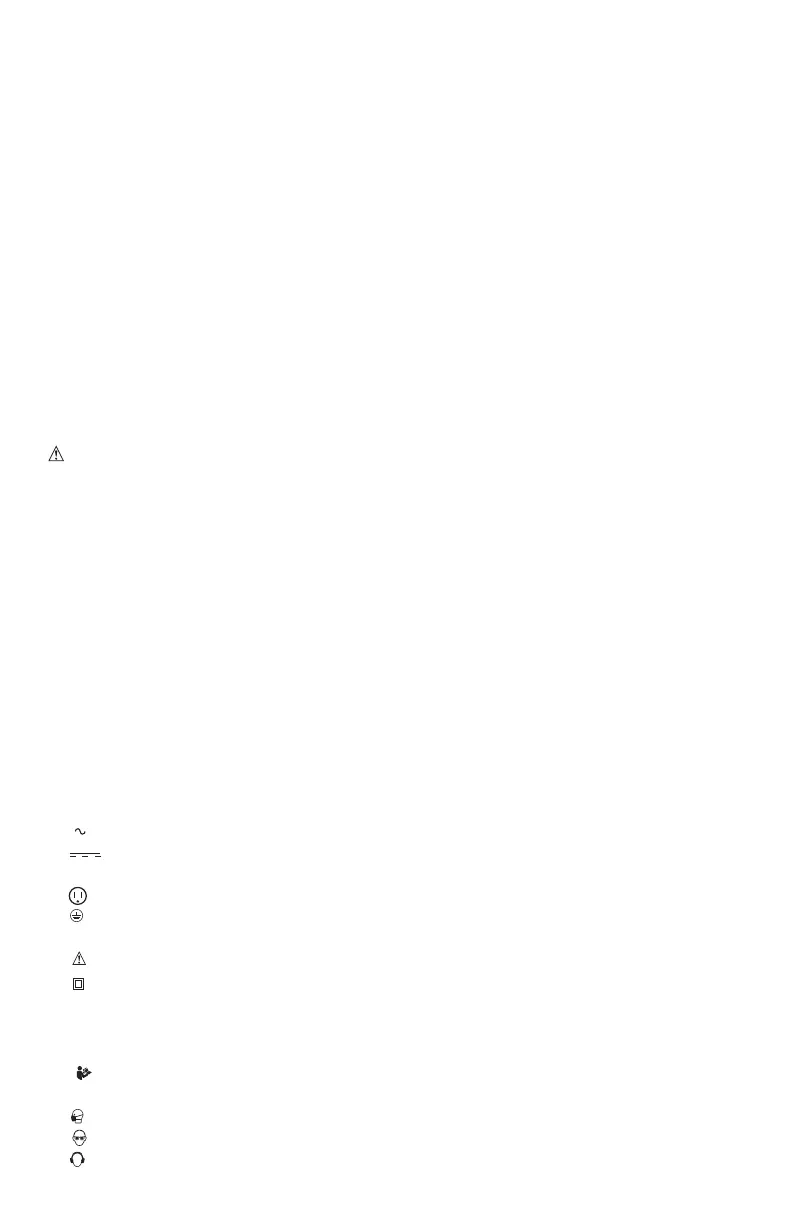
SYMBOLS
following symbols. The symbols and their
definitions are as follows:
V ..................volts
A ..................amperes
Hz ................hertz
W .................watts
min ..............minutes
or AC ...... alternating current
or DC ..direct current
n
o ................no load speed
................Class I Construction
................earthing terminal
(grounded)
................ safety alert symbol
................Class II Construction
.../min or rpm ...revolutions or reciprocations
(double insulated)
per minute
...........Read instruction manual
before use
.................... Use proper respiratory protection
................Use proper eye protection
.................. Use proper hearing protection
To Reduce the Risk of
Kickback
at all times.
the material is cut and weakens, it will
sag, causing a pinched blade.
Fig. E).
Material supported only at the ends (Fig.
D) will lead to blade pinching.
and will pinch blade.
clamped (figure G) and solidly supported
and balanced on a strong, stable and
level work surface. Support the work so
that the wide portion of the saw shoe is on
the portion of the material that doesn’t fall
after the cut is made. Never hold cut off
piece by hand (figure F)
ripping. Be careful as the cut off strip can
sag or twist, closing the cut and pinching
knots, hardness, toughness, wetness,
pressure treated and freshly cut green
lumber can heavily load the saw which
can lead to stalling. Push the saw slower
when this occurs.
while the blade is moving.
blade contacts material to be cut.
Starting the saw with the blade against
the work or pushed forward into cut can
lead to stalling or sudden backward
movement of saw.
a bevel cut. This leads to blade binding
and stalling.
workpiece movement during cut.
your cut begins to go off line. This can
from cut and start a new cut on the line.
one tooth of the blade projects below the
workpiece as shown in (figure I).
cut. Twisting the saw can cause the back
edge of the blade to dig into the material,
climb out of the work and run back toward
the operator.
remove all nails from lumber before
cutting.



 To Next Page