LOWER BLADE GUARD
WARNING: Laceration Hazard. The
lower blade guard is a safety feature
which reduces the risk of serious
personal injury. Never use the saw if the
lower guard is missing, damaged, mis-
assembled or not working properly. Do
not rely on the lower blade guard to
protect you under all circumstances.
Your safety depends on following all
warnings and precautions as well as
proper operation of the saw. Check
lower guard for proper closing before
each use as outlined in Additional
Safety Rules for Circular Saws. If the
lower blade guard is missing or not
working properly, have the saw serviced
before using. To assure product safety
and reliability, repair, maintenance and
adjustment should be performed by an
authorized service center or other
qualified service organization, always
using identical replacement parts.
WARNING: To minimize the risk of
eye injury, always use eye protection.
Carbide is a hard but brittle material.
Foreign objects in the work piece such as
wireGor nails can cause tips to crack or
break. Only operate saw when proper saw
blade guard is in place. Mount blade
securely in proper rotation before using, and
always use a clean, sharp blade.
WARNING: To reduce the risk of
injury, It is important to support the
work properly and to hold the saw firmly
to prevent loss of control which could
cause personal injury. Figure G
illustrates typical hand support.
OPERATING INSTRUCTIONS
WARNING: To reduce the risk of
serious personal injury, read,
understand and follow all important
safety warnings and instructions prior
to using tool.
BLADE SELECTION
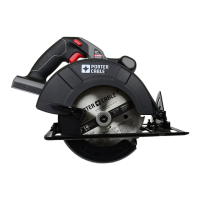
Your circular saw is designed for use
with 5-1/2 inch (140 mm) diameter
blades that have a 3/8 inch (10 mm)
diameter bore. Blades must be rated for
6000 RPM operation (or higher). DO NOT
use any abrasive wheels.
GENERAL CUTS
WARNING: To reduce the risk of
injury
, remove the battery, and follow all
assembly, adjustment and set up
instructions.
Make sure lower guard operates. Select the
proper blade for the material to be cut.
Safety Rules and Instructions).
equipment (See Safety Rules).
Safety Rules).
turns saw on and off.
SWITCH
feature to prevent unintentional operation.
off button (2) from either side of the saw
and hold it in as you depress the trigger
switch (1).
button. The tool will continue to run as
long as the trigger is depressed.
NOTE: This tool has no provision for
locking the tool on, and the switch should
never be locked on by any other means.
AUTOMATIC ELECTRIC BRAKE
Your saw is equipped with an electric blade
brake which stops the saw blade within
automatic and requires no adjustment.
SAWING
WARNING: To reduce the risk of
serious personal injury,always hold the tool
with both hands.
before starting the cut.
while performing the cut.
workpiece.
HINTS FOR OPTIMUM USE
cut on the top side of the workpiece
cannot be avoided, cut on the side where
splintering is acceptable.
when cutting laminates, clamp a piece of
plywood onto the top of the workpiece.
POCKET CUTTING (FIG. M)
WARNING: Never tie the blade guard
in a raised position. Never move the saw
backwards when pocket cutting. This
may cause the unit to raise up off the
work surface which could cause injury.
A pocket cut is one that is made when the
edge of the material does not push the
lower guard open, but the bottom edge of
the rotating blade cuts into the middle of
the material.
12



 To Next Page