17 - ENG
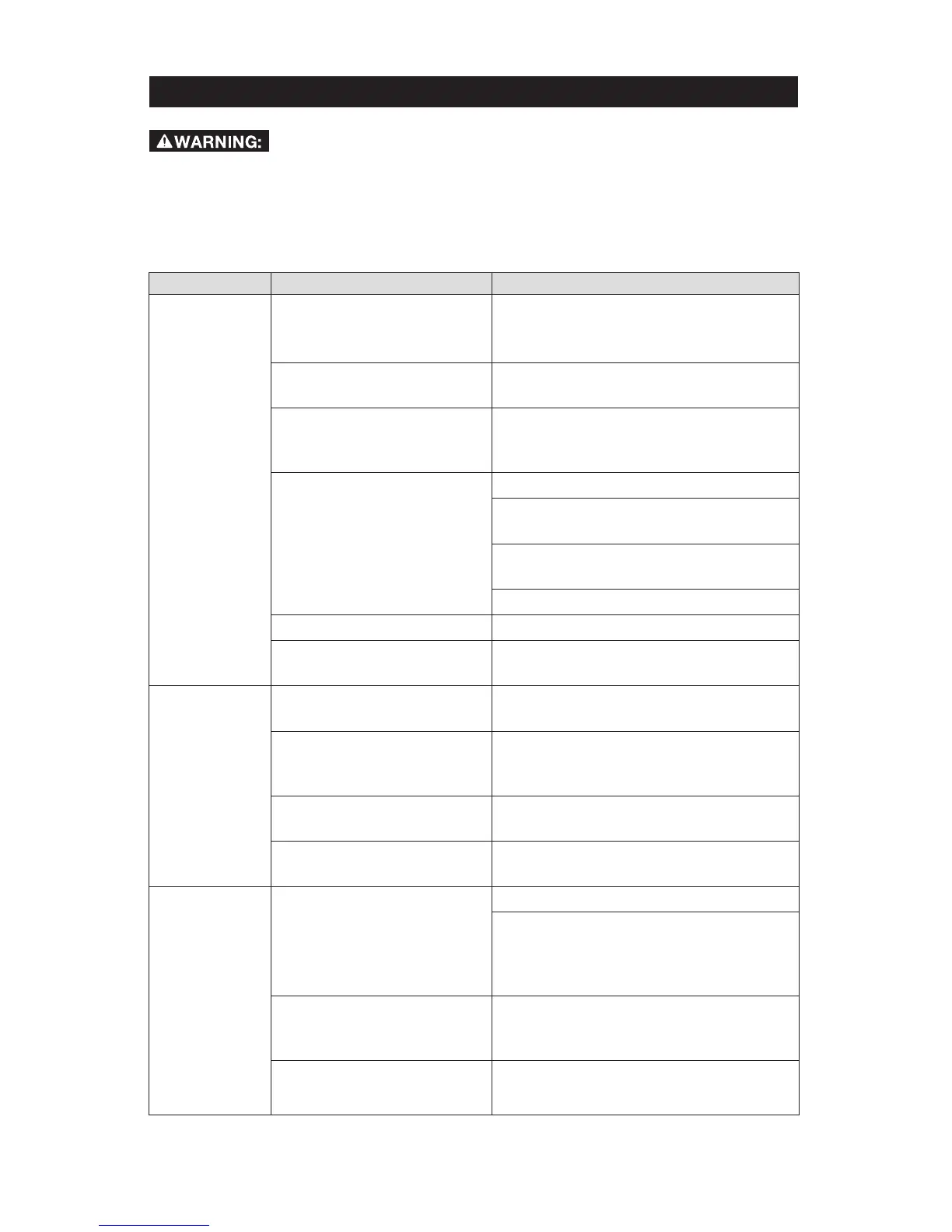
TROUBLESHOOTING
Risk of Unsafe Operation. Unit cycles automatically when
power is on. When servicing, you may be exposed to voltage sources, com-
pressed air, or moving parts. Before servicing unit unplug or disconnect elec-
trical supply to the air compressor, bleed tank of pressure, and allow the air
compressor to cool.
Problem Possible Cause Solution
The compressor
does not run.
□ There is a loss of power or
the motor is overheated.
□ Check for proper use of extension cord.
□ There is no power to the
unit.
□ Check to be sure the unit is plugged in.
□ The circuit breaker has
tripped or a fuse has blown
at the main power source.
□ Check the fuse/breaker.
□ The thermal overload
protector is actuated.
□ Turn the air compressor OFF (O).
□ Unplug the air compressor and wait until
the compressor cools down.
□ Plug the air compressor into an approved
outlet.
□ Turn the air compressor AUTO (I).
□ The pressure switch is bad. □ Bring the compressor to a service center.
□ The compressor has reached
automatic shutoff pressure.
□ Release the air from the tank until the
compressor restarts automatically.
The motor hums
while running
slowly, or it does
not run at all.
□ There is low voltage from
the power source.
□ Call an electrician.
□ The wrong gauge wire or
length of extension cord is
being used.
□ Check for proper gauge wire and cord
length.
□ There is a shorted or open
motor wiring.
□ Bring the compressor to a service center.
□ There is a defective check
valve or unloader.
□ Bring the compressor to a service center.
The fuses blow
or circuit breaker
trips repeatedly.
□ The incorrect fuse type is
being used.
□ Check for the proper fuse.
□ Use a time-delay fuse. Disconnect other
electrical appliances from the circuit
or operate the compressor on its own
branch circuit.
□ The wrong gauge wire or
length of extension cord
is used.
□ Check for the proper gauge wire and
cord length.
□ There is a defective check
valve or unloader.
□ Bring the compressor to a service center.


 To Next Page