Page 89
WARNING:
Planned decompression diving requires additional training
and support equipment. NO NOT attempt to use a SE7EN
rebreather for decompression diving without proper training
and equipment! In particular, when diving with a SE7EN enabled
for decompression diving, it is the DIVER’S RESPONSIBILITY
to ensure access to an adequate supply of breathing gas to
effect a safe and controlled bailout to the surface, including full
decompression requirements!
Setpoint
A SE7EN enabled for decompression diving uses a different PO
2
setpoint algorithm. The intent
of the algorithm is to keep the setpoint higher for longer when a decompression ceiling has
been encountered during a dive. This comes at the cost of making buoyancy control more
difcult in shallow water. The algorithm will always use the highest setpoint (typically 1.3 bar),
subject to the following limitations:
1. The FO
2
is limited to 75%. Thus at the surface the setpoint would be 0.75 bar. At 3m the
setpoint would be 0.98 bar, and at 6m and greater the setpoint would be 1.3 bar (for a rig
with a 1.3 high setpoint value).
2. The hyperoxic linearity test still applies. Thus a rig that fails the hyperoxic linearity test will
not be allowed to use a setpoint > 1 bar. (See chapter 3, hyperoxic linearity test in the
SE7EN manual).
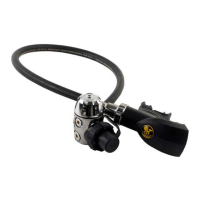
Open-Circuit Bailout
On a SE7EN that is not enabled for decompression diving, the system monitors the amount of
gas remaining in the diluent cylinder, and warns the diver when the calculated amount of
6. Decompression Diving with the SE7EN
A SE7EN enabled for decompression diving will behave differently compared to a SE7EN that
is not congured for decompression diving. Important changes in the functionality when a
diver approaches and enters decompression are:
• The ceiling indicator will not ash. It will just be on and not ashing. When the ceiling indi-
cator is on, the alert triangle will not be on.
• The rig will not issue an alarm (HUD & Buddy lights, Audio Alarm) when decompression is
entered.” There is no audio alarm when decompression is entered on a non-decompres-
sion conguration.
• When the mouthpiece is found to be in an indeterminate state (neither in Open-Circuit nor
Closed-Circuit position) a different audio alarm signal will alert the diver to correct the
mouthpiece position. The reason for this is that when the mouthpiece is in an indetermi-
nate position, decompression is calculated as though the diver is breathing in open-circuit
mode. The alarm helps prevent the diver from being penalized from a decompression
point of view.
Controlling Resource Algorithm (CRA)
A SE7EN enabled for decompression diving has a different controlling resource algorithm (CRA).
In a standard SE7EN, the remaining dive time is the minimum of remaining no-decompression
dive time (RNDT), Oxygen supply, Battery supply or OTU’s. What this means in practice for
most divers on most dives is that the remaining dive time is the RNDT.
For a decompression-enabled SE7EN, an RNDT of zero is permissible and will not generate an
alarm. Thus, after the RNDT reaches zero (i.e., when a decompression ceiling exists), the CRA
instead only takes into account the Oxygen Supply, Battery Supply, and OTU value when cal-
culating the remaining dive time.
While a decompression ceiling exists, the CRA is not displayed on the LCD screen, because
this part of the screen is used for the total decompression time (see chapter 3, dive proce-
dures in the SE7EN manual). However, the CRA is still calculated (excluding the RNDT value)
and used to generate alarms, if needed. Also, whenever a decompression ceiling exists, if the
TTS exceeds 80% of the CRA time (for any of the CRA values other than RNDT), an alarm will
alert the diver that the dive must be terminated.
diluent is insufcient to reach the surface. When using a SE7EN enabled for decompression
diving, the system assumes that the diver is carrying additional gas supplies for open-circuit
bailout, and therefore no warnings are given to the diver when the standad diluent supply is
insufcient to allow a safe open-circuit bailout to the surface.
Planning your CC Dive and OC bailout
For more comprehensive planning tool use the “WeDive” application which can be
used with iPhone and iPad. See AppStore for further information.



 To Previous Page