pletelyaroundtherearhandlewhether
youraredghthandedoNeffhanded.Keep
yourleftarmstraightwiththeelbow
locked
• Positionyourleft hand on the front handle-
bar so it is in a straight ltne w_th your right
hand on the rear handle when making
bucking cuts. Never reverse right and left
hand positions for any b/pe of cutting.
• Stand with your weight evenly balanced on
both feet.
• Stand slightly to the left side of the saw to
keep your body from being in a direct line
with the cutting chain.
• Do not overreach. You could be drawn or
thrown off balance and lose control of the
saw.
• Do not cut above shoulder height, it is diffi-
cuSt to maintain control of saw above
shoulder height.
KICKBACK SAFETY FEATURES
,li_ WARNING: Thefollowingfeatures
are included on your saw to help reduce the
hazard of kickback; however, such features
wilt not totalty eliminate this danger. As a
chain saw user, do not rely only on safety de-
vices. You must follow alt safety precau-
tions, instructions, and maintenance in this
manuaI to help avoid kickback and other
forces which can resuIt in serious injury.
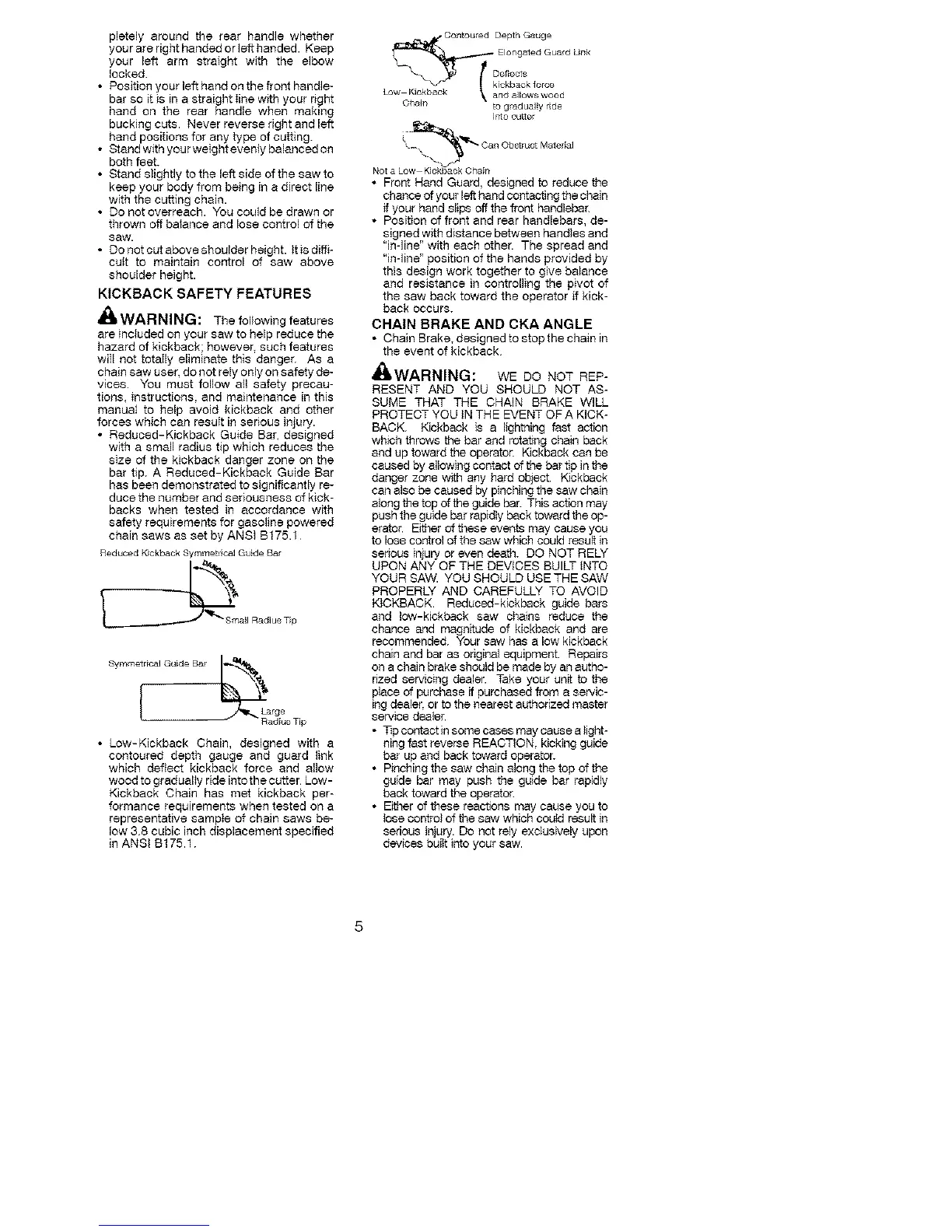
• Reduced-Kickback Guide Ba£ designed
with a small radius tip which reduces the
size of the kickback danger zone on the
bar tip. A Reduced-Kickback Guide Bar
has been demonstrated to significantly re-
duce the number and seriousness of kick-
backs when tested in accordance with
safety requirements for gasoline powered
chain saws as set by ANSI B175.1
ReducedKickbackSymmetricalGuideBar
• Low-Kickback Chain, designed with a
contoured depth gauge and guard link
which deftect kickback force and allow
wood to gradually ride into the cutter Low-
Kickback Chain has met kickback per-
formance requirements when tested on a
representative sampte of chain saws be-
low 3.8 cubic inch displacement specified
in ANSI 8175.1
Chair, to gradual!y ride
nlo cutter
• Front Hand Guard, designed to reduce the
chance of your left hand contacting the chain
if your hand slips oft the front handlebar.
• Position of front and rear handlebars, de-
signed w_th distance between handles and
"in-line" with each other. The spread and
"in-line" position of the hands provided by
this design work together to give balance
and resistance in controlling the pivot of
the saw back toward the operator if kick-
back occurs.
CHAIN BRAKE AND CKA ANGLE
• Chain Brake, designed to stop the chain in
the event of kickback
,_I_WARNING: WE DO NOT REP-
RESENT AND YOU SHOULD NOT AS-
SUME THAT THE CHAIN BRAKE WILL
PROTECT YOU IN THE EVENT OPA KICK-
BACK. Kickback is a lightning fast action
which throws the bar and rotating chain back
and up toward the operator. Kickback can be
caused by allowing contact of the bar tip in time
danger zone with any hard object Kickback
can also be caused by pinching the saw chain
along the top of the guide baE This action may
push the guide bar rapidly back toward the op-
erator. Either of these events may cause you
to lose control of the saw which could result in
serious injury or even death. DO NOT RELY
UPON ANY OF THE DEVICES BUILT iNTO
YOUR SAW. YOU SHOULD USE THE SAW
PROPERLY AND CAREFULLY TO AVOID
KICKBACK. Reduced-kickback guide bars
and low-kickback saw chains reduce the
chance and magn_ude of kickback and are
recommended. Your saw has a low kickback
chain and bar as edgina_ equipment. Repairs
on a chain brake should be made by an autho-
rized servicing dealer. Take your unit to the
place of purchase if purchased from a servic-
ing dealer, or to the nearest authorized master
service dealer.
• _p contact in some cases may cause a light-
ning fast reverse REACTION, kicking guide
bar up and back toward operator.
• Pinching the saw chain along the top of the
guide bar may push the guide bar rapidly
back toward the operator
• Either of these reactions may cause you to
lose control of the saw which could result in
serious injury. Do not rely exc}usively upon
devices built into your saw.


 To Next Page
 Loading...