D:\manual\UM_PCM-BNT\661-BT1K-000.doc
- 5 -
3.6 Silence:
When UPS is under “BACKUP” mode, press power switch more than 1
second to silence the audible alarm. (The function is disable when UPS is under
condition of “LOW BATTERY” or “OVERLOAD”)
3.7 Self test function:
Press power switch while utility power is connected, UPS will
perform self-test procedure automatically.
4. A
LARM
4.1 “BACKUP” (slow alarm):
When the UPS is working under “BACKUP” mode,
the UPS would emit audible alarm. The alarm stops when the UPS is return to “LINE”
mode operation.
Attention:
The alarm of “BACKUP” is going to beep every 2 seconds. (Slow-speed
beep).
Attention:
The UPS provides mute function for the warning. When the beeping sound
occurs, press "ON" to stop it; and press "ON" again to regain the sound.
4.2 “LOW BATTERY” (rapid alarm):
In the “BACKUP” mode, when the energy of
battery becomes to lower level. (about 20%~30%) The UPS beeps rapidly until the
UPS shuts down from battery exhaustion or returns to “LINE” mode operation.
Attention:
The alarm of the batteries caused by low voltage beeps every 0.5 second.
Attention:
The rapid alarm under “LOW BATTERY” condition cannot be muted.
4.3 “OVER LOAD” (continuous alarm):
When the UPS is working under
overload condition (the connected loads exceed the maximum rated capacity), the UPS
will emit continuous alarm to warn an overload condition. In order to protect the unit
and the loads, the UPS will be automatically turn off. Please disconnect nonessential
devices from UPS to eliminate the overload alarm.
5.
S
OFTWARE AND
I
NTERFACE
P
ORT
5.1 Power Monitoring Software
The UPS-MON series software (or other power monitoring software) is applied
standard RS-232 interface to perform monitoring functions, and then provides an
orderly shutdown of a computer in the event of power failure. Moreover, UPS-MON
displays all the diagnostic symptoms on monitor, such as Voltage, Frequency, Battery
level and so on. The software is available for DOS, Windows 3.1x, Windows 95,
Windows 98, Windows NT V3.5 or later, Novell Netware, Linux, and others. Call your
dealer for more information on computer OS compatible solutions.
D:\manual\UM_PCM-BNT\661-BT1K-000.doc
- 6 -
5.2 Interface Kits
A series of interface kits is available for operation systems that provide UPS monitoring.
Each interface kit includes the special interface cable required to convert status signals
from the UPS into signals which individual operating system recognizes. The interface
cable at UPS side must be connected to REMOTE PORT, at computer side can be
either COM 1 or COM 2. The other installation instructions and powerful features
please refer to READ.ME file.
z
zz
z
CAUTION
:
Use only factory supplied or authorized UPS monitoring cable!
5.3 The characteristics of computer interface port
The computer interface port has the following characteristics:
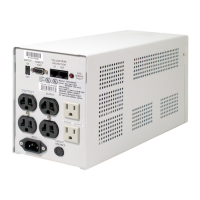
The communication port on the back of the UPS may be connected to host computer.
This port allows the computer to monitor the status of the UPS and control the
operation of the UPS in some cases. Its major functions normally include some or all
of the following:
To broadcast a warning when power fails.
To close any open file before the battery is exhausted.
To turn-off the UPS.
Some computers are equipped with a special connector to link with the communication
port. In addition, special plug-in cord may be needed. Some computers may need
special UPS monitoring software. Contact your dealer for the details on the various
interface Kits.


 To Next Page
 Loading...