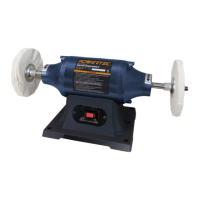
6. Thread the arbor nut onto the shaft to secure the
buffing wheel in place. NOTE: The left hand arbor hex
nut is left hand threaded and is installed by rotating it
counterclockwise onto the threaded shaft. The right hand
arbor hex nut is right hand threaded and is installed by
rotating it clockwise onto the shaft.
7. Repeat the steps to assemble the second buffing wheel.
PERMANENT MOUNTING
Refer to Figure 3
Mounting hardware or stand are sold separately
CAUTION
To avoid serious injury, the buffer MUST be permanently
mounted to a work surface or temporarily clamped to a table,
stand or board/plywood. If clamps are used, make sure the
clamps do not interfere with the buffing wheels, the movement of
the user or the material during use.
Use the mounting holes in the base of the machine to firmly
attach the buffer to a solid work surface or stand. The two
mounting holes are 7/16" in diameter and 7‑3/4" apart.
Figure 3
POWER SOURCE
WARNING
Do not connect to the power source until the machine is
completely assembled.
The machine is wired for 120 volts, 60 HZ alternating current.
Before connecting the machine to the power source, make sure
the switch is in the “OFF” position. Running the unit on voltages
which are not within range may cause overheating and motor
burn‑out. Heavy loads require that voltage at motor terminals be
no less than the voltage specified on nameplate.
GROUNDING INSTRUCTIONS
WARNING
Improper connection of equipment grounding conductor can
result in the risk of electrical shock.
• The machine should be grounded while in use to protect
operator from electrical shock.
• In the event of an electrical short circuit, grounding reduces
the risk of electrical shock by providing an escape wire for the
electric current.
• This machine is equipped with an approved 3‑conductor cord
rated at 120V and a 3‑prong grounding type plug for your
protection against shock hazards.
• Grounding plug should be plugged directly into a properly
installed and grounded 3‑prong grounding‑type receptacle, as
shown (Figure 4).
Figure 4
Properly Ground Outlet Box
3‑Prong Plug
Grounding Prong
• The plug must be plugged into an outlet that is properly
installed and grounded in accordance with all local codes
and ordinances.
• Check with a qualified electrician or service personnel if these
instructions are not completely understood or if in doubt as to
whether the tool is properly grounded.
• Do not modify plug provided. If it will not fit in outlet, have
a proper outlet installed by a qualified electrician. Use only
3‑wire extension cords, that have 3‑prong grounding type
plugs and matching 3‑conductor receptacles that accept the
machine’s plug, as show in Figure 4.
WARNING
Do not permit fingers to touch the terminals of plug when
installing or removing from outlet.
Inspect tool cords periodically, and if damaged, have it
repaired by an authorized service facility.
• The conductor with insulation having an outer surface
that is green with or without yellow stripes is the
equipment‑grounding conductor. If repair or replacement of
the electric cord or plug is necessary, do not connect the
green (or green and yellow) wire to a live terminal.
• A temporary 3‑prong to 2‑prong grounding adapter may be
used to connect this plug to a matching 2‑conductor receptacle
as shown in Figure 5. The temporary adapter should be used
only until a properly grounded outlet can be installed by a
qualified electrician.
Grounded Lug
Adapter
3‑Prong Plug
Make Sure This
is Connected to a
Known Ground
2‑Prong Receptacle
Figure 5
In Canada, the use of temporary adapter is not permitted by the
Canadian Electric Code. Where permitted, the rigid green tab or
terminal on the side of the adapter must be securely connected
to a permanent electrical ground such as a properly grounded
water pipe, a properly grounded outlet box or a properly
grounded wire system.
4
ASSEMBLY


 To Next Page