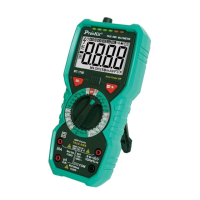
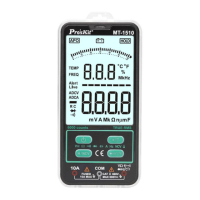
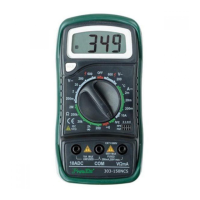
STAND & HOOK-UP
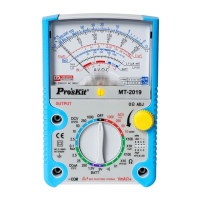
This meter can be used in any operating position. It has an oblique bracket and a
hook behind it. Users should choose according to their own needs. And it have
magnets on its back to absorb the suspension.
OPERATING INSTRUCTIONS
CAUTION!
When making voltage or current measurements, develop the habit of turning
off all power to the circuit under test. Connect the test leads at the desired
points in the circuit, and then turn on the power while taking readings. Turn off
the power before disconnecting the test leads from the circuit.
INTERNAL BATTERY CHECK
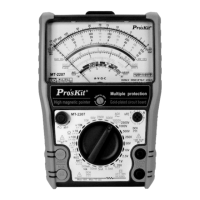
To check the battery condition, insert the black test lead into the (-) jack. Set
the range switch to the R X1 range position and short the ends of the two sides
of the test leads. If the pointer can not be brought to the zero mark, replace the
1.5V batteries. (See battery replacement.)
BEFORE OPERATING
1. Set the range switch to the proper position before making any
measurement.
2. Never apply more voltage or current than the rated value in every position.
3. When the voltage or current to be measured it not known, always start with
the highest range.
4. If meter indication is in the lower half of the scale and falls within the range
of a lower scale, reset selector switch to the lower range for greatest
accuracy.
5. If the meter won’t work at all, check the fuse located on the PCB. If it’s
blown, replace it. (See fuse replacement.)
6. Avoid placing the meter where extreme shock or continuous vibration is
encountered and do not store in excessively hot or damp places. Although
very rugged, the meter is a sensitive measuring device and should be
handled carefully & properly.
7. Do not check resistance, transistor, diode, LED, or capacitance when live
voltage or current input across the circuit.
8. When the meter is not in use, keep the selector switch to the “DC or AC
voltage” range position, this provides direct short across meter movement
for minimum needle bounce when transporting meter.
9. If you should accidentally apply excessive voltage or current on a certain
range, disconnect the leads from the circuit as quickly as possible, check
instrument operation on that range by applying peoper input. If the meter
does not operate properly, check fuse. If it is blown replace it. (See fuse
replacement.)


 To Next Page