
 Need help?
Do you have a question about the PROEMION CANlink mobile 3000 Series and is the answer not in the manual?
Details the version history and changes made to the manual.
Contains legal information, trademarks, and copyright notices.
Provides contact details for Proemion GmbH, Corp., and Ltd.
Explains the manual's purpose, target audience, and safety symbol meanings.
Covers device elements, type labels, and intended use of the CANlink mobile.
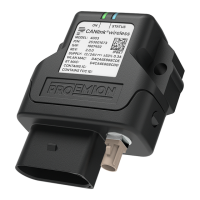
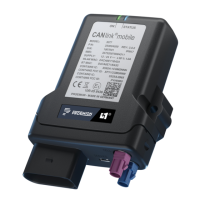
Identifies physical components and connectors of the CANlink mobile device.
Explains the information provided on the device's type label, including part numbers.
Describes how and where the device is meant to be used, including safety classes.
Lists compliance with various regulatory standards like CE, UKCA, FCC, and ISED.
Outlines the device's capabilities and available types, including wireless modules.
Details the different device variants, their part numbers, and feature availability.
Describes the hardware components included in the launch kit for device setup.
Lists downloadable software and available accessories for the device.
Provides critical safety warnings and precautions for operating the device safely.
Details CE conformity requirements, antenna gain limits, and EIRP for the EU.
Outlines UKCA conformity requirements, antenna gain limits, and EIRP for the UK.
Explains FCC compliance, interference limits, and antenna gain specifications for the USA.
Covers ISED Canada compliance, radiation exposure, and antenna gain limits for Canada.
Details the various functions and capabilities of the CANlink mobile device.
Explains how the device acts as a wireless bridge for CAN data transfer.
Describes wireless data transmission via Bluetooth and WLAN interfaces.
Information on the integrated battery, its runtime, and charging specifications.
Details the device's mobile radio capabilities for data transmission.
Explains how CAN messages are transmitted bidirectionally in real-time.
Describes how the device records CAN messages, GNSS data, and internal variables.
Covers additional input/output functions for logging status and monitoring states.
Explains the function of the acceleration sensor for detecting motion.
Details the GNSS receiver for position data determination.
Information about the integrated eSIM card, its activation, and potential issues.
Identifies the connectors on the device and their specifications.
Details the 14-pin main plug connector for CAN bus and power.
Explains the micro-USB port for diagnostics and updates.
Describes the function and status indication of the device's LEDs.
Information on device cables, potential malfunctions, and handling recommendations.
Guidance on cable management, strain relief, and bending radius.
Guides on installing necessary software like Proemion Configurator for device setup.
Instructions on how to connect the device to power and system for initial operation.
Details on connecting the device to a power source using the main plug connector.
Instructions for charging the integrated battery before first use.
Explains how to connect the device to a CAN bus and related baud rate information.
Guides on connecting mobile radio and GNSS antennas, including safety warnings.
Explains how the device is powered on and put into sleep mode without a switch.
Steps to activate the device, typically via the DataPortal, for its integrated eSIM card.
Overview of device configuration, including CAN messages and DataPlatform settings.
Step-by-step guide for connecting the device to a PC for configuration.
Instructions for setting up communication parameters in the Proemion Configurator.
Explains how to perform a node scan to check device connections and identify nodes.
Guides on modifying demo configuration files for specific device requirements.
Describes how to load configuration files onto the device using the CAN interface.
Steps to connect the device to the DataPlatform for initial setup and monitoring.
Instructions and considerations for physically mounting the device for optimal performance.
Guidance on positioning the device for optimal GNSS, Bluetooth, and mobile radio reception.
Recommends performing an installation study to ensure correct operation in real conditions.
Prerequisites and steps for validating the device's suitability under real operating conditions.
Guide to configuring the device using the Proemion Configurator software.
Instructions on creating, renaming, and deleting object dictionary groups and objects.
Details how the device logs CAN messages, GNSS data, and internal variables.
Steps to configure the device to operate in logging mode.
Configuring variables for enabling CAN communication and data logging.
Example of configuring cyclic logging for J1939 messages.
Configuring the device to log GNSS position data, including satellite systems.
Instructions on creating and assigning PDC files for data evaluation on DataPlatform.
Explains how the device transmits CAN messages and GNSS data in real-time.
Steps to configure the device to operate in RealTime mode.
Describes transferring files between DataPlatform and machine CAN open network.
Guide for transferring ECU update files from DataPlatform to CANlink mobile.
Describes simple file transfer up to 128k Byte via CAN bus to DataPlatform.
Information on accessing local nonvolatile file storage via CANopen SDO for ECU updates.
Details the device's support for encrypted data transfer using TLS to the DataPlatform.
Information on key device variables that control the device's functions.
Explains GNSS receiver capabilities and how to set satellite system combinations.
Describes available input/output functions and sensors like analog inputs.
Lists device variables related to the integrated battery's status and performance.
Explains power management settings for safe shutdown and protection against data loss.
Describes geofence monitoring functions for tracking device location relative to defined areas.
Provides an overview of available protocols and connections supported by the device.
Provides a guideline for performing secure remote firmware or configuration updates.
Outlines a phased approach for safe and successful firmware/configuration roll-outs.
Instructions on updating device configuration via CAN interface or DataPlatform.
Steps for performing configuration updates remotely via the DataPlatform.
Loading firmware updates via DataPlatform, CAN, or micro-USB interface.
Loading firmware updates via the micro-USB interface.
Using micro-USB for device diagnosis and recording debug logs.
Information on performing a factory reset to restore original device settings.
Performing a factory reset using the CAN interface and available reset variants.
Performing a factory reset using the start cable and specific switch operations.
Lists common problems and their possible causes and solutions for the device.
Guidelines on how to request support and the information required for troubleshooting.
Troubleshooting steps for devices unable to establish a connection to the DataPlatform.
Regular maintenance checks for connectors and the integrated battery.
Instructions on how to clean the device safely, avoiding water penetration.
Explains the purpose and location of the warranty void sticker.
Information about the service sticker covering the USB socket.
Information on proper packaging and transport conditions to prevent damage.
Guidelines for the correct disposal of the device and its battery according to EU regulations.
Provides dimensional drawings and CAD file information for the device.
Detailed technical specifications including mechanical, electrical, and interface data.
Mechanical specifications like dimensions, weight, material, and chemical resistance.
Electrical specifications including voltage ranges, power consumption, controller, and memory.
Details about the CAN, Mobile Radio, Bluetooth, and WLAN interfaces.
Lists the available communication protocols supported by the device.
Details device certifications, qualifications, and declarations of conformity.
 General
| Series | CANlink mobile 3000 |
|---|---|
| Wi-Fi | 802.11 b/g/n |
| CAN Interfaces | 2 |
| Digital Inputs | 4 |
| Digital Outputs | 2 |
| Analog Inputs | 2 |
| Operating Temperature | -40°C to +85°C |
| Protection Class | IP67 |
| Weight | 250 g |
| Certifications | CE, FCC, E-Mark |
| Supported Protocols | CAN, J1939 |
| Cellular Connectivity | 4G LTE, 3G, 2G |
| GNSS | GPS, GLONASS |
| Serial Interfaces | RS-232 |


 To Next Page