EN
a. Field strengths from fixed transmitters, such as base stations for radio (cellular / cordless)
telephones and land mobile radios, amateur radio, AM and FM radio broadcast
and TV broadcast cannot be predicted theoretically with accuracy. To assess the
electromagnetic environment due to fixed RF transmitters, an electromagnetic
site survey should be considered. If the measured field strength in the location
in which the Prolife PA3 Backlight is used exceeds the applicable RF compliance
level above, the Prolife PA3 Backlight should be observed to verify normal opera-
tion. If abnormal performance is observed, additional measures may be necessary,
such as reorienting or relocating the Prolife PA3 Backlight.
b. Over the frequency range 150 kHz to 80 MHz, field strengths should be less than
3 V / m.
Recommended separation distance between portable and mobile RF commu-
nications equipment and the Prolife PA3 Backlight.
The Prolife PA3 Backlight is intended for use in an electromagnetic environ-
ment in which radiated RF disturbances are controlled. The customer or the
user of the Prolife PA3 Backlight can help prevent electromagnetic inter-
ference by maintaining a minimum distance between portable and mobile
RF communications equipment (transmitters) and the Prolife PA3 Backlight
as recommended below, according to the maximum output power of the
communications equipment.
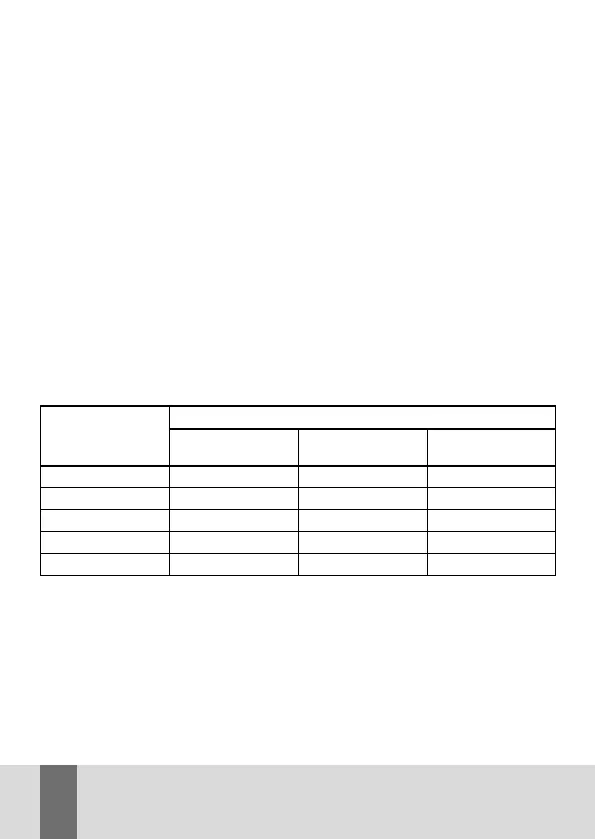
Rated maximum
output power of
transmitter (W)
Separation distance according to frequency of transmitter (m)
150 kHz to 80 MHz
d=1,2√P
80 MHz to 800 MHz
d=1,2√P
800 MHz to 2.5 GHz
d=2,3√P
0,01 0,12 0,12 0,23
0,1 0,38 0,38 0,73
1 1,2 1,2 2,3
10 3,8 3,8 7,3
100 12 12 23
For transmitters rated at a maximum output power not listed above, the recom-
mended separation distance d minimetres (m) can be determined using the
equation applicable to the frequency of the transmitter, where P is the maximum
output power rating of the transmitter in watts (W) according to the transmitter
manufacturer.
Note1: At 80 MHz and 800 MHz, the separation distance for the higher frequency
range applies.
Note2: These guidelines may not apply in all situations. Electromagnetic propaga-
tion is affected by absorption and reflection from structures, objects and people.


 To Next Page
 Loading...