Instructions for use
PROTEC GmbH & Co. KG, In den Dorfwiesen 14, 71720 Oberstenfeld, Germany
1.4 Intended use
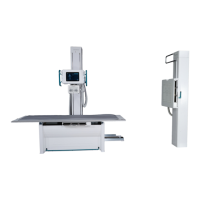
The general-purpose diagnostic radiographic systems of the PRS 500-series are intended for various
routine applications in planar X-ray imaging in human medicine.
They are stationary systems that can be used both for analogue and digital imaging.
NOTE
At the acceptance test a 25mm Aluminium / 99,5% purity can be used as a
phantom for a patient equivalent.
The acceptance test has to be made in accordance to the local laws and directives.
Only Special trained People are allowed to do this.
1.5 Indication and Contraindication
1.5.1 Indications
Justification of medical exposures
According to §83 of the German radiation protection law (StrlSchG), an X-ray examination is only
justified if the patients benefit from x-ray diagnostics outweighs the radiation risk. The examination
method, means the conventional X-ray with the PRS 500 system, must be suitable to answer the
diagnostic question and no other more suitable alternative method is available.
Accordingly, it is also described by the International Atomic Energy Agency (IAEA) in the document
Radiation Protection and Safety of Radiation Sources: International Basic Safety Standards (Requirement 37:
Justification of medical exposures). It also refers to the need to consider national or international
guidelines for the justification of a medical exposure.
A complete list of indications is unrealisable for conventional radiography, because the spectrum of
conventional X-rays is very diverse and can vary in the course of medical-technical progress.
Some examples of indications for an X-ray examination may be:
• For the diagnosis of a bone fracture or bony injuries of the skeletal system or pathological
changes of hard tissues.
• To control the bone setting.
• For the diagnosis of luxations and ligament ruptures of the locomotor system.
• For the diagnosis of degenerative, inflammatory, traumatic and tumorous diseases and
changes of the locomotor system.
• For diagnostic of malformations and malalignments of the skeletal system.
• For the diagnosis of thoracic and pulmonary symptoms (thorax exposures)
• For the diagnosis of sclerotherapy.
• For the diagnosis of inflammatory and expansive processes of the mucosa, cranial bones and
paranasal extension.
• For the diagnosis of the abdomen (e.g. acute abdomen, plain abdominal radiography,
urethrogram, cystogram).
1.5.2 Contra indications
There are no absolute contraindications for conventional X-rays.
But it is not allowed to make any exposures on humans when they are not medically indicated (see
Justification of medical exposures, chapter 1.5.1 Indication).
For pregnant women and children it is important to consider if the exposure is really necessary. It
should be avoided if possible.


 To Next Page