EasyManua.ls Logo

PSB Powered Subwoofers - AC Power Socket; Power Switch; External Fuse; V. Room Acoustics, Subwoofer Placement, Multiple Subwoofers & Control Settings

PSB Powered Subwoofers
24 pages
Print Icon
To Next Page IconTo Next Page
To Previous Page IconTo Previous Page
Loading...
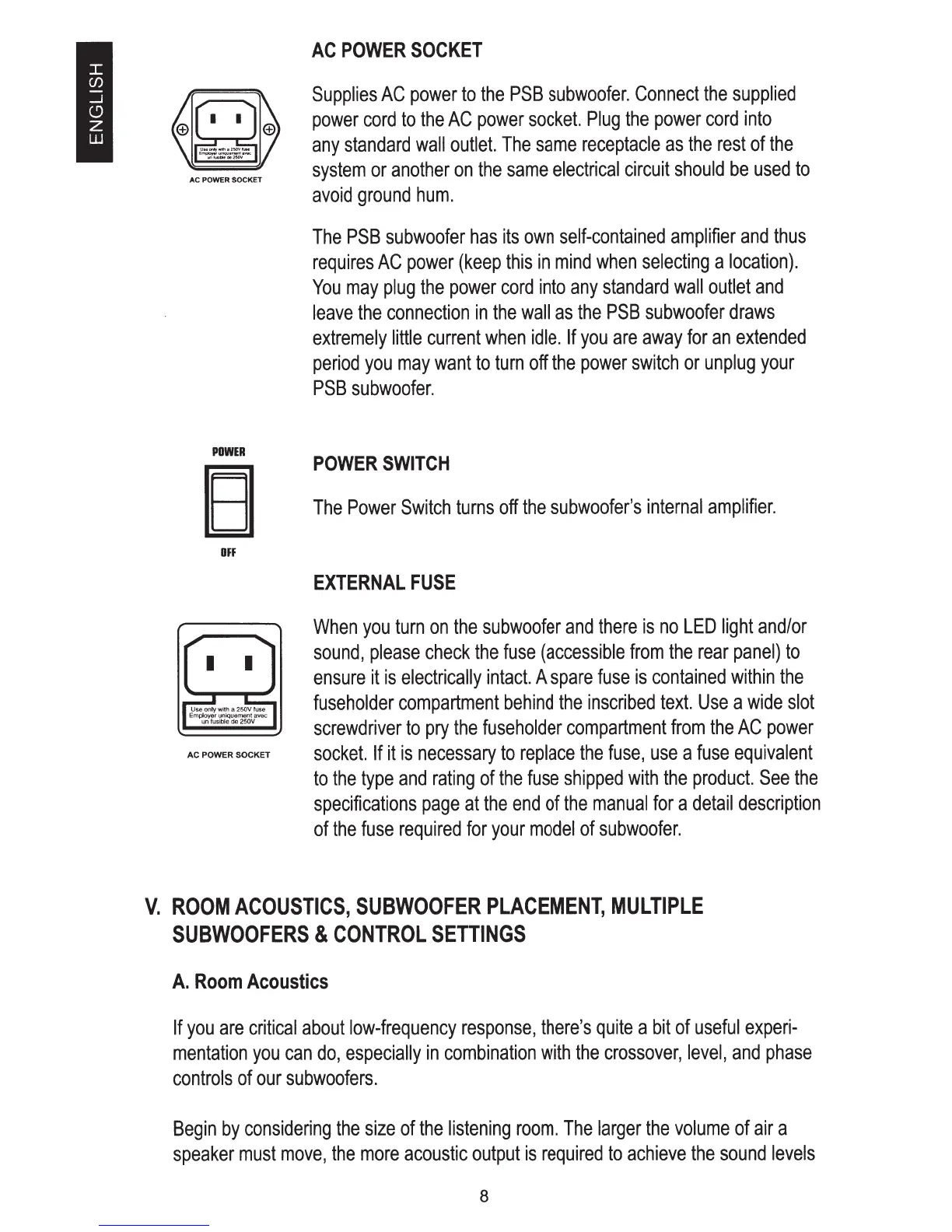
AC POWER SOCKET
POWER
8
OFF
AC
POWER SOCKET
AC
POWER
SOCKET
Supplies
AC
power
to
the
PSB
subwoofer.
Connect
the
supplied
power
cord
to
the
AC
power
socket.
Plug
the
power
cord
into
any
standard
wall
outlet.
The
same
receptacle
as
the
rest
of
the
system
or
another
on
the
same
electrical
circuit
should
be
used
to
avoid
ground
hum.
The
PSB
subwoofer
has
its
own
self-contained
amplifier
and
thus
requires
AC
power
(keep
this
in
mind
when
selecting
a
location).
You
may
plug
the
power
cord
into
any
standard
wall
outlet
and
leave
the
connection
in
the
wall
as
the
PSB
subwoofer
draws
extremely
little
current
when
idle.
If
you
are
away
for
an
extended
period
you
may
want
to
turn
off
the
power
switch
or
unplug
your
PSB
subwoofer.
POWER
SWITCH
The
Power
Switch
turns
off
the
subwoofer's
internal
amplifier.
EXTERNAL
FUSE
When
you
turn
on
the
subwoofer
and
there
is
no
LED
light
and/or
sound,
please
check
the
fuse
(accessible
from
the
rear
panel)
to
ensure
it
is
electrically
intact.
A
spare
fuse
is
contained
within
the
fuseholder
compartment
behind
the
inscribed
text.
Use
a
wide
slot
screwdriver
to
pry
the
fuseholder
compartment
from
the
AC
power
socket.
If
it
is
necessary
to
replace
the
fuse,
use
a
fuse
equivalent
to
the
type
and
rating
of
the
fuse
shipped
with
the
product.
See
the
specifications
page
at
the
end
of
the
manual
for
a
detail
description
of
the
fuse
required
for
your
model
of
subwoofer.
V.
ROOM
ACOUSTICS,
SUBWOOFER
PLACEMENT,
MULTIPLE
SUBWOOFERS
&
CONTROL
SETTINGS
A.
Room
Acoustics
If
you
are
critical
about
low-frequency
response,
there's
quite
a
bit
of
useful
experi-
mentation
you
can
do,
especially
in
combination
with
the
crossover,
level,
and
phase
controls
of
our
subwoofers.
Begin
by
considering
the
size
of
the
listening
room.
The
larger
the
volume
of
air
a
speaker
must
move,
the
more
acoustic
output
is
required
to
achieve
the
sound
levels
8