
 Need help?
Do you have a question about the PULSECOM 4TOLB-3L1 and is the answer not in the manual?
Details changes made in the practice document regarding power specifications and UL recognition.
Lists functional features including 4-wire VF transmission, DC isolation, attenuation selection, and loopback.
Explains application flexibility through switch settings on the PC board and front panel.
Details connector pin functions and connections to D4 and SLC 96 channel banks.
Covers selecting desired functions via PC board option switches for 'prescription' or 'in-line' alignment.
Describes how VF signals are processed through the transmit path, including amplification and attenuation.
Explains how received signals are processed through the receive filter, attenuator, and amplifier circuits.
Details the three methods for activating the loopback circuit: Tone, Manual, and Local.
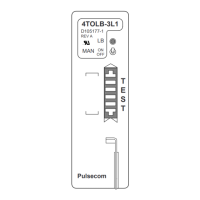
The Pulsecom 4TOLB-3L1 is a 4-wire, 600-ohm transmission-only channel unit with loopback, designed for use in D4 Carrier Systems. It provides a 4-wire 600-ohm interface between a D4 or SLC 96 channel bank and a 4-wire voice-frequency (VF) transmission facility without DC signaling. This unit is UL recognized and features a conductive front panel grounded to the frame.
The 4TOLB-3L1 facilitates 4-wire voice-frequency (VF) transmission with DC isolation. It incorporates an active loopback (LB) circuit with an LB tone frequency of 2713 Hz, enabling remote or local testing of the 4-wire facility. The unit can also be used on tandem carrier circuits that utilize end-to-end single-frequency (SF) signaling.
Attenuation in both the transmit (TRMT) and receive (RCV) paths can be selected using DIP switches, allowing compensation for variations in transmission levels. The transmit path offers attenuation from 0 to 32.5 dB in 0.1-dB steps, while the receive path provides 0 to 24 dB of attenuation in 0.1-dB steps.
The loopback circuit can be activated in three ways:
The unit also offers sealing current source/sink capabilities, available with a power-up ZAP (source mode). In S5-SRC position, it provides a momentary current surge (ZAP current) upon insertion into the channel bank, followed by a constant lower-level current through the T/R and T1/R1 cable pairs. This ensures good contact at cable splices by removing high-resistance film. In S5-SINK position, the unit provides a circuit closure, allowing current from metallic-side equipment to flow. S5-OFF disables sealing current.
The 4TOLB-3L1 is compatible with Pulsecom PD4 or PSC-96 channel banks, as well as AT&T D4 or SLC 96 channel banks. It occupies a 1.5-inch wide mounting space. When replacing older 4TOLB units, loopback function leads on the backplane may need to be reconnected. For a 48-channel bank filled with 4TOLB-3L1 plugs, a 325A power converter unit may be required to supply sufficient +12V power.
The unit features a front-panel maintenance-access connector (MAC) with bifurcated contacts, allowing for easy testing and alignment. Switch S6 routes TEK5, TEK6, and LOCAL LB leads to appropriate card-edge connector pins, depending on whether the unit is used in a D4/COT bank or an SLC 96 remote terminal. SLC 96 banks must be configured to Mode 3 (special services).
Loopback gain/loss can be selected to maintain transmission level point (TLP) levels during loopback. The amount of gain or loss is determined by comparing TRMT input and RCV output levels, then subtracting and rounding to the nearest 0.25 dB.
When in loopback mode, the transmit and receive ports (T, R, T1, and R1 leads) are disconnected, and sealing current is disabled. The transmit and receive paths are internally connected through the gain/loss network, allowing remote testing. The front-panel LB indicator glows when the unit is in loopback mode. The normally closed LB relay contact, which connects TEK5 and TEK6, opens during loopback operation, allowing these leads to disable an externally connected modem.
The 4TOLB-3L1 is composed of solid-state circuits and requires no routine maintenance. In case of malfunction, a test card (such as a standard AT&T P6AD cord or Pulsecom B105097 adapter) can be used with a transmission measuring set (TMS) to diagnose issues. The front-panel TEST jack (J1) provides access to the TRMT TLP, RCV TLP, and T and R leads, and can also be used to remove the RNDIS RCV disable signal. A MAC jack to bantam jack adapter (e.g., Pulsecom B105097) provides bantam jack access to test points.
Alignment involves setting pc board option switches to desired positions, either through a "prescription" method based on formulas for TRMT and RCV attenuation, or a "verified in-line" alignment using a TMS. Pulsecom does not recommend field repairs; defective units should be returned to the Pulsecom Repair Department. When replacing a unit, it is crucial to ensure that the switches on the replacement unit are in the same position as those on the unit that was removed.

 To Next Page
 General