6 quED Manual www.qutools.com
In the time domain, the crystal birefringence in combination with dispersion lead to an un-
wanted effect as well. The arrival times of photons at the output face of the second crystal
depend on their wavelengths and polarizations, which reveal the actual position of the photon-
pair’s origin. This leads to a partial loss of coherence between the two emission processes, and
thus to the reduced entanglement quality. The detrimental temporal effect is two-fold, which is
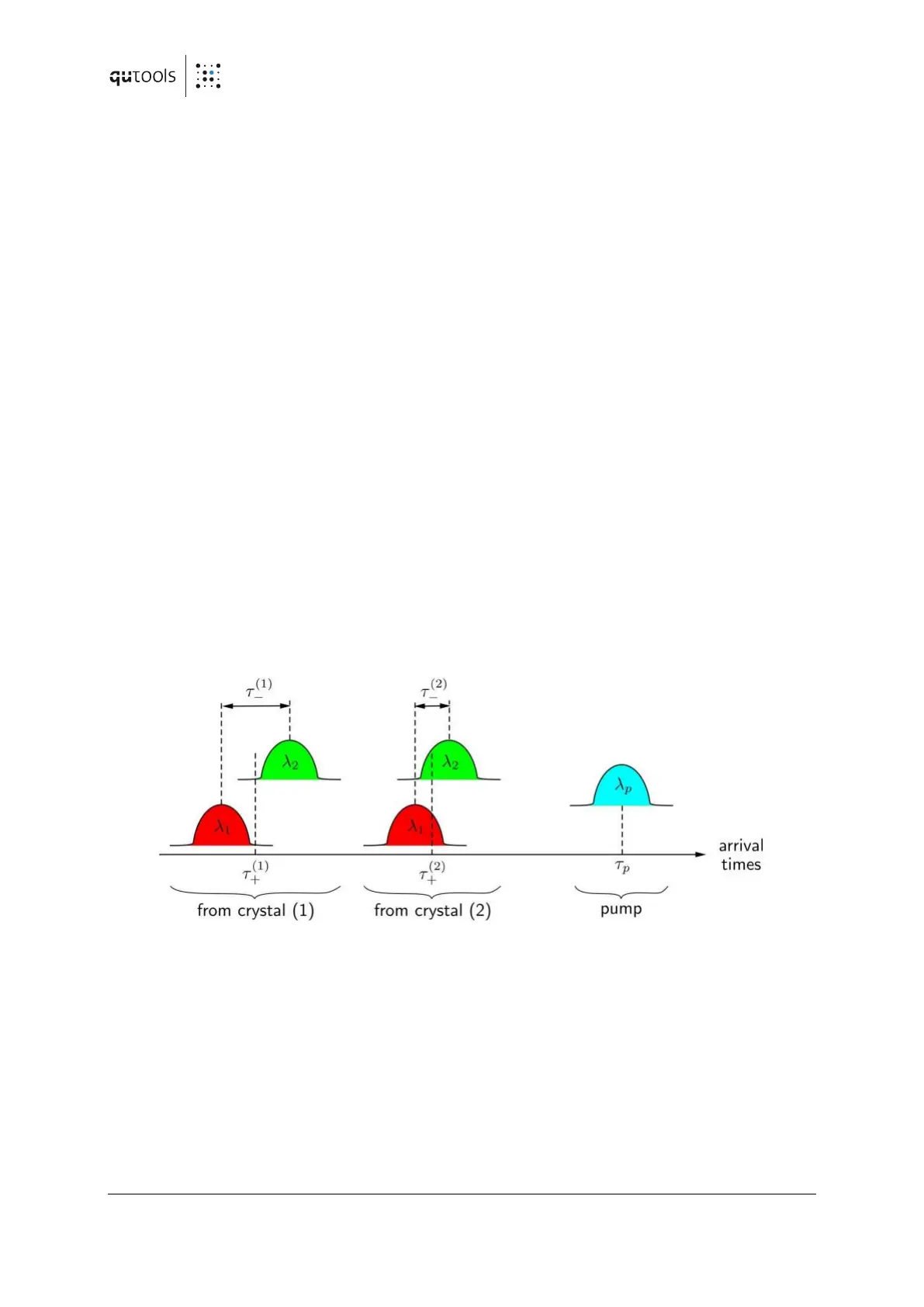
illustrated in a simplified fashion in Figure 2. First, it is primarily the group-velocity mismatch
between the pump and the down-conversion light, which causes the photon pairs born in the
first crystal to be advanced with regard to those originating from the second crystal. This is
usually precluded using a continuous-wave pump laser. Since a (spectrally broadband) free-
running blue laser diode is used as the pump in the quED, a special birefringent crystal has to
be included in the path of the pump beam. It introduces a proper temporal retardation
between its horizontally and vertically polarized components and thus effectively pre-
compensates the effect. Second, the dispersive delay of the down-conversion photons at non-
degenerate wavelengths are different for the two emission possibilities, because the photons
generated in the first crystal acquire an extra spread by propagating through the second
crystal; (since the type I SPDC emission is spectrally very broadband, the detection of photons
with very non-degenerate wavelengths is indeed possible in the quED).
Figure 2: Explanation of the detrimental time effect inherent to SPDC emission in a two-crystal
configuration. Due to crystal birefringence and dispersion, the arrival times of non- degenerate
photons
at the output face of the second crystal (2) differ in general for the two
emission possibilities. The photon pairs from the first crystal (1) are advanced with regard to
photon pairs from the second
.Moreover, the photons originating from the first
crystal experience higher dispersive delay due to their pass through the second crystal
. Consequently, a compensation using two additional birefringent crystals erasing
their temporal distinguishability has to be applied.



 To Next Page