Please read before connecting your
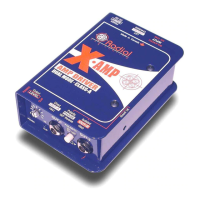
Radial X-Amp
Caution must be used when connecting electronic equipment
to the X-AMP. The X-AMP bridges all electronic equipment
connected to it so faulty wiring or incorrect grounding of any
of the equipment may cause a shock hazard to be present
and/or damage to the X-AMP or other connected equipment.
Because grounding schemes differ between manufacturers,
it is important to check for correct polarity, in particular with
older amplifiers using 2-prong ungrounded A/C cords. If the
polarity is reversed on an ungrounded amplifier there may be
a potential of 120V present between the amp chassis and
ground. Radial Engineering takes no responsibility for this or
how the X-AMP is connected or used. It is the user’s full
responsibility to ensure that proper electrical polarity is
maintained on all equipment connected to the X-AMP and that
proper building electrical codes have been followed
wherever the X-AMP is being used.
To reduce opportunity for shock hazard or damage to the X-
AMP or connected equipment, plug the ¼” connectors into the
amplifiers first and then into the X-AMP. This is especially
important when using old amplifiers that do not have 3-prong
plugs as the possibility exists to touch the chassis ground
with the connector plug tip when the plug is inserted into the
jack.
Cautions for amplifiers with ungrounded 2-prong A/C cords:
Before connecting any input to an ungrounded amplifier,
power the amp up and listen to the residual hum. If the amp
has a two-position ground polarity reverse switch, set the
switch in the position that produces the least residual hum
from the speakers. If there is no polarity switch, reverse the
A/C plug at the outlet to find the least residual hum.
To ensure an ungrounded amplifier does not present a shock
hazard:
Test for voltage potential by connecting a voltmeter between
the amplifier chassis and the X-AMP chassis. If voltage is
present, reverse the amplifier’s A/C supply polarity and test
again. Note that due to this potential problem, damage to
the X-AMP or other connected equipment caused by
improper A/C polarity is not covered under warranty.
2
True to the Music
X•AMP User GuideRadial Engineering


 To Next Page