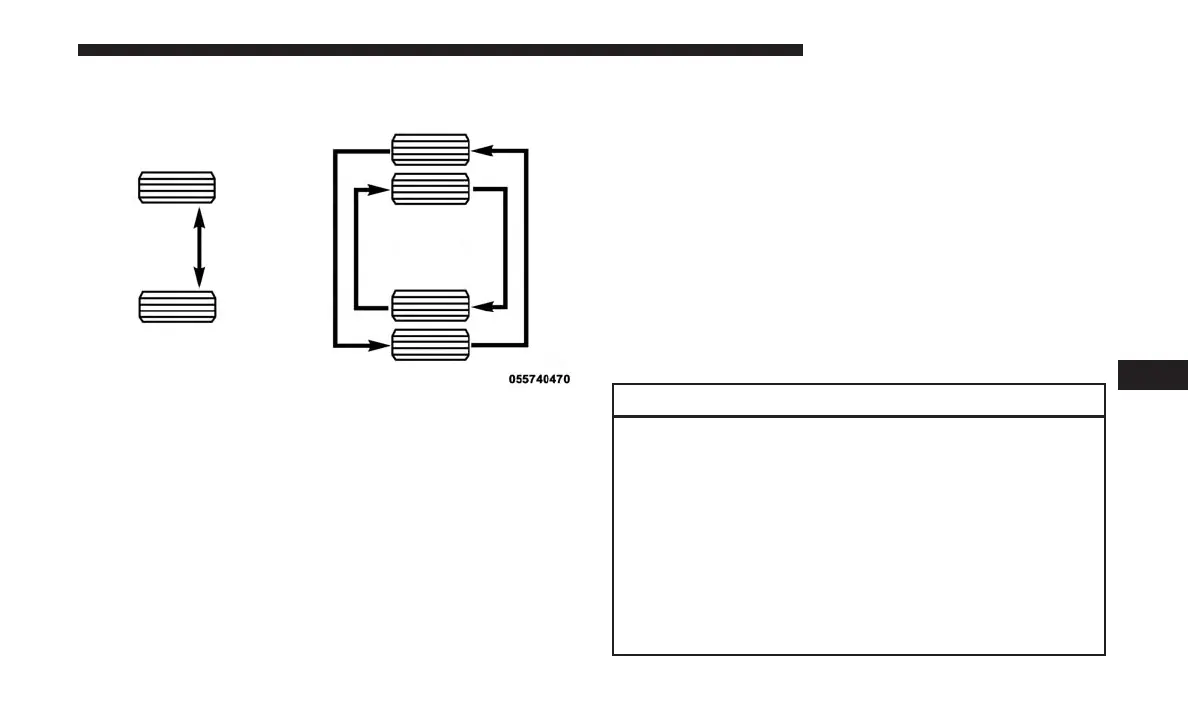
Dual Rear Wheels
The tires used on dual wheel assemblies should be
matched for wear to prevent overloading one tire in a set.
To check if tires are even, lay a straight edge across all four
tires. The straight edge should touch all the tires.
NOTE: If your vehicle is equipped with a Tire Pressure
Information System (TPIS):
• The Tire Pressure Information System (TPIS) uses
unique sensors in the inner rear wheels to help identify
them from the outer rear wheels, because of this, the
inner and outer wheel locations can’t be switched.
• After a tire rotation is completed, as shown below, the
system can auto learn the locations of each sensor ID.
Auto learning/localization occurs when the vehicle ig-
nition status is changed from Off to On and speeds of
greater than 5 mph (8km/h) are obtained and remain
over 5mph (8km/h) for at about a 15 minute period. You
may need to drive for 20 minutes to account slower
speeds and stops.
• If the tires are rotated incorrectly, the Auto localization of
the TPIS sensors will fail to locate correctly resulting in
incorrect locations for the pressure values displayed in
the Instrument Cluster.
CAUTION!
• 4500/5500 Dual Rear Tires may only have one ap-
proved direction of rotation. This is to accommodate
the asymmetrical design (tread pattern) of the On/
Off road tire.
• When replacing a flat, the spare tire may have to be
remounted on the rim or installed at a different
location to maintain the correct placement of the tire
on the wheel relative to the tire/wheel position on
the vehicle. For example, if the spare is used to
(Continued)
Tire Rotation
8
SERVICING AND MAINTENANCE 415








 To Next Page