17
OPERATION
FOUR-WHEEL DRIVE
The four-wheel drive is engaged and disengaged
through the use of the lever on the top left-hand side
of the transmission, Figure 12.
To engage the four-wheel drive, depress the clutch
pedal fully and move the four-wheel drive lever fully
forward . To disengage, move the leverf ully
rearward.
IMPORTANT: The front wheel drive should be used
when additional traction is required while operating
in loose soil, wet, slippery conditions or on slopes.
For normal operation on firm soil, level hard
surfaces and roading the unit at high speeds, front
wheel drive should be disengaged to maximise tire
and drive line life and fuel economy.
SWINGING DRAWBAR (where fitted)
The swinging drawbar may be fixed or allowed to
swing the full width of the hanger.
Fasten the drawbar in position using the swing
limiter pins when pulling equipment which requires
accurate positioning and when transporting
equipment.
Allow the drawbar to swing when pulling ground
engaging equipment which does not require
accurate positioning. This will make steering and
turning easier.
WARNING: Always secure the draw-bar
to prevent swinging when transporting
equipment or when operating any but
ground engaging equipment.
IMPORTANT: When transporting equipment on the
highway it is recommended that a safety chain
having a tensile strength equal to the gross weight
of the implement be installed between the tractor
and implement hitch.
WARNING: Always use the drawbar or
lower links in the lowered position for
pull-type work.
POWER TAKE-OFF
The power take-off (P.T.O.) in your tractor transfers
engine power directly to mounted or pull-type
P.T.O. equipment. The standard rear P.T.O. speed is
540 + 10 rpm. Most P.T.O. equipment is designed to
operate efficiently at this speed. This speed is
obtained when engine rpm is set at 2292 or 2325 (if
H.S.T. equipped) rpm, as indicated by the P.T.O.
symbol on the Proof-Meter rpm scale.
IMPORTANT: Do not exceed 2292 rpm or 2325
(if H.S.T. equipped) rpm engine speed when
operating P.T.O.-driven equipment.
The optional mid P.T.O. speed is 2000 1 10 rpm.
This speed is obtained when engine rpm is set at
2251 or 2284 (if H.S.T. equipped) rpm.
The transmission rear P.T.O. and mid P.T.O. are
controlled through levers shown in Figure 1 5. The
transmission P.T.O. can be engaged, operated, and
disengaged as described under “POWER
TAKE-OFF OPERATION.”
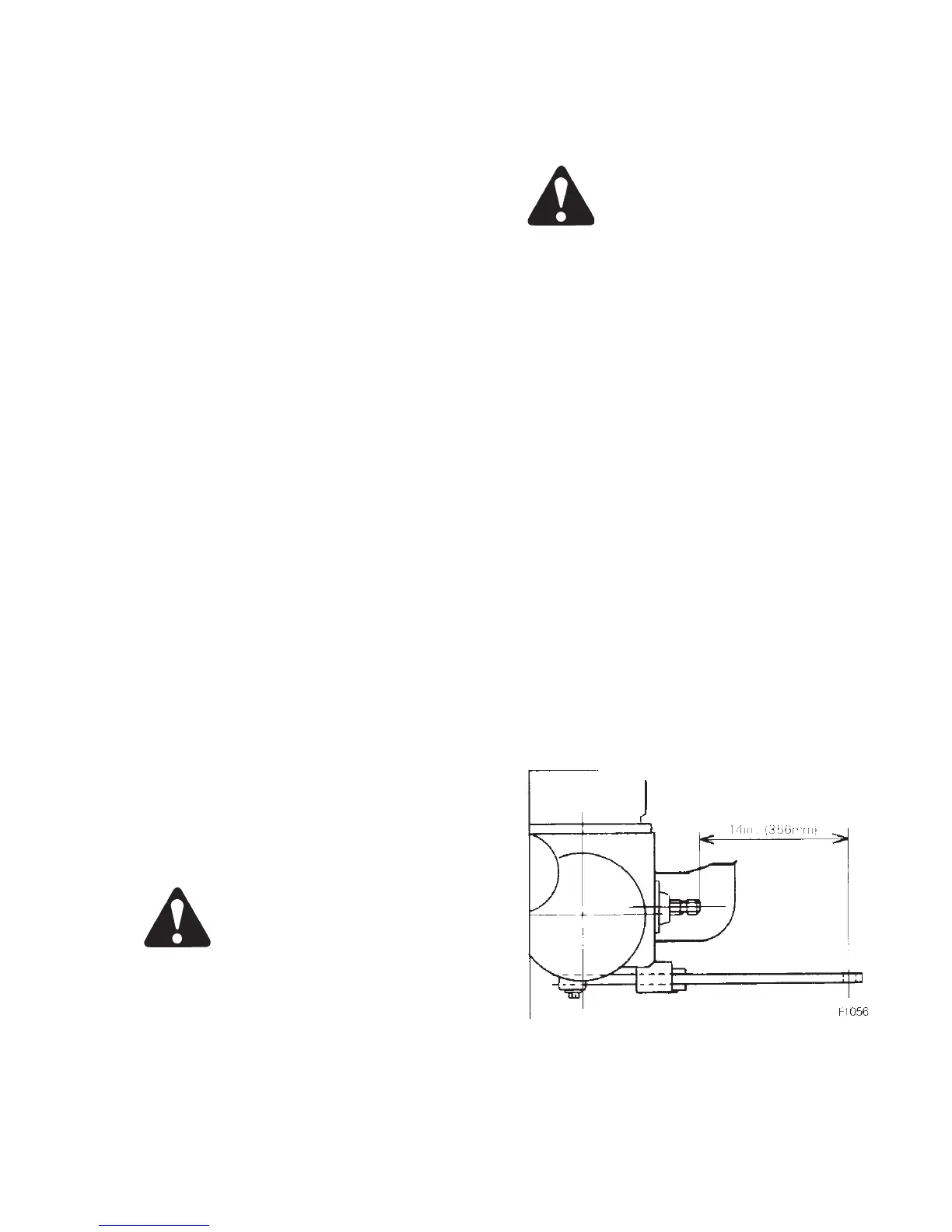
IMPORTANT: The drawbar is required to provide
standard rear P.T.O. drawbar relationship, Figure
24.
Figure 24 - Drawbar Settings for PTO Operation


 To Next Page