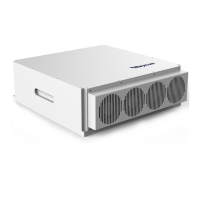
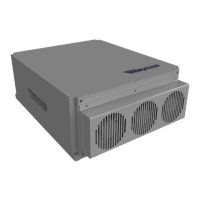
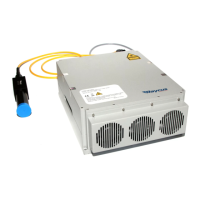
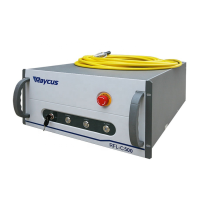
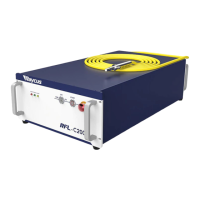
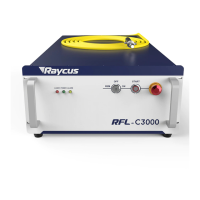
This document describes the RFL-P100QA pulsed fiber laser, a high-power laser source designed for industrial laser marking systems and other applications. It offers high speed and efficiency, with unique advantages in increasing the conversion efficiency of pump light by 10 times compared to traditional lasers. Its low power consumption and automotive design make it suitable for both lab and field operations. The device is compact and convenient for independent placement, flexible in use, and easy to connect to equipment.
Function Description:
The RFL-P100QA emits pulsed light with a wavelength of 1060-1085 nm. It operates under the control of an industrial laser's standard interface, driven by a 24 VDC power source. The laser output power is controlled by setting PIN1-PIN8 (TTL level) from 0 to 255, corresponding to 0-100% of the laser output power. The device includes a guide laser (red diode) that can be switched on/off via PIN 22. Emission enable (EE) is controlled by PIN 18, where HIGH enables emission and LOW/disconnected disables it. Emission modulation (EM) is controlled by PIN 19, with HIGH (>3 V) for ON and LOW/disconnected (<1 V) for OFF. Pulse repetition rate (PRR) synchronization is input via PIN 20 as a square wave.
Important Technical Specifications:
- Pulsed fiber laser model: 100QA
- Wavelength: 1060-1085 nm
- Polarization: Random
- Optical isolator: Yes
- Nominal average output power: ≥100 W
- Single pulse energy: 1.25 mJ @ 80 kHz
- Beam quality (M2): <1.6
- Beam diameter: 5.5-8 mm
- Pulse duration: 250-290 ns @ 80 kHz
- Pulse repetition rate: 80-120 kHz
- Output power tunability: 10-100%
- Output fiber cable length: 3.0 m
- Working voltage: 24 ± 1 VDC
- Power consumption (at 20°C): 380 W
- Cooling: Forced Air Cooled
- Dimension (W×H×D): 310 × 116.5 × 260 mm
- Operating temperature: 0°C ~ 40°C
- Store temperature: -20°C ~ 60°C
- Operating humidity: ≤80%
Usage Features:
- Safety Information: The device is classified as a high-power Class IV laser. Users must ensure correct 24 VDC power source connection with proper anode and cathode polarity to avoid damage. Direct exposure to the invisible 1060-1085 nm wavelength light is dangerous; appropriate laser safety eyewear must be used. Do not look directly into the light output end.
- Environmental Requirements: The pulsed laser requires a 24±1 VDC power source. Proper grounding of the device is crucial.
- Output Head Handling: The output head is connected with an optical cable and must be handled carefully to avoid dirt and contamination. Specialized lens paper should be used for cleaning. A protective cover should be used on the light isolator when the laser is not installed or in use.
- Cooling: The device has three cooling fans at the rear panel for heat dissipation. A minimum space of 10 cm width is required in front and rear for adequate airflow. If mounted in a cabinet with fans, their direction must match the laser's fans.
- Pulse Repetition Rate: Ensure the pulse repetition rate is higher than 80 kHz. The longest time without a pulse is 100 µs. If there is no pulse output, stop marking immediately to prevent further damage.
- Power Supply: Continuous power supply is essential; sudden interruption can cause significant harm to the laser device.
- Installation: The module should be fixed stably to a bracket with good ventilation. The power line connects to 24 VDC, ensuring sufficient DC output power. Polarity: anode-brown, cathode-blue, PE-yellow and green.
- Control Interface: The device has DB9 (RS232, for debugging only) and DB25 interfaces. The DB25 is the main interface for connecting the control system. Ensure a reliable connection before operation.
- Fiber Bending Radius: The bending radius of the delivery fiber should not be less than 15 cm.
- Operation Procedures:
- Starting: Ensure the control system is on before powering on the fiber laser. Wait at least 1 minute after power-on before proceeding with subsequent operations.
- Frequency Setting: For the P100QA model, the frequency setting range is 80 kHz to 120 kHz.
- Laser Marking Check: For initial testing, set power to zero. After successful startup, draw a quadrate and continuously increase power from 0% to 100% while marking. Observe the laser on a ceramic material; it should become stronger. If not, shut down and check the device.
- Operation Cautions:
- Marking frequency must be within 80-120 kHz for P100QA.
- Do not modulate the frequency while marking.
- Always stop marking, turn power to zero, and cut power off before shutting down the device.
Maintenance Features:
- Warranty: Raycus warrants products against defects in materials and workmanship during the warranty period, ensuring compliance with purchase orders and specifications under normal use. Raycus reserves the right to repair or replace defective products or issue credit notes.
- Limitations of Warranty: The warranty does not cover issues resulting from tampering, disassembling, misuse, accidents, modifications, unsuitable physical or operating environments, improper maintenance, excessive use, or failure to follow instructions by non-Raycus personnel. Damage caused by faulty operation is not warranted. Accessories and fiber connectors are excluded. Clients must notify Raycus within 31 days of discovering a defect.
- Service and Repairs: All maintenance must be performed by Raycus, as no user-replaceable accessories are provided. Contact Raycus for warranty-related maintenance issues. Products returned for service must be placed in a suitable container. Any damage during transit should be immediately reported to the carrier.
- Pre-inspection: Before operation, ensure the device's appearance is in good condition, and the output fiber is not excessively bent or broken. Verify that the signal lines of the laser and marking system are properly connected.
- Internal Access: Do not take apart the device or damage labels, as this will void the warranty and risk electric shock.

 Need help?
 General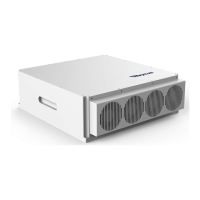

 To Next Page