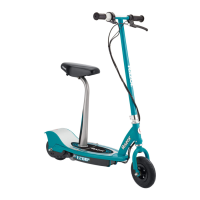
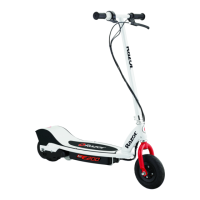
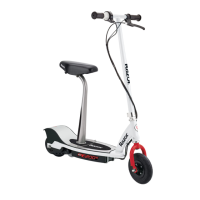
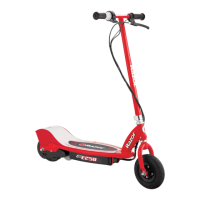
Need help?
Do you have a question about the Razor E200s and is the answer not in the manual?
Information on how long assembly and charging will take.
Details on where to find the product identification code.
Step-by-step instructions for attaching the handlebars to the scooter.
Procedure for inflating scooter tires to the correct pressure.
Instructions for attaching the seat to the E200S model.
Instructions on how to turn on and begin riding the scooter.
Procedure for safely bringing the scooter to a complete stop.
Steps for adjusting the scooter's brake system for optimal performance.
Detailed guide for replacing the chain and rear tire.
Instructions on how to replace the front tire of the scooter.
Guidelines for maintaining and safely disposing of the scooter's battery.
Information and warnings related to the scooter's charger.
Information on how to obtain replacement parts for the scooter.
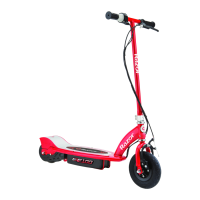
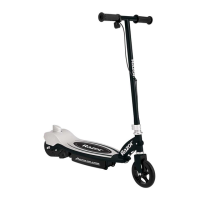
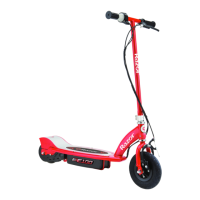
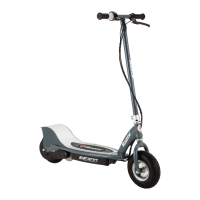
The document is an owner's manual for the Razor E200/E200S Electric Scooter, providing comprehensive information on its assembly, operation, maintenance, and safety.
The Razor E200/E200S Electric Scooter is a recreational riding product designed for personal transportation on flat, dry surfaces. It is powered by an electric motor and rechargeable batteries, offering a top speed of approximately 12 mph (19 kmh). The scooter features a twist-grip throttle for speed control and a hand brake for stopping. The E200S model includes an additional seat for seated riding. The scooter is intended for use by individuals aged 13 and older, with a maximum weight limit of 154 lb (70 kg). It is designed for outdoor use in environments suitable for riding, away from cars and motor vehicle traffic. The scooter's design emphasizes safety and durability, with components selected for compatibility and performance.
To operate the scooter, the user must first ensure the battery is fully charged, which takes up to 12 hours for an initial charge and up to 12 hours for subsequent recharges. Before each ride, a pre-ride checklist should be followed, including checking the brakes, tire pressure, frame, fork, handlebars, and ensuring all hardware is secure. The tires are inflated to the correct PSI as indicated on the sidewall, with a valve extender provided for the rear tire.
To start the scooter, the power switch is turned on, and the twist-grip throttle is engaged while the rider is on the scooter in a safe, outdoor environment. The scooter is designed to cut power to the motor when the hand brake is applied, serving as an additional safety feature. To stop, the rider releases the throttle and applies the brake until the scooter comes to a complete stop. Riders are cautioned against skidding the rear tire to a stop, as this can lead to loss of control or damage.
The manual emphasizes safe riding practices, including maintaining a hold on the handlebars at all times, riding defensively, and being aware of potential obstacles. It advises against riding in wet, slick, bumpy, uneven, or rough surfaces, or in mud, ice, puddles, or water, as these conditions can impair traction and lead to accidents. Stunts, tricks, racing, or other maneuvers that could lead to loss of control are explicitly discouraged. The scooter is not designed to withstand abuse from such activities. Only one person should ride the scooter at a time, and it should not be used at night or when visibility is limited, near steps, or swimming pools. Hands, feet, hair, body parts, clothing, or similar articles should be kept clear of moving parts, wheels, or the drive train chain while the motor is running. The use of headphones, cell phones, or texting while riding is also prohibited.
Proper riding attire is crucial for safety. Riders should always wear an approved safety helmet (securely buckled), elbow pads, and kneepads. A long-sleeved shirt, long pants, and gloves are recommended, along with athletic shoes (lace-up shoes with rubber soles) with shoelaces tied and kept away from moving parts. Barefooted riding or sandals are not permitted.
Regular maintenance is essential for the scooter's longevity and safe operation. Before each use, the scooter's condition should be checked, including chain guards, covers, brake function, and tire inflation and tread. The scooter should be maintained and repaired according to the manufacturer's specifications, using only authorized replacement parts. Modifications to the original design or configuration are not permitted.
Battery care is a significant aspect of maintenance. The battery should be charged immediately after riding and fully charged before storing for extended periods. It is crucial to unplug the charger from the wall outlet when not in use. Failure to recharge the battery periodically can lead to it not accepting a charge. The manual warns against storing the product in freezing or below-freezing temperatures, as this can permanently damage the battery. The charger supplied with the scooter should be regularly examined for damage to its cord, plug, enclosure, and other parts. If damage is found, the scooter should not be charged until the charger is repaired or replaced. The charger has built-in overcharge protection.
Adjusting the brakes involves threading the brake lever adjuster in or out to achieve the desired tension. If further adjustment is needed, a 10 mm wrench can be used to loosen or tighten the nut on the brake cable.
Replacing the rear tire and chain involves a multi-step process. First, the chain guard is removed, followed by loosening the brake cable anchor bolt and disconnecting the cable. The cable guide bracket is then removed from the frame and brake plate. Using two 16 mm wrenches, the axle locknuts are loosened, and the wheel is removed from the frame, detaching the chain from the rear sprocket. Reassembly involves installing the chain onto the rear wheel sprocket, slipping the wheel axle into the frame slots, and pushing down the chain tensioner to create slack. The cable guide bracket is reinstalled, the brake cable is threaded, and all nuts and bolts are securely tightened. Finally, the chain guard is replaced.
Front tire replacement requires two 16 mm wrenches to loosen the front axle bolts by turning them counter-clockwise, then removing and replacing the wheel.
The manual also addresses battery disposal, stating that the sealed lead-acid batteries must be recycled in an environmentally safe manner and should not be disposed of in household trash or fire. Exhausted batteries should be returned to a federal or state-approved lead-acid battery recycler or a local seller of automotive batteries. In case of a battery leak, contact with the acid should be avoided, and the damaged battery should be placed in a plastic bag. Skin or eye contact with acid requires flushing with cool water for at least 15 minutes and contacting a physician. The manual also warns that battery posts, terminals, and related accessories contain lead and lead compounds, advising users to wash their hands after handling.
For troubleshooting, the manual provides a guide for common issues such as the scooter not working, short ride time, or intermittent operation, along with possible causes and solutions. For replacement parts and product support, users are directed to the Razor website or customer service hotline.
 General
| Max Speed | 12 mph (19 km/h) |
|---|---|
| Max Range/Run Time | 40 minutes of continuous use |
| Weight Limit | 154 lbs (70 kg) |
| Deck Material | Steel |
| Frame | Steel frame |
| Charge Time | Up to 12 hours |
| Foldable | No |
| Motor | 200W, high-torque |
| Battery | 24V (two 12V) sealed lead-acid, rechargeable |
| Wheel/Tire Size | 8 inch (200 mm) pneumatic tires |
| Brake System | Hand-operated, rear brake |
| Throttle | Twist-grip throttle |
| Handlebars | Adjustable height |
| Recommended Age | 13+ |

 To Next Page